To increase gallons collected per route in used cooking oil (UCO) collection, send trucks to containers that are ready, keep stops close together, protect the oil before pickup, and plan the dump run as part of the route. Start by finding which limit binds first: on heavy-volume routes the tank often fills before the shift ends, while on light, spread-out routes the clock runs out first. Either way, the fastest gains come from fewer half-full stops and a dump leg you planned, not one the driver improvises. Then measure gallons per stop, per mile and per route hour, per load, so you know which lever moved.
Disclosure: DynoRoute makes route planning software for UCO collectors. Vendor figures on this page are labeled as vendor-reported.
Key Takeaways
- Pump what is ready. FoxInsights reports that collections at its waste oil partner operations in Germany moved from a 30 to 100% fill spread to 80 to 90%, with 7% more quantity per tour (vendor-reported, 2025 data, waste oil rather than UCO).
- The dump leg is part of the route. At ATRI's 2025 average of $2.336 per mile, a 90-mile detour to a disposal site and back to the route costs about $210 per load.
- Weight can cap the load before volume does. The federal gross vehicle limit on the Interstate is 80,000 lb, and we plan with about 7.5 lb per gallon of UCO.
- Measure fill rate per load, not per shift. A truck that dumps once and fills twice reads over 100% on a shift basis.
- We found no independent US benchmark for UCO gallons per route or truck capacity utilization, so your own routes are the baseline.
What Limits Gallons Collected per Route?
Collected oil has a large market. U.S. biofuel producers consumed about 7.4 billion pounds of yellow grease, the EIA category that includes used cooking oil, in 2024. So the question is rarely whether the oil is worth collecting. It is how much of each route's time and tank goes to oil you actually bring back.
Most lost gallons come from four places: stops pumped before the container is full, miles between scattered stops, oil that is gone before the truck arrives, and a dump run that was never planned. Each one costs the same driver and truck time while adding no oil. The sections below take them one at a time. Each ends with the number to track.
1. Dispatch by Fill Level, Not the Calendar

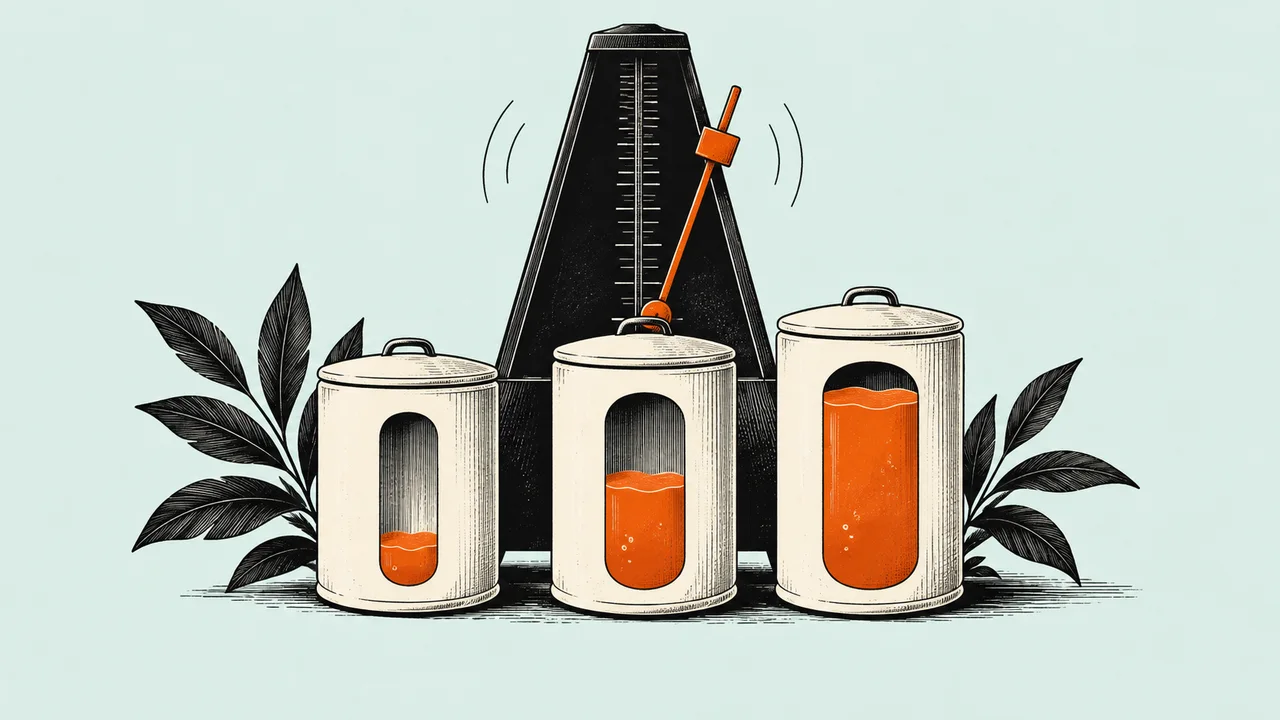
Gallons per stop climb when the truck goes to containers that are ready, not to whatever the calendar says. A fixed weekly visit to a slow account pumps a half-full container. You pay for the stop and get half the oil.
FoxInsights, a fill-level sensor vendor, published its 2025 analysis of waste oil collectors using its platform in Germany. The data covers waste oil, not UCO. Before monitoring, collections were spread across the 30 to 100% fill range. After, they concentrated at 80 to 90%, with 7% more quantity collected per tour and 11% more orders per tour. Its guide sums up the economics: a trip to an 85%-full container costs the same as a trip to a 45%-full one, for about double the yield. These are vendor figures, not independent studies.
You don't need sensors to start. Forecast each account from its pickup history:
gallons per account per day = gallons collected / days between visits
next visit = last service date + (container gallons x your trigger % / gallons per day)
Illustrative example: a 300-gallon container that filled with 120 gallons over 30 days makes 4 gallons a day. At an 80% trigger (240 gallons), the next visit is about 60 days after the last pickup (240 / 4).
- Pick your own trigger. There is no regulated fill level. Set a level below overflow, such as 80%, as a starting setting, then adjust it per account by how fast it fills and what a missed pickup costs you. Our guide to dynamic routing by UCO container fill level covers how to choose it.
- Start new accounts conservatively. Use the container size and a short first interval, then adjust from real pickups.
- Use sensors where they pay. High-volume or theft-prone accounts justify them first.
For the scheduling side, see our guide to UCO pickup frequency and fill cycles.
What to track: gallons per stop, and how many stops you pump below your trigger.
2. Tighten the Route So More Stops Fit
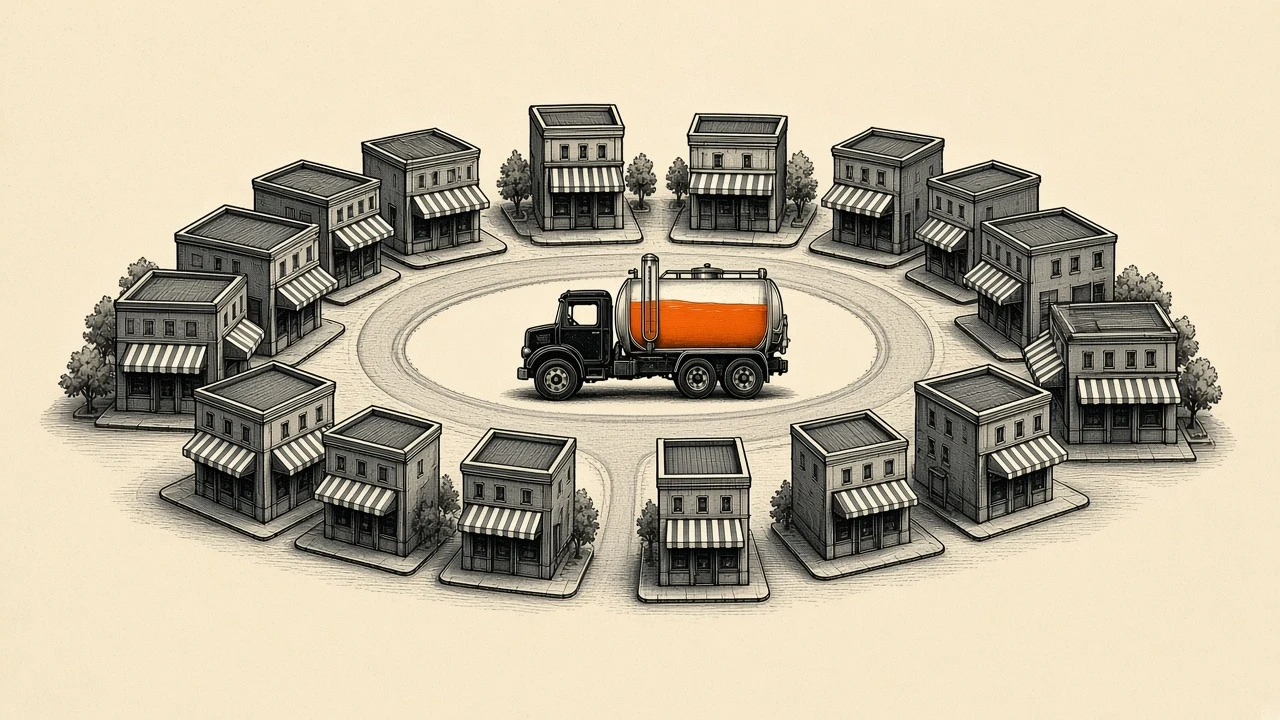
Gallons per route rise when stops sit close together, because less of the day goes to driving between them. Plan the multi-stop route as the unit, not the single account. A tight cluster gets more stops pumped before the tank or the shift runs out.
- Group by territory and day. Put neighboring accounts on the same route day and keep them there.
- Move the fringe. Shift outlying accounts to the route that already passes them.
- Cut dry runs. A truck sent to an empty or locked-out stop burns time and adds no gallons.
- Judge small accounts by location. A small account next to a big one can be worth more than a large account 20 miles out. More gallons are not always more profit, so score each stop with our guide to finding unprofitable UCO pickup stops.
How many stops fit depends on the tank and the clock. Our guide to restaurant stops per UCO route shows the math.
What to track: miles between stops per route, and dry runs per week.
3. Protect the Oil Before the Truck Arrives
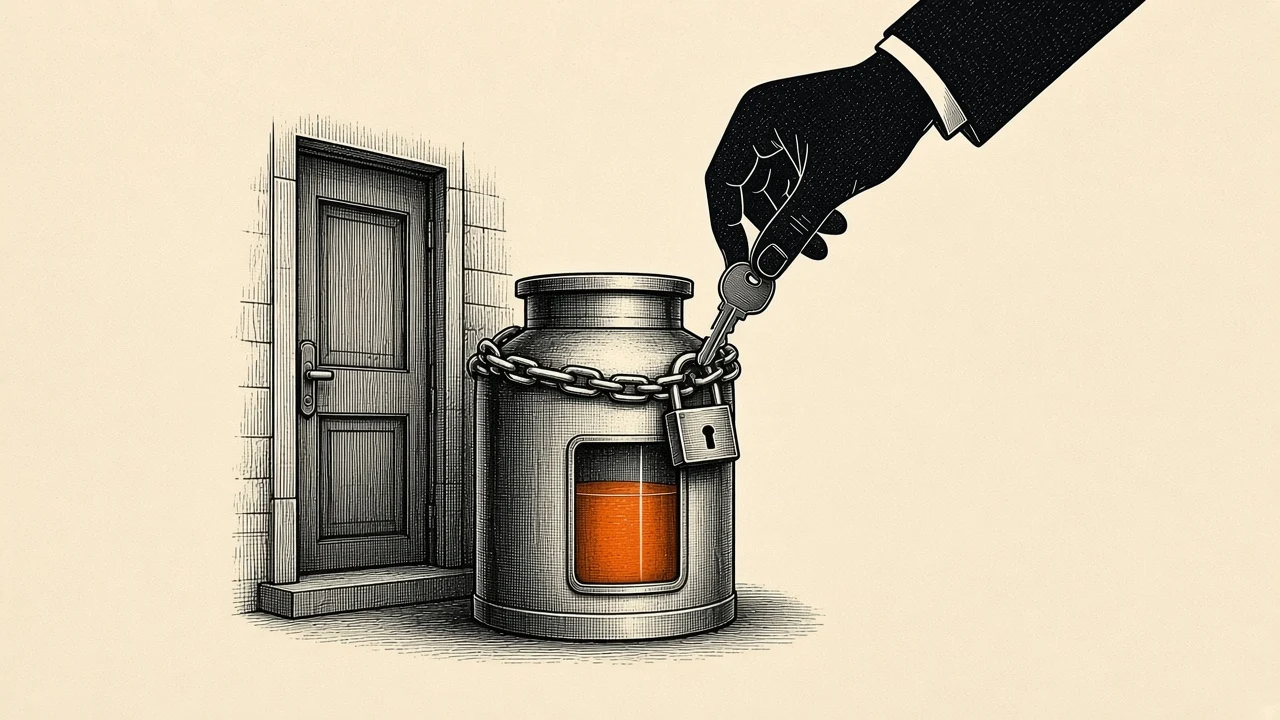
Oil that is stolen before pickup is a loss no routing plan can recover. It also throws off the forecast for the next visit, so the truck arrives early or late next time too.
- Lock outdoor containers at accounts with open access.
- Flag shortfalls. Any stop well below its forecast deserves a question.
- Keep container records. Knowing which container sits where makes a shortfall easy to trace. See how UCO container tracking works.
More on spotting theft in the data: used cooking oil theft prevention.
What to track: stops with pumped gallons far below forecast, by location.
4. Plan the Dump Run as Part of the Route
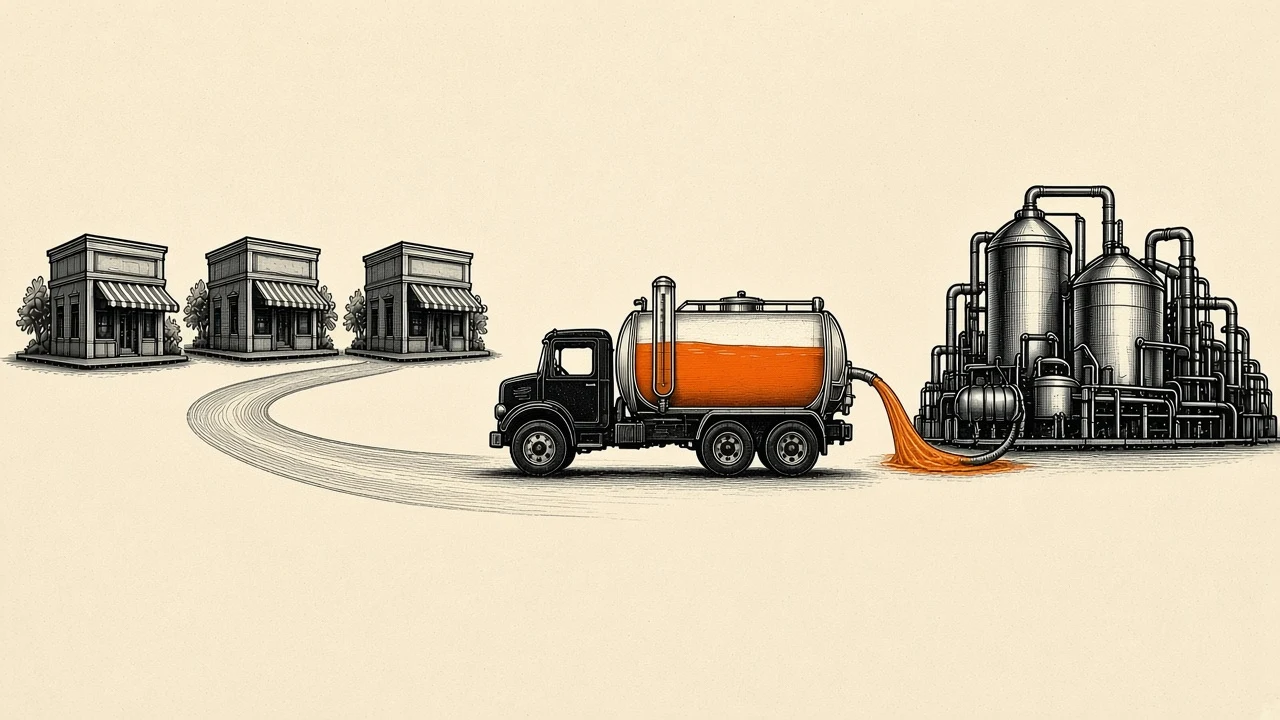
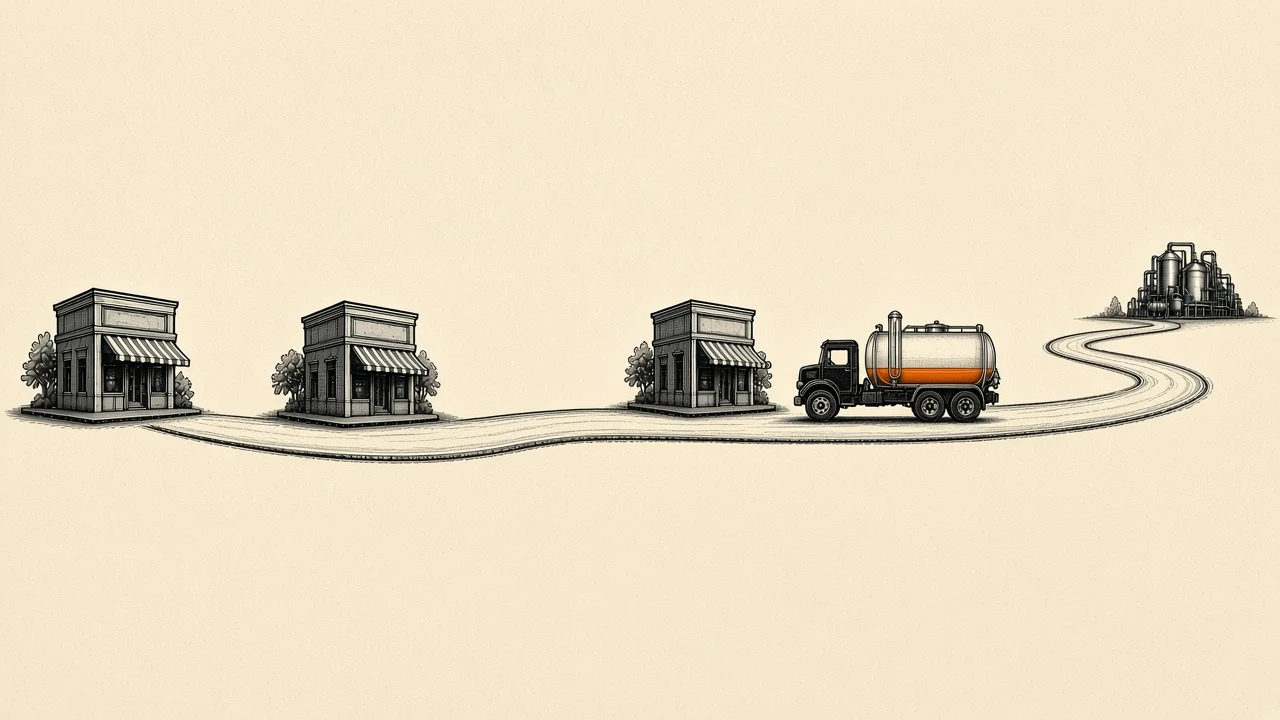
A full truck is a planned event, so sequence stops against the truck's capacity and put the unload on the route before the truck rolls. Keep a running total of expected gallons. When the next stop would not fit, the route goes to the disposal site or depot, then continues from there.
What Does the Dump Leg Do to Gallons per Route?
This example is illustrative. A 4,000-gallon truck runs ten stops, unloads, then starts a new load at stop 11. The dispatcher chose to unload at 3,200 gallons (80% of nameplate) to leave room for a heavy stop.
| Route point | Pickup (gal) | Running load (gal) | % of 4,000 gal |
|---|---|---|---|
| Stops 1 to 3 | 920 | 920 | 23% |
| Stops 4 to 6 | 960 | 1,880 | 47% |
| Stops 7 to 10 | 1,320 | 3,200 | 80% |
| Unload at disposal site | minus 3,200 | 0 | New load starts |
| Stop 11, from the disposal site | 320 | 320 | 8% |
The ten stops cover 60 miles in 6 hours. The dump leg, from stop 10 to the disposal site and on to stop 11, adds 90 miles and 2.5 hours.
| Metric for the 3,200-gallon load | Dump leg left out | Dump leg counted |
|---|---|---|
| Miles | 60 | 150 |
| Gallons per mile | 53.3 | 21.3 |
| Route hours | 6 | 8.5 |
| Gallons per route hour | 533 | 376 |
The oil didn't change. Only the accounting did. Now price the dump leg. The ATRI 2026 operational costs report puts the 2025 industry-average cost to run a truck at $2.336 per mile. That makes the 90-mile dump leg about $210 (90 × $2.336). Fuel alone, at 6 mpg and the EIA's U.S. on-highway diesel average of $6.127 for the week of November 9, 2026, is 15 gallons, or about $92. ATRI's figure is a carrier-wide average across trucking, so use your own cost per mile if you have it.
Two moves follow:
- End each load near the dump. Sequence the last stops toward the disposal site.
- Compare sites by the full cycle. A site 20 miles closer saves about 40 round-trip miles, or roughly $93 per load at ATRI's average.
For the full planning workflow, see UCO collection route planning and our capacity-based route planning guide.
What to track: dump-leg miles and hours per load.
How Full Is a Full UCO Truck? Capacity Utilization by Weight and Volume
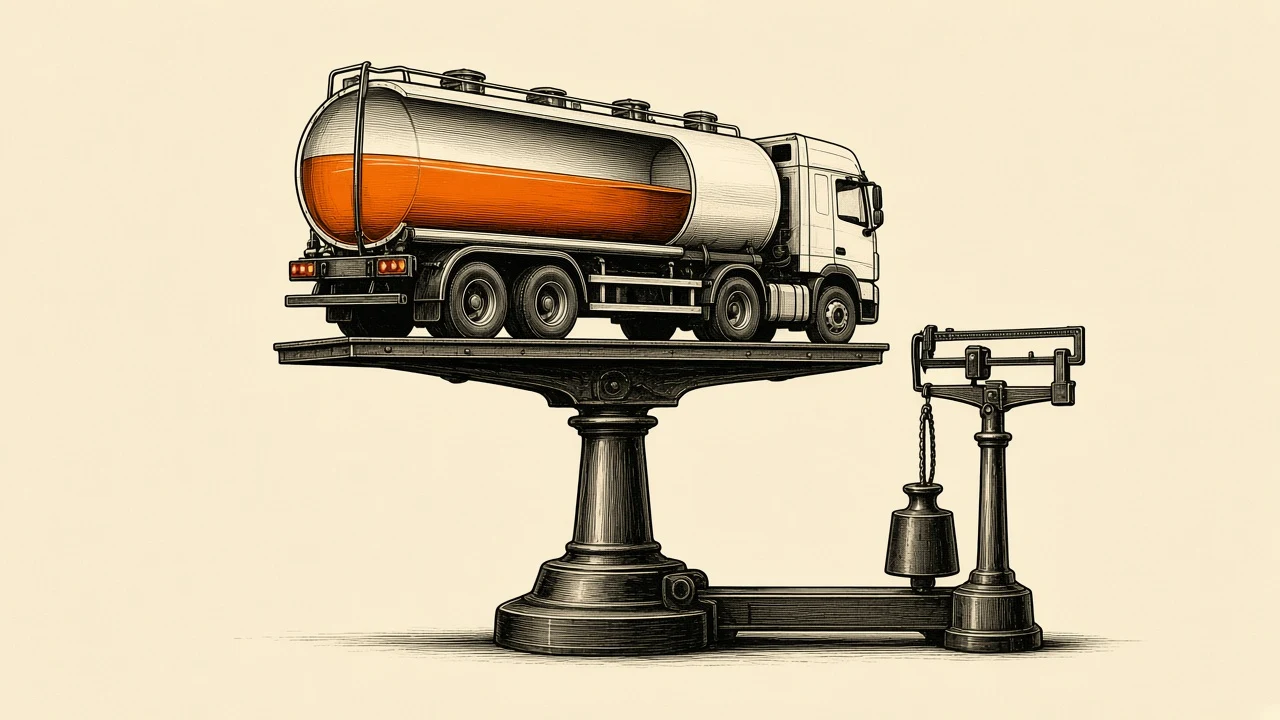
A UCO truck is full at whichever limit it hits first: tank volume or legal weight. The FHWA's federal size and weight standards cap gross vehicle weight at 80,000 lb on the Interstate, with 20,000 lb on a single axle and 34,000 lb on a tandem axle. State and axle limits can bind sooner.
Here is an illustrative check. We use about 7.5 lb per gallon as a planning figure, so weigh your own loads, and use your own truck's empty weight.
legal payload (lb) = 80,000 - empty truck weight
payload in gallons = legal payload / 7.5
A truck that weighs 35,000 lb empty has 45,000 lb of legal payload, or 6,000 gallons. A 4,000-gallon tank on that truck will fill by volume first. A larger trailer tank can hit the weight limit while it still looks part empty.
- Report the limit that binds. A load at 95% of legal weight and 60% of tank volume is a 95% load.
- Use usable capacity. Subtract the oil that stays in the tank and a safety buffer from the nameplate.
What to track: percent of weight and volume used on each load, and which limit bound first.
How Do You Measure Truck Fill Rate on UCO Routes?
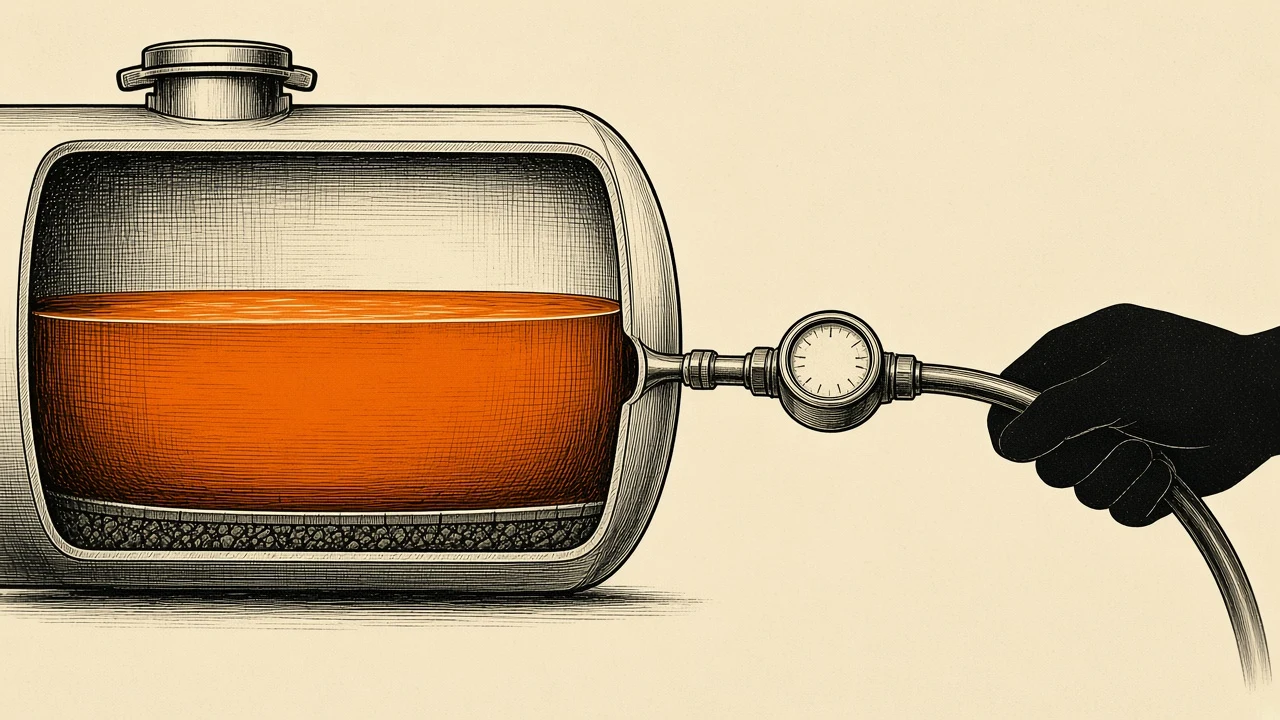
Truck fill rate is gallons collected on a load divided by usable truck capacity, times 100. Measure it per load, not per shift.
fill rate (%) = gallons collected on the load / usable capacity x 100
usable capacity = nameplate - residual oil - safety buffer
Illustrative example: a 4,000-gallon truck with 100 gallons of residual and a 300-gallon buffer has 3,600 usable gallons. A 3,200-gallon load is about 89% of usable capacity, or 80% of nameplate. Pick one basis and label it on every report.
| Data you have | How to get gallons collected | How far to trust it |
|---|---|---|
| Flow meter or scale ticket per load | Read the meter, or divide ticket weight by 7.5 | Strongest, one record per load |
| Gauge reading at each unload | Read before and after unloading | Usable if readings are consistent |
| Driver estimates or shift totals only | Add up the driver's numbers | Rough, and multi-load shifts blur |
Weights and pickup proof make this easier. See UCO pickup proof and weights.
What to track: fill rate per load, and how often a truck unloads well under its trigger.
Which Metrics Show Gallons per Mile and per Route Hour?
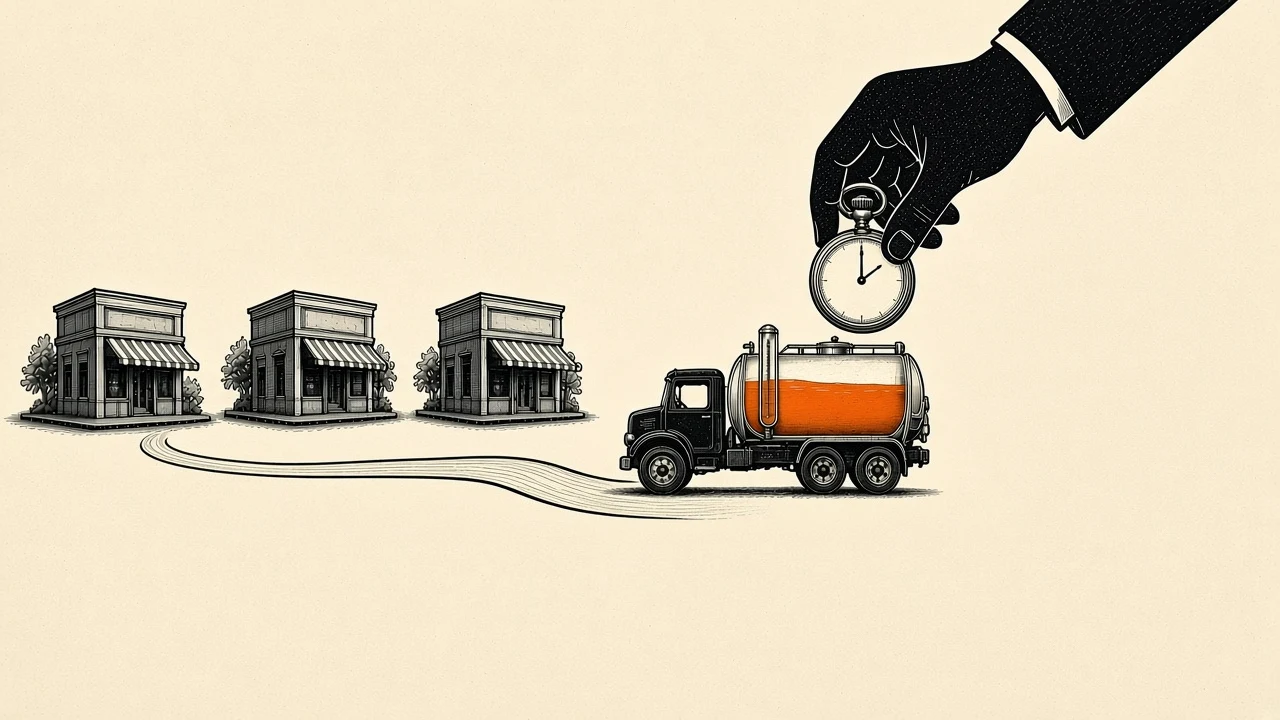
One metric can't tell you which lever to pull, so track three, by route, every week.
- Gallons per stop shows yield. A falling number points to early visits or lost oil.
- Gallons per mile shows density. Count the dump leg, or the number flatters you. Don't confuse it with diesel burned per mile, which is 1 divided by your miles per gallon.
- Gallons per route hour shows the whole working day, including pumping, traffic and unloading.
Also watch dry stops, the stops that produced no oil, as a share of all stops. If that share doesn't fall, your pickup intervals are probably still wrong, and the other three numbers won't move much. Our guide to dispatching UCO collection trucks shows how to use these numbers on the daily board.
Compare the same weeks year over year so seasonal surges don't mislead you.
Can Route Software Account for Truck Tank Capacity?

Yes, UCO route software can hold each truck's capacity, add up expected gallons stop by stop and put the unload in the route before the truck runs out of room. Many map apps only sequence addresses and don't track liquid in the tank. Some general route planners do enforce vehicle load limits for pickups, so judge any tool by what it does, not its category.
DynoRoute's UCO software lets you set a capacity for each truck in gallons, pounds, or the unit your operation uses. It builds routes around expected gallons, usable truck capacity, service time and the depot or offload return, and starts the next load with the return already counted. When actual gallons or an urgent pickup changes the day, it re-plans the remaining work. It suggests which truck and driver should take each job by capacity, location, availability and workload, and the dispatcher keeps final control. Where tanks have fill-level sensors, it collects those readings through its API and webhooks. Plans are flat monthly with usage credits, month-to-month, with no setup fee and no per-seat fees.
UCO-specific tools exist too. Route Simplified offers fill rate tracking for UCO routes, with its Local plan at $100 per month plus $1 per account for up to 500 accounts (checked November 10, 2026). We publish no measured gain in gallons for DynoRoute, so test any tool on your own routes.
Book a 30-Minute Intro Call
Bring your truck sizes, your unload sites and a typical week of stops. On a 30-minute call we'll talk through where your routes lose gallons, how DynoRoute plans capacity and the dump run, and what your plan would cost. The first call is a conversation about fit and pricing, not a software demo. Book a 30-minute intro call.
Frequently Asked Questions
How do you increase gallons collected per route?
Dispatch by fill level instead of a fixed calendar, cluster stops, lock containers and plan the dump run into the route. FoxInsights reports 7% more quantity per tour after its waste oil partners moved to level-based collection (vendor-reported). Measure gallons per stop, per mile and per route hour to see which change worked.
What is a good gallons per mile for a UCO route?
We found no independent US benchmark for oil collected per mile. Build your own baseline from 30 days of routes, with the dump leg counted. In the illustrative example above, counting a 90-mile dump leg drops the figure from 53 to 21 gallons per mile.
How many pounds is a gallon of used cooking oil?
Plan with about 7.5 lb per gallon, and weigh your own loads to confirm it. At that figure, a 4,000-gallon load is about 30,000 lb of oil. Weight matters because the federal gross limit on the Interstate is 80,000 lb, truck included.
How do you measure truck fill rate on UCO routes?
Divide the gallons collected on one load by the truck's usable capacity and multiply by 100. Usable capacity is nameplate minus residual oil and a safety buffer. Measure per load, because a shift with two loads would read over 100%.
Can route software account for truck tank capacity on UCO routes?
Yes, if it holds a capacity per truck, keeps a running load as each pickup adds oil, and places the unload trip in the route. Check those three things rather than the product's category. DynoRoute sets capacity in gallons, pounds, or the unit your operation uses, and plans the offload return.
How much does a dump run cost?
At ATRI's 2025 average of $2.336 per mile, a 90-mile dump detour costs about $210. Fuel alone for that detour is about $92 at 6 mpg and the EIA diesel average of $6.127 for the week of November 9, 2026. Your own cost per mile will differ.
What is a good fill level to pump a UCO container?
There is no regulated number. A level around 80% works as a starting setting because it leaves room before overflow, and FoxInsights reports that its partners' waste oil collections concentrated at 80 to 90% after moving to level-based dispatch. Adjust the trigger per account, based on how fast it fills and the cost of a missed pickup.