Key takeaways
- Theft rarely shows up as a crime scene; it shows up as a gap between the gallons a stop should have yielded and the gallons your driver pumped.
- A light stop has six possible explanations, and five of them are cheaper to check than filing a police report.
- Put a number on every suspected loss: what the container should have held, minus what was pumped, minus what was left behind — then judge it against that site's normal swing.
- In the first hour, photograph everything before servicing, rule out your own trucks, measure what's left, and ask the restaurant to save camera footage the same day.
- A full 330-gallon container held roughly $1,300 to $1,800 worth of oil at July 2026 prices, so spend on locks, cameras, and sensors in proportion to what each site holds and how often it gets hit.
- Keep one incident file per event: the photos, the last verified pickup, the loss math, and the contract clause that proves the oil is yours to claim.
- Pay the restaurant's rebate on what you actually collected, and show the theft on the statement — a silently short check invites them to suspect you first.
Used cooking oil theft usually reaches a collector as a number: a route that should have yielded, say, 900 gallons comes home with 600. The fastest detection tool you own is already in your per-stop pickup records: an expected-gallons figure for every container, checked against what the driver actually pumped. This guide covers what the restaurant-facing advice never does: reading theft out of route data, ruling out the innocent explanations, the first-hour dispatch response, and keeping rebates and records straight while a case is open.
I build DynoRoute, capacity-based routing and dispatch software for UCO fleets — pricing is public — and I have spent this year talking with the operators who run them. This is the collector side of a story the news only tells from the restaurant's parking lot.
Why thieves want your oil: the short version
The news coverage of oil theft is consistent, and it checks out. Renewable-fuel incentives turned yellow grease into a commodity worth stealing: a generic liquid with no serial numbers, untraceable the moment it reaches a broker's tank, with biodiesel and sustainable aviation fuel demand holding the price up. And the people stealing it are mostly not freelancers with a pickup truck. Jay Ford, general manager of Louisville collector VOCARS, told WDRB about a federal five-state operation that "confiscated $27 million in cash, along with 150 vehicles and 26 warehouses involved in the theft ring." The stolen oil flows back into the legitimate fuel supply — St. Louis Magazine reported a federal case this June in which a buyer moved stolen grease under forged traceability documents and collected about $1.3 million before the indictment. On the restaurant side, the standard defense is physical: locked heavy-gauge containers, lighting, indoor tanks where possible, and cameras above all — a Bensalem Township detective interviewed by collector Mopac credited video for every local case his department solved.
None of that tells collectors how to find out they are being robbed. Your containers sit at sites you may not see again for weeks, and between visits the only witness is the data.
How do you know oil is missing before the totals say so?
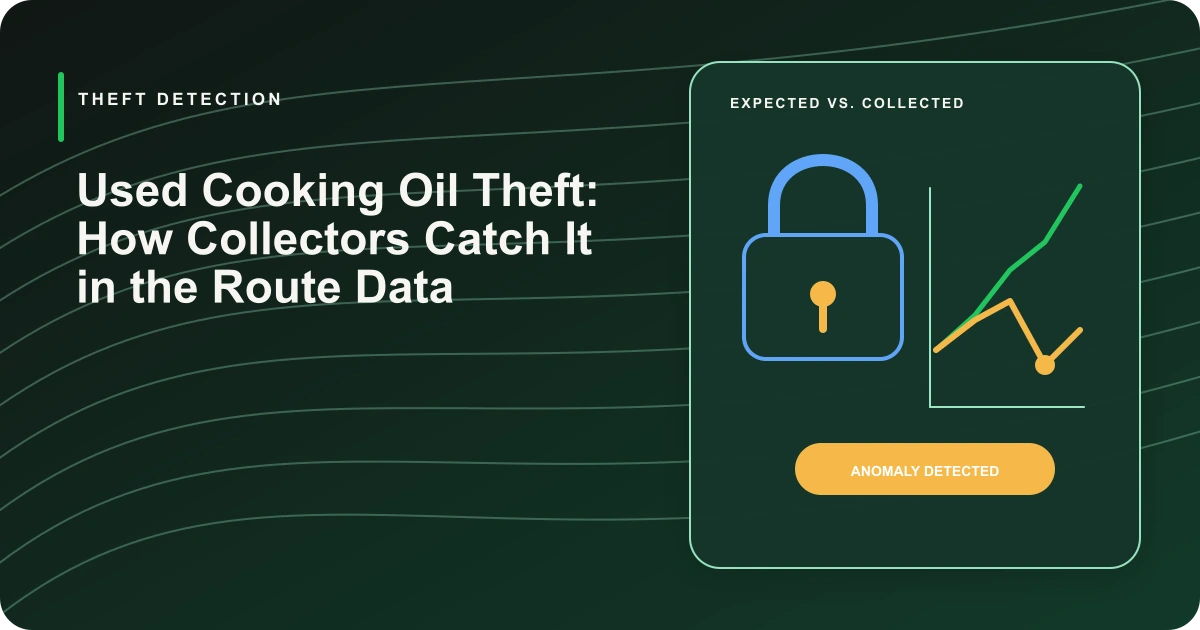
Detection is one comparison, run at every stop: expected gallons against pumped gallons. Expected comes from the site's own history: what recent pickups at the same cadence yielded, and how much they swung. Pumped comes from the driver's verified record. Log both on every visit, and theft can no longer hide in the averages.
The gap is also visible at fleet scale. When a ring worked the accounts of Louisville collector VOCARS, its general manager told WDRB: "We usually have our drivers make about 22 to 24 stops in a day, and they might hit four or five of those where there's nothing in the tank" — customer count rising, tonnage falling. That is an extreme case, one collector under an organized ring, but the shape is what to watch: volume leaving between visits.
Three per-stop patterns are worth an alert:
- A steep drop. A site whose history says near-full turns up near-empty, usually with a cut lock or a spill.
- A repeat drifter. The same site comes in light three pickups running while its neighbors hold steady.
- A route cluster. Several stops on one route go light in the same week. Crews work areas; sometimes they work your schedule.
When one fires, put a number on it before anyone says the word theft:
suspected loss = predicted pre-event volume − verified pickup − remaining volume
Judge the result against the site's normal swing. Illustrative numbers: a container that averages 60 gallons a week on a three-week cycle should hold about 180, give or take 20, on pickup day. The driver pumps 40 and a dip check finds 10 left. Suspected loss: 180 − 40 − 10 = 130 gallons, more than six times the site's swing — far outside anything forecast error explains. The same math kills false alarms: a 30-gallon gap at a site that swings 40 is nothing.
If you already plan loads with capacity-based route planning, the expected-volume number exists in your system today. Detection is the same math run backward.
Six explanations for a light stop, and theft comes last
Rule out the cheap explanations first, in this order:
| Cause | What the record usually shows | The fast check |
|---|---|---|
| Authorized pickup | A verified pickup you forgot: schedule change, swapped truck, early service | Your own dispatch log and photo timestamps |
| Forecast error | A gap inside the site's normal swing; slow season, menu change, closed week | Site history, then a call to the account |
| Restaurant behavior | Gradual decline, container undamaged; kitchen habits changed or a second vendor signed the account | Ask the manager directly |
| Leak | Slow loss with residue at the pad, valve, or fittings | Driver inspects at the next stop |
| Measurement error | A one-off oddity in an otherwise steady history | Re-measure at the next visit; check the entry |
| Theft | A steep drop with physical evidence: cut lock, broken keypad, spill | The first-hour protocol below |
Authorized pickup sits first for a reason: filing a police report over your own reroute costs credibility you will want later.
What should happen in the first hour?
Document, verify, measure, call, report — then service the container.
- Document before touching anything. The driver photographs the lock, lid, spill, and surrounding area, timestamped and geotagged. Evidence beats memory.
- Verify it was not you. Dispatch checks for schedule changes, a swapped truck, an early service. Two minutes on the radio closes the most common false alarm.
- Measure what is left. That number is the third term of the loss formula. Skip it and your loss figure is a guess.
- Call the restaurant the same hour. Ask them to save camera footage now (many systems overwrite within days), what staff saw, and whether a gate log exists.
- Report while the trail is warm. In Flagler County, deputies on a routine 3 a.m. business check caught two men siphoning about $5,000 of oil into an unmarked box truck (ClickOrlando). One standing rule for drivers: never confront a crew — photograph the plate from the cab and leave.
- Then service the container, flagging the visit as theft-affected so the event never contaminates the site's baseline.
Match the control to the container, not the catalog
Every control is a bet that its cost beats the loss it prevents, so start from what each container holds. A 330-gallon container carries about 2,475 pounds of oil when full, per DAR PRO's published spec for its Cleanstar 2500. USDA's July 2026 by-product feedstuff report listed regional yellow-grease asks at 53 to 73 cents a pound (prices move monthly — check the current sheet). Call it roughly $1,300 to $1,800 of gross commodity value in a full box, an estimate that ignores collection cost, rebate, and quality discounts. That figure is your loss exposure; a thief fencing through a broker clears less, but your books absorb the full number.
Layer controls against that number and the site's history:
- Every container: lock, lighting, theft-reporting signage. Cheap; it filters out casual scavengers. It does not stop rings: in Lake Oswego, KATU reported crews cutting collector locks and breaking keypads in early-morning hits — one business put its loss at 200-plus gallons in a few weeks.
- Repeat-hit and high-volume sites: a camera placed to capture the vehicle and plate (the Bensalem detective's whole playbook), plus an anchored enclosure a box-truck crew cannot pry open in two minutes.
- Highest-value sites: restricted-access equipment, like DAR PRO's design that only its own truck hose can draw from, or indoor storage that removes outdoor access entirely.
- A monitoring layer where it pays: third-party fill-level sensors, such as Sensoneo's UCO units that flag abnormal emptying speed and alert in real time, make sense where cycle value and hit history are high and someone can respond. An alert nobody answers is a subscription, not a control.
Price each tier against per-cycle value times hit history. A twice-hit container off a highway ramp justifies hardware that a quiet cul-de-sac site never will.
Build the incident packet while it is fresh
Police, your insurer, and your customer ask for most of the same facts; the insurer adds its own claim forms. Assemble the file once, the day it happens:
- Container ID, site, and the driver's first-hour photos
- The last verified pickup: date, driver, gallons, photo proof
- The loss math: predicted, pumped, remaining, and the site's normal swing
- Camera footage, or your dated written request for it, plus any plate or vehicle description
- The service agreement showing who owns the oil in that container
- Repair and cleanup costs: locks, keypads, enclosure, spilled oil
The ownership line is the one worth reading twice. Theft cases stall when nobody can show standing — that the loss is yours to claim — so put the contract clause on top of the file. Prosecutions are real: the St. Louis buyer who papered stolen grease with forged traceability documents drew federal charges. A boring, dated, per-stop service history is the one thing forged paperwork cannot imitate, and it is what turns "our yields are down" into a case number.
What happens to rebates while the case is open?
Pay on verified collected volume, and show the theft math on the statement. The restaurant's rebate comes from what you collect, so a theft craters their check, and a short check with no explanation invites the restaurant to suspect you first. A statement line reading "estimated 130-gallon loss, theft event July 14, police report #4482" (illustrative) turns the shortfall into shared evidence and often turns the manager into an ally.
On the records side, four housekeeping moves keep the route honest:
- Exclude theft-affected visits from the site's baseline so the forecast does not drift downward.
- Reset the fill clock: an emptied container starts from zero, so expect the next pickup to run light and do not log it as a second hit.
- Raise the site's risk tier after any second hit and re-run the control decision above.
- Schedule lock or keypad repair as a routed job, so it happens on a truck day instead of dying on a sticky note.
Where DynoRoute fits
The detection method in this article is your own records plus arithmetic, and DynoRoute keeps those records runnable — the per-stop history is what makes theft visible in the first place. If you want the comparison run for you, configure an agent as a loss watch: an agent you set up that checks expected against pumped gallons at every stop, working from your own route and pickup records, and flags the gap the day it opens. Custom fields per stop hold expected and pumped gallons — the two numbers the loss formula needs. Recurring schedules build each site's baseline. The driver app's timestamped, geotagged photo proof is the first-hour documentation, already filed. Custom records tie every container to its site and service history, which is most of the incident packet. When a driver burns an hour at an incident, the AI dispatcher recommends where that truck's remaining stops should go, confidence scored. Import your customer list from a CSV and the baseline starts building on the first route. Get started.