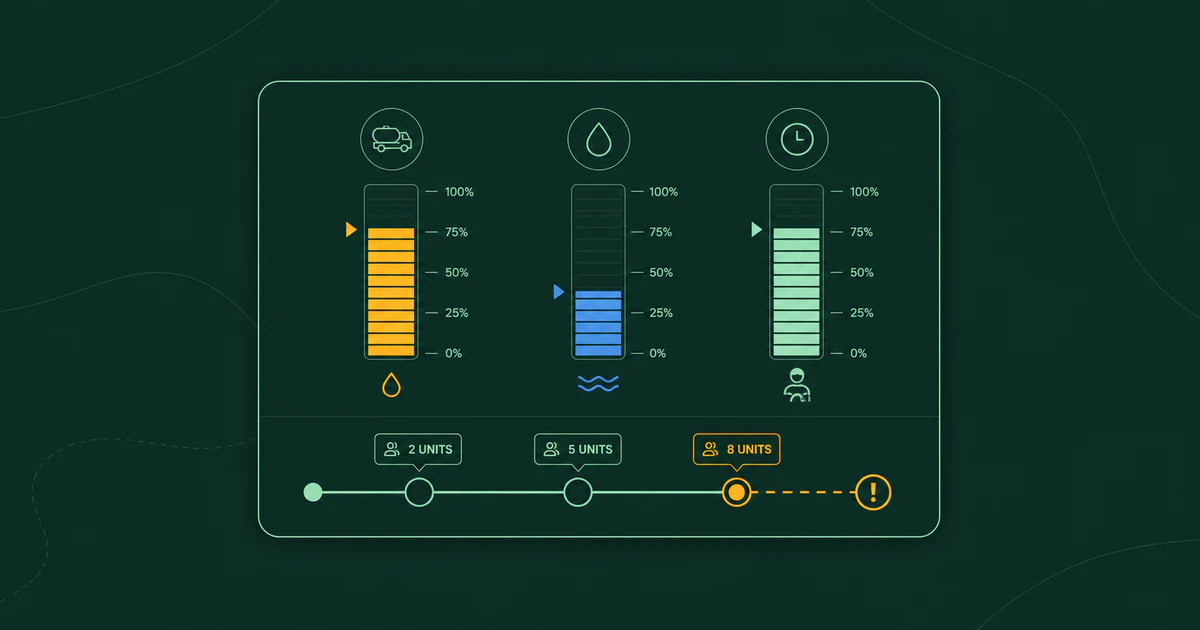
Key takeaways
- A rebate argument is almost always a measurement argument: the contract's unit (gallons or pounds), method, quality basis, and price date decide the number before anyone measures anything.
- The two defensible measurement paths are a calibrated truck flowmeter and certified scale weights; each has failure modes the record must cover.
- Per-stop totals must reconcile to the depot's net received, within a stated tolerance, or every stop's number is arguable.
- Contamination deductions (water, solids, quality) need a defined test and pre-agreed terms in the contract, not a judgment call at settlement.
- Fix the price reference in writing: which index, which date (pickup, settlement, or period average), and which quality adjustments.
- A dispute-ready pickup record carries the quantity, method and device ID, timestamped geotagged photos, driver, and the customer-visible ticket.
- Resolve disputes by procedure — pull the packet, recheck the math, correct or confirm, and log the outcome — so the second dispute takes ten minutes, not a week.
UCO rebate disputes end when the per-stop record is stronger than either side's memory; keeping that record intact, stop after stop, is the job DynoRoute's UCO collection software was built around, and pricing is public. The record that does it has four parts: the contract's terms (unit, measurement method, quality basis, price date), a quantity captured at the stop by a defensible method, evidence that survives — photos, timestamps, device IDs — and a reconciliation that ties every stop's number to what the depot actually received. Restaurants dispute volumes and rebates because those parts usually live in three heads and two spreadsheets; dispatching decisions move stops between trucks and the paperwork doesn't follow.
If you collect oil, you have had the call: a kitchen manager sure the bin was full, a rebate statement that reads something like 140 gallons, and a driver who remembers a lot of water in the bottom. I build routing software for collection fleets, and rebate friction is the complaint UCO operators raise most after routing itself. This article is the measurement-and-records method that turns those calls into a ticket lookup.
The rebate number is defined before it is measured
Start every settlement conversation at the contract, because it decides four things the gauge cannot: the unit (gallons or pounds), the measurement method that governs, the quality basis, and the price date. Two honest parties can measure the same pickup carefully and still disagree if those four are fuzzy.
The unit matters because oil converts between volume and weight through density, and density moves with temperature and contamination. DAR PRO's Cleanstar container is rated 330 gallons and 2,475 pounds, an implied 7.5 pounds per gallon for that product, not a universal constant to settle contracts on. A gallons contract and a pounds contract can price the same pickup differently, so the contract picks one and the records keep it.
The price reference needs the same precision. Yellow grease trades on published markets: USDA's April 2026 report listed 35–48 cents per pound in Minnesota and 46–57 cents across listed California markets. That is a dated snapshot, and the spread across regions inside one report is the argument for naming your index. Commercial assessments like Argus's US UCO prices are location-specific and quality-bounded. Whichever reference the contract uses, it should also fix the date: price at pickup, price at settlement, or a period average. Leaving the date open invites relitigating every falling market.
Flowmeters and scales: how a pickup gets proven
Two measurement paths produce defensible per-stop quantities: a calibrated flowmeter on the truck, reading gallons as the oil is pumped, or certified scale weights, taken as the difference between the truck's weight before and after the pickup. An industry filing to EPA describes both in practice (truck flowmeters for collection, certified scales supporting weight collected per stop), and each carries failure modes the record has to answer.
A flowmeter gives per-stop resolution cheaply, but it measures whatever flows: oil, water, and suspended solids together. Its defense is calibration on a schedule (with the certificate on file), the meter ID on every ticket, and a contamination story handled separately in settlement. Scale weights carry the strongest authority, but per-stop scale differences are practical only where the route geometry allows a weigh between stops; most fleets weigh the truck at the depot and reconcile the route total instead. The workable pattern for many operators is metered gallons per stop plus a weighed route total as the cross-check.
Whichever path governs, write it into the contract and put the device at the center of the record: meter or scale ID, reading, timestamp. A quantity without a method is an opinion with digits.
Reconcile the route, not just the stop
Per-stop numbers earn trust when they add up: the sum of a route's pickups should match the depot's net received for that load, within a tolerance you state in advance, after accounting for documented residual, any samples pulled, and water or solids removed. A fleet that reconciles every route can defend every stop; a fleet that never reconciles is arguing from one meter reading.
The mechanics are bookkeeping, not chemistry. Each stop's ticket carries its gallons; the route's tickets sum to a route total; the depot's intake (a weighed or metered net) sits beside that total with the difference computed. Small, consistent differences are measurement tolerance and residual; name the expected band and move on. Large or drifting differences are a finding: a meter losing calibration, water riding along as product, or gallons leaking from the record between the stop and the depot. Every one of those is cheaper to find on Tuesday's reconciliation than in a customer dispute three weeks later.
This is also the honest answer to why restaurant, driver, and depot totals disagree. They measure different things at different moments: the bin's apparent contents, the metered pull, the depot's settled net. The reconciliation is what connects them, and the tolerance is what keeps the connection from becoming an argument.
Contamination changes the number, so define it early
Water and food solids in the bin lower what a load is worth, and quality limits are built into the market itself — Argus's US UCO assessments specify maximums of 15% free fatty acids and 2% moisture and impurities. The settlement question is never whether contamination matters but who eats it, and the only good time to answer is in the contract, before the first pickup.
A workable contamination clause has three parts: a defined basis (what gets tested or observed, and how), evidence attached to the deduction (the driver's photo of a watery bin at pickup beats a depot assertion a week later), and pre-agreed terms: a deduction schedule or quality bands, so the math is mechanical when the case arises. Vertical software vendors in this trade describe per-account pricing with contamination deductions as standard practice; the practice only stays friendly when the deduction is a lookup, not a negotiation.
The settlement formula, assembled: gross quantity by the contract's method, times the contract price at the fixed reference date, minus documented quality deductions. As a worked illustration with round numbers: a 100-gallon metered pickup at the DAR PRO-implied 7.5 pounds per gallon is 750 pounds; at a 42-cents-per-pound reference that's a gross commodity value of $315, before the collector's costs, the contracted revenue split, and any quality adjustment. The inputs are invented for the walkthrough; what matters is that every term in the line traces to a record.
The dispute-ready pickup record
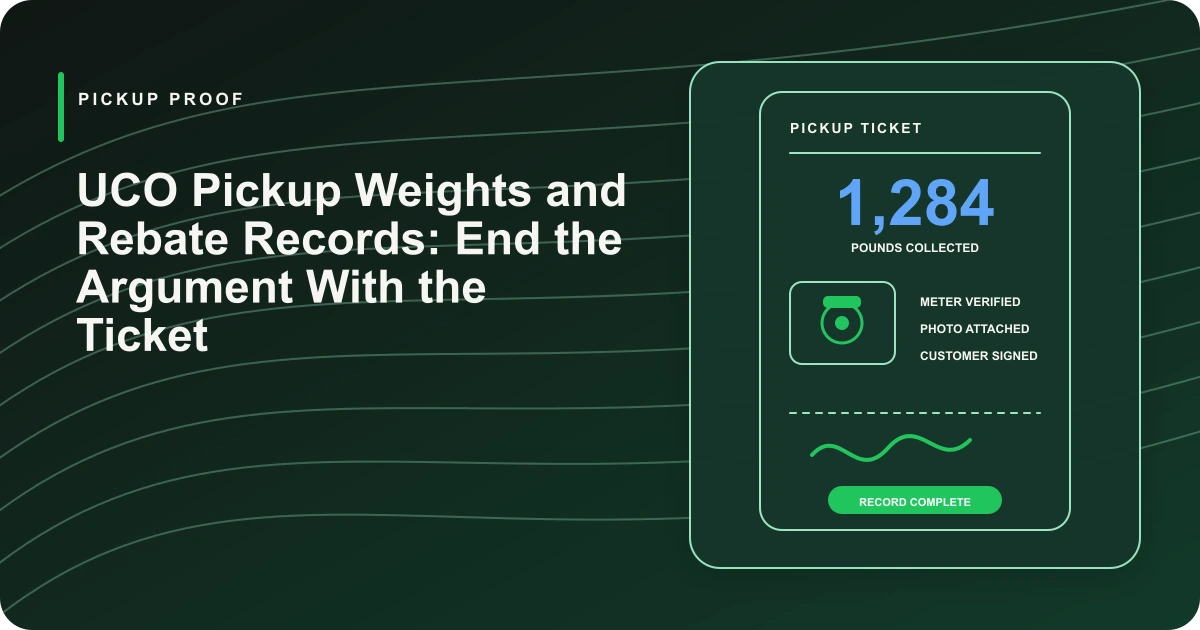
One stop's record should let a stranger reconstruct the pickup: account and container, date and time, driver and truck, method and device ID, the quantity, timestamped geotagged photos of the container before and after, the customer-visible ticket, and the price reference in force. That is the packet; a dispute is somebody asking for it.
Most of those fields cost nothing to capture at the stop and everything to reconstruct later. The photo pair is the workhorse — it settles "the bin was full" and "there was water in it" in one glance. The device ID ties the number to a calibration certificate. The ticket makes the customer part of the record at pickup time instead of at statement time, which is where most disputes are actually born: a month-end number with no shared memory behind it.
This is the record-keeping DynoRoute makes routine for collection fleets. Every stop carries its container and expected volume as fields; drivers log each service with timestamped, geotagged photo proof; and when dispatch swaps a stop between trucks, the records ride with the job, so the settlement never depends on which truck happened to finish the route. Container and asset tracking keeps the bin inventory straight, service records hold the quantities and dates your invoicing runs on, and the per-stop history doubles as the measured-yield data your capacity planning runs on. The meters, scales, and contracts stay yours; the software makes sure their outputs never go missing, and an agent you set up can run the route reconciliation each evening and post whatever doesn't square.
Resolving the dispute that still happens
When a dispute arrives anyway, run a procedure instead of a debate: pull the stop's packet, recheck the settlement math against the contract terms, compare the route's reconciliation for that day, then correct or confirm, and log the outcome either way. A corrected error paid promptly builds more trust than a stonewalled one ever costs; a confirmed number with the packet attached usually ends the conversation in one email.
The log matters as much as the resolution. Disputes cluster: one account, one driver's technique, one meter drifting out of calibration. A dispute log read quarterly turns those clusters into fixes — a re-trained pour, a recalibrated meter, a contract clause tightened at renewal — which is how fleets get to the state where the monthly statement is boring — and boring is what keeps accounts.
If your pickup records live on paper tickets and your rebate month-end is a reconstruction, get started with DynoRoute — put the per-stop record on rails and let the argument end at the ticket.