Key takeaways
- UCO dispatch is a readiness problem before it is a routing problem: the question is which containers are worth a truck today, not how to sequence a fixed list.
- Rank candidate stops by projected fill at the next feasible visit minus a safety margin, then adjust for theft calls, overflow risk, access windows, and commitments.
- Estimate fill from each account's measured history first; fixed cadence and sensors are fallbacks and upgrades, not the foundation.
- Collecting too early wastes a stop on a half-empty bin; collecting too late buys an overflow or a theft loss. Both failures are dispatch decisions.
- Track four different numbers separately: container capacity, predicted contents, actual gallons collected, and the truck's remaining room.
- A theft or overflow call gets triaged like an emergency job: verify, weigh it against committed pickups, and route the truck that can take it without breaking a promise.
- When a stop moves between trucks, its records move with it — container, gallons, photos, time, driver — or the rebate conversation later has holes.
Dispatching UCO collection trucks means deciding, every morning, which containers are worth a truck today and which truck should take them. That readiness-before-sequencing ordering is the heart of capacity-based route planning, and it is what DynoRoute's used cooking oil collection software is built around — pricing is public. A restaurant's bin is not a delivery address; it fills at its own pace, gets skimmed by thieves, and pays you in oil whose value changes with the market. So the dispatch question runs in this order: which stops are ready, which are at risk, what does each candidate pay, and how many of them fit the truck before a depot return. Sequencing the drive comes last.
If you dispatch oil trucks today, the morning probably starts with a cadence list, a couple of overnight voicemails about missing lids, and a judgment call about which of the two you trust. I build routing software for fleets that fill up, and UCO dispatchers describe the same two failures to me from both directions: trucks visiting half-empty bins, and full bins overflowing or getting robbed while the truck was somewhere less useful. This article is the decision structure that avoids both.
Which stops should go on today's trucks?
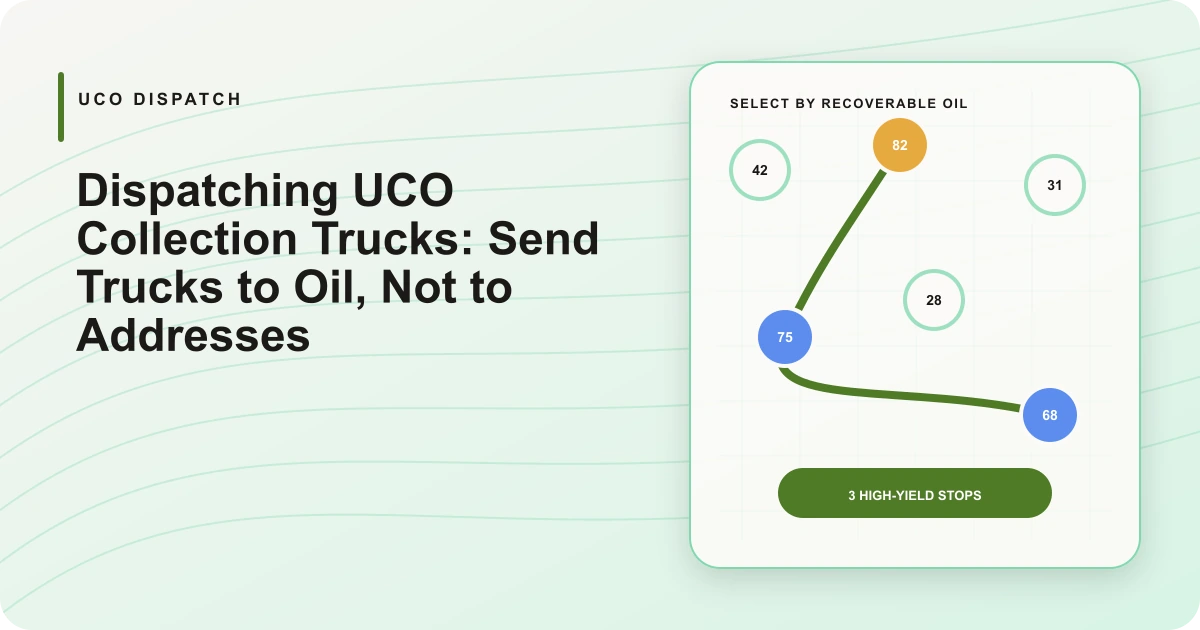
Rank every candidate stop by one number: projected fill at the next feasible visit, minus a safety margin. A bin projected to be near capacity before your truck can plausibly return goes on today's route; a bin that will still have comfortable room next week does not. On top of that base ranking, three adjustments move stops up or down: risk (a theft call or an overflow-prone site outranks its fill number), access (a kitchen that only allows service before opening constrains which truck can take it), and commitments (a promised pickup is a promise, whatever the bin holds).
The two failure modes this prevents are well documented in the trade. FoxInsights, a sensor vendor writing for collectors, names them plainly: collecting too early and collecting too late. An early visit spends a stop's worth of time on a fraction of a load, a late one converts a paying pickup into an overflow cleanup or a theft loss. One automation vendor's case page describes a collector with nearly a thousand tanks whose drivers were visiting half-empty tanks while unlogged stops got skipped, a vendor-reported account, but a recognizable morning for anyone who has dispatched from a static list.
The economics belong in the ranking too, because UCO stops pay differently. Yellow grease is a priced commodity. USDA's April 2026 report listed 35–48 cents per pound in Minnesota and 46–52 cents on California's Central Coast — check the current report before pricing anything on it. Either way, a 280-gallon bin near full is a materially different prize than a 55-gallon drum — two standard sizes from the container lineups covered below — and a stop's drive time weighs against the oil it yields. Gallons per mile is a dispatch metric, not just an accounting one.
Fixed schedules, forecasts, and sensors: a confidence hierarchy
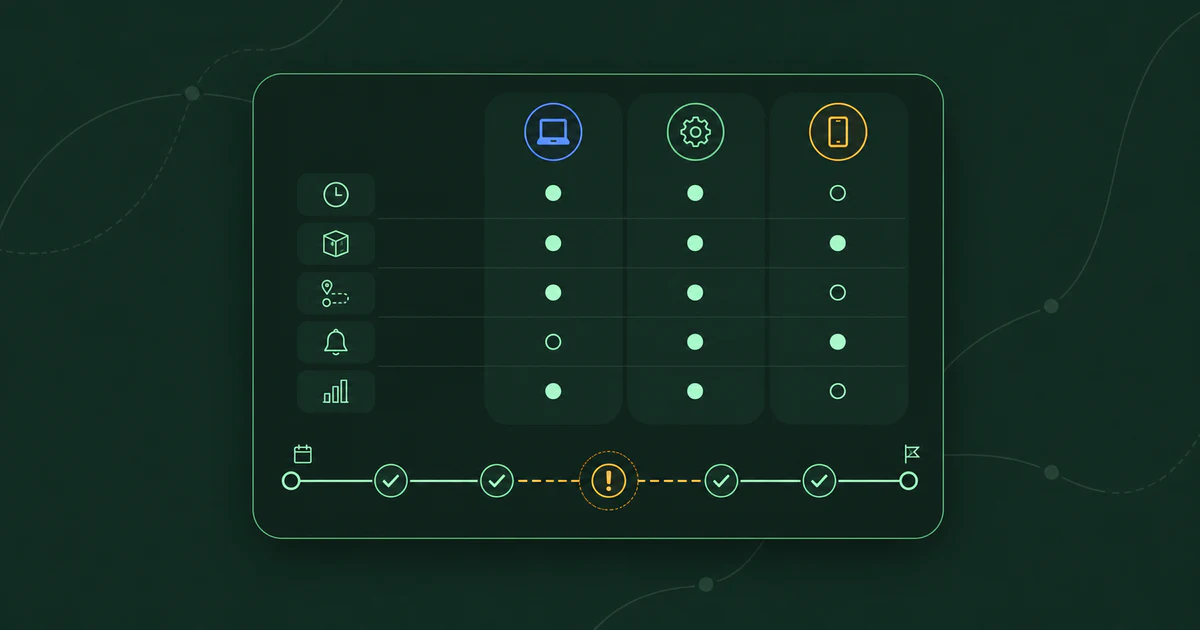
Use the best fill information you have per account, in this order: measured history (what this stop actually yielded, visit after visit), then cadence adjusted by season and the account's fryer volume, then live telemetry where a sensor is installed. Each layer overrides the one below it; none replaces judgment about risk and access.
Measured history is the workhorse because there is no defensible industry average to lean on — no published US-wide gallons-per-restaurant-per-week figure survives scrutiny, and fryer count, cuisine, and season swing the real number too widely. Your own pickup records, kept per account, are the forecast. A stop that yielded, say, 60, 65, and 58 gallons on a three-week cadence is a solved problem; a new account is an estimate bounded by its container size until two or three services teach you its pace.
Container sizes give the estimate its ceiling. The makers' published lineups put common outdoor UCO containers at 55, 110, 200, and 280 gallons, tank manufacturers list collector models from 80 through 325 gallons, and DAR PRO rates its Cleanstar 2500 at 330 gallons, about 2,475 pounds of oil. A container can't yield more than it holds, so the fleet's stop list should carry each account's container size the way a grease fleet carries trap sizes.
Sensors are the upgrade path, not the price of entry. Level-monitoring vendors report strong results — one platform claims 25% more fill per pickup and a third fewer tours for a representative deployment (vendor-reported rather than an independent average), and where a high-value account justifies the hardware, telemetry turns that stop's forecast into a reading. A dispatch method that requires sensors everywhere fails on day one, though; the hierarchy works with whatever each account has.
Can the truck actually take the stop?
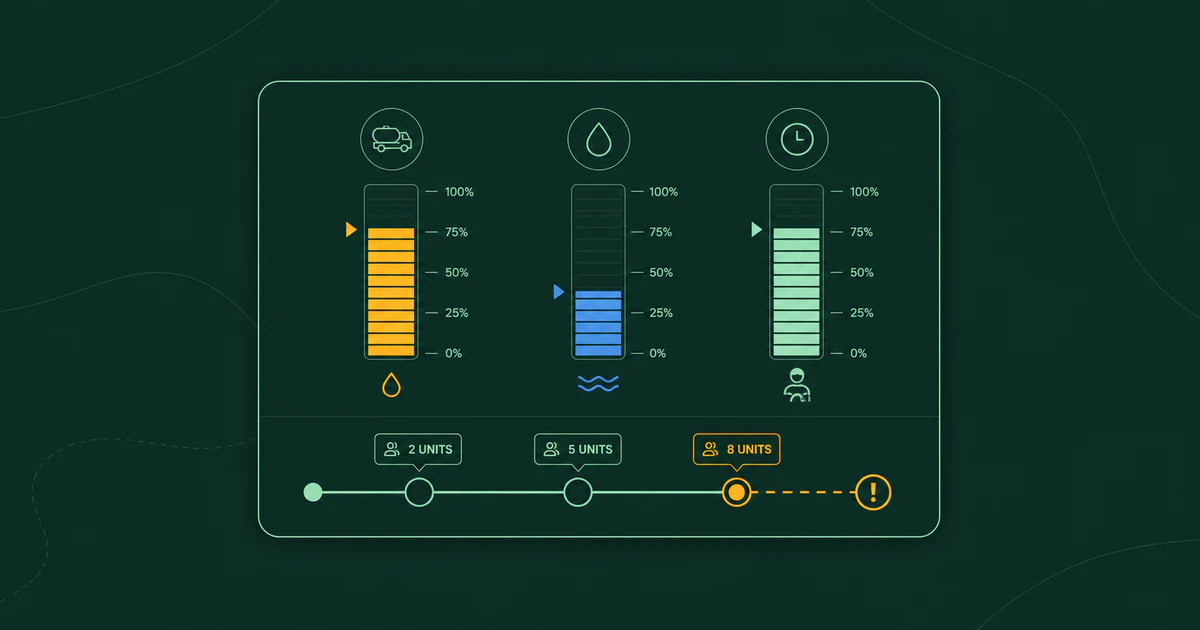
A ready stop still needs a truck with room, and the arithmetic runs in gallons: the truck's remaining capacity divided by a conservative per-stop estimate says how many more candidates fit before a depot return. Recompute it after every actual pickup, because actuals drift from projections all day, and the drift compounds.
Keep four numbers distinct per stop, because dispatch errors hide in their confusion: the container's capacity (a ceiling), the predicted contents (a forecast), the actual gallons collected (a record), and the truck's remaining room (a live constraint). A 280-gallon container predicted at 200 that yields 240 — invented figures, but three different numbers describing one stop — leaves the truck's plan to absorb the 40-gallon surprise. Trucks in this trade range from vans hauling drums to the 7,000-gallon stainless trailer Coastal runs for its largest customers, so "how many stops fit" is a per-truck answer, never a fleet constant.
The depot return is part of the same math. When the tank approaches full, the return trip is a planned stop with its own time cost, and the question of one more restaurant versus heading in is the same second-trip test every collection fleet runs.
The theft call and the overflow call
Treat a theft or overflow callout like an emergency job insertion: verify it, size it, and assign it to the truck that can absorb it without breaking a committed pickup. Oil theft is a real economics problem: the same commodity price that pays your rebates makes an unlocked bin worth a thief's evening. The dispatch response has two halves: service the site, and capture evidence.
The triage order keeps it sane. First, confirm what actually happened: a missing lid and a drained bin are different events with different urgency, and a driver photo settles it faster than a phone description. Second, decide the routing cost honestly: which truck can reach the site inside its access window, with capacity to take whatever remains, at the smallest disruption to promised stops? Sometimes the answer is the nearest truck; often it is the truck whose afternoon has slack. Third, document the visit like it may be contested later, because it may: photos, timestamps, gallons recovered, condition of the container. A pattern of theft at one corner of your territory is a route-planning input as much as a security one — timing services earlier in the day or right after weekend nights is a dispatch decision.
The committed-pickup rule holds through all of it. Robbing a promised stop to chase a theft call converts one unhappy account into two. If the day cannot absorb both, the honest move is a called reschedule, not a silent skip.
When a stop changes trucks, its proof rides along
Every reassignment must carry the stop's records with it: which container, expected gallons, the collected actual, photos, timestamps, and which driver serviced it. UCO pays by what left the bin, so a swapped stop with a broken record is a rebate dispute waiting for month-end.
This is where dispatch and the office meet. The rebate math — weights, prices, contamination deductions — has its own article in UCO pickup weights and rebate records; dispatch's job is making sure the inputs exist no matter how the day was rearranged. The per-stop record is the unit of truth: if truck 2 finished what truck 1 started, the record shows both, with each truck's gallons, and the office never has to reconstruct a route from memory.
In DynoRoute, that record-keeping is the default rather than the discipline: every stop carries its container and capacity fields, drivers log each service with timestamped, geotagged photo proof, and when a job moves between trucks — the AI dispatcher recommends the swap by capacity, location, and availability, and flags travel-impossible ones before they happen — the stop's records move with it. Container and asset tracking keeps the answer to "where is that 280-gallon bin" current, and recurring service schedules hold each account's cadence without a spreadsheet rebuild. You can also set up an AI agent on your own triggers — one that watches the low-fill and overflow patterns behind this article's metrics and flags the accounts drifting.
The dispatch metrics that expose waste
Six numbers tell you whether UCO dispatch is working: pickups that arrive to low or empty containers, overflows and theft losses, skipped or unlogged stops, gallons collected per route mile, truck capacity utilization at day's end, and unplanned mid-day swaps. The first two move against each other — early pickups fall as late ones rise — which is exactly why both stay on the board.
Run them for each truck, week by week, and the story tells itself: rising low-fill pickups mean your projections or cadences are stale; rising overflows mean the safety margin is too thin or the season shifted; gallons per mile falling while stop counts hold means the territory is diluting. Each is a dispatch decision waiting to be re-made. In this trade, dispatch quality is measurable in oil.
If your dispatch board is a cadence list and a memory, get started with DynoRoute — put your accounts, containers, and measured yields into one system, and send trucks to oil instead of addresses.