Key takeaways
- A day's stop count is capacity cycles: how many loads the truck can collect, times the stops per load, minus the time every disposal loop consumes.
- Dump-run time is five parts: travel from the last stop, gate and scale queue, unload, cleanup and paperwork, and travel to the next stop. Budget all five or the afternoon pays the difference.
- Dump-run cost is time cost plus mileage cost plus the tip fee, and published tip fees range from under $40 to over $180 per ton depending on the facility.
- Keep a written record per facility: accepted materials, hours and last intake, fee basis and minimums, typical queue by day, permits, and a fallback site.
- The cheapest facility is decided by total route cost (time, miles, fee, queue, rejection risk), not by the lowest fee or the shortest drive.
- One added stop can trigger an entire extra disposal trip. Price the marginal stop against that trip, not against its drive minutes.
- Log actual disposal timestamps and scale tickets; they recalibrate queue buffers and fill estimates better than any assumption.
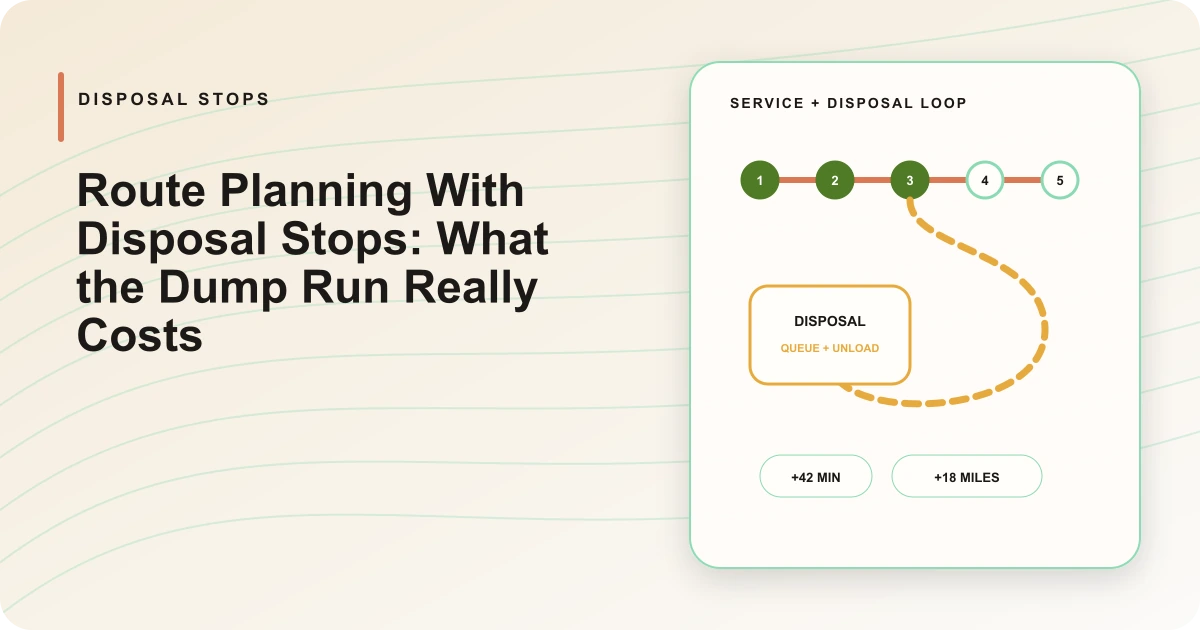
Planning routes with disposal stops means treating every dump or offload as a stop the route pays for: a leg out, a queue, an unload, cleanup, and a leg back, plus the tip fee. Build those trips into the plan and the day holds; discover them mid-route and the last stops slide to tomorrow. The working method is capacity-based planning with the disposal trip as a scheduled node, placed before the truck hits its limit, at a facility chosen on total cost rather than nearest gate. That placement problem is half of what DynoRoute's capacity-based routing exists to solve for fleets that fill up or empty out.
You know the version of this day that goes wrong: the truck fills two stops early, the driver picks the nearest facility from memory, the queue runs long, and a route that looked comfortable at 7 a.m. hands three customers to tomorrow. I build routing software for these fleets — pricing is public — and the disposal leg is where operators tell me their planned day and their actual day part company. What follows is the arithmetic that closes the gap.
Stops per day is really loads per day
A route's realistic stop count is capacity cycles times stops per cycle, minus the time disposal consumes. One cycle is: collect until the truck approaches its limit, drive to disposal, unload, return, resume. A day holds as many cycles as the clock allows, and every cycle's disposal loop is subtracted from stop time.
That framing explains why adding disposal to the plan changes the answer so much. Route Optimization Consultants' audit of residential routes treats dump count as the factor that often limits added workload, and caps a standard route at two dumps in eight hours or three in ten. Those are consultant benchmarks for curbside collection, but the structure transfers to any trade: the day is built from loads, and loads are separated by disposal loops. The same audit flags dump waits over 20 minutes and disposal more than 15 miles from the route as conditions that pull a route below standard performance, which is a consultant's way of saying the loop, not the stop list, sets the ceiling.
Routing engines that handle waste model exactly this cycle. HERE's waste tour planning documentation sends the full truck to a dumping site modeled as a reload location with a fixed service duration, resumes the tour afterward, and requires the route to end by offloading whatever remains. The dump is a stop with a duration, not a gap between stops.
The five-part time cost of a dump run
Budget every disposal trip as five segments: travel from the last stop, gate and scale queue, unload, cleanup and paperwork, and travel to the next stop or the yard. The formula is plain:
dump-run time = travel out + queue + unload + cleanup/paperwork + travel back
There is no defensible national average for that total — facility geometry, queue patterns, material, and where the route sits relative to the gate dominate it — so the honest number comes from your own history at each facility. As a worked illustration only: 25 minutes out, a 30-minute queue, 20 minutes to unload and clean up, 25 minutes back is a 100-minute loop. Two of those in a day is more than three hours of route time that collects nothing, which is exactly why the loop belongs in the plan and not in the driver's improvisation.
The money version adds three lines:
dump-run cost = (crew and truck hourly cost × loop hours) + (round-trip miles × cost per mile) + tip fee
The first two terms are your own numbers. The third is published, and it moves more than most operators expect — the next section's fee spread is the argument for shopping facilities deliberately.
What belongs on every facility's record
Each disposal or receiving site your fleet uses should carry a written record: accepted materials, hours and last-intake cutoff, fee basis with minimums and the date you checked it, your permit or account status, typical queue by weekday, unload procedure, and a named fallback facility. If those facts live in a driver's memory, your route plan inherits that driver's day off.
Fees earn their column. Published rates at the time of the cited schedules: Fairfax County's FY2027 commercial solid-waste rate is $98 per ton; Key West lists a $182.34 per ton tipping fee; Washington County, Utah proposed $37.15 per ton for commercial MSW, $32 for C&D, $77.59 for slurry, and $8.56 per cubic yard at its transfer station; Seattle publishes material-specific transfer rates with minimums. Those four schedules span nearly five-fold on a ton of waste, and every one of them changes on its own calendar, so record the rate per material with a checked-on date, and reconfirm before you build economics on it.
Acceptance is the other line fleets learn the hard way. A facility being open does not mean your load is welcome: receiving programs control what arrives by permit and paperwork, per EPA's guidance on truck-hauled waste, and a load refused at the gate converts your cheapest facility into your most expensive afternoon. Material match, account status, and cutoff time sit on the record so dispatch checks them before the truck rolls, not after. For grease and septage fleets, the compliance half of this record — manifests riding with multi-stop loads — is covered in scheduling grease routes around disposal sites.
Which facility is actually cheapest for this route?
Pick the facility by total route cost: loop time at your hourly cost, round-trip miles, the tip fee for this material, queue risk, and rejection risk. The nearest gate and the lowest fee are both one-variable answers to a five-variable question.
Run the comparison with the formula above, one line per candidate facility, and let an invented example show the shape (swap in your own figures). A close facility 12 miles out with a $98-per-ton fee and a 40-minute Friday queue, against a farther one 22 miles out at $37 per ton with a 10-minute queue: on a 4-ton load, the fee difference is $244 in the far facility's favor, against roughly 20 extra round-trip miles and, with the shorter queue, a loop that may cost no extra time at all. Some days the math flips: a tight cutoff makes the near gate the only feasible gate, or the cheap facility doesn't take this material. The point of the facility record is that dispatch runs this comparison in a minute, per route, instead of the fleet defaulting to habit.
A farther facility is worth it only when its fee, queue, and acceptance advantages clear the added travel and still fit the day's clock. That is a route-planning decision, which is why facility choice belongs in route optimization rather than in the cab.
The stop that triggers a whole extra trip
Marginal cost in collection work is discontinuous: most added stops cost their minutes, but the stop that pushes the load past the truck's limit costs an entire additional disposal loop. Price that stop against the loop, not against its drive time.
Illustration with round numbers. A truck's plan ends the day at 95% of its safe limit. Sales books one more 300-gallon account on the route corridor — two minutes of deviation, easy yes. Except 300 gallons doesn't fit in the remaining 5%, so the plan now needs a second disposal loop: the 100-minute example above plus a $150 fee, spent to serve one $180 stop. The corridor logic that makes on-route stops nearly free — the logic in our route density guide — reverses completely at the capacity boundary.
The operational answer isn't "refuse the stop." It's to see the boundary before quoting: move the stop to the emptier truck, slot it after the planned dump, or book it for tomorrow's fuller route. Any of those beats discovering the extra loop at 2 p.m. And when the stop is worth a dedicated trip, price it like one.
Closing the loop: actual dump trips teach the next plan
Every disposal trip your fleet runs produces three numbers worth keeping: the timestamped loop duration, the queue you actually sat, and the scale ticket's weight or gallons. Logged per facility and per weekday, they turn next week's queue buffer and fill estimates from guesses into medians.
The recalibration is mechanical. Loop durations by weekday replace the flat 30-minute assumption with "Tuesdays run 20, Fridays run 50." Scale tickets against planned loads sharpen per-stop estimates, which tightens where the dump lands in the route. Fee receipts keep the facility records current without a phone-around. None of this needs new hardware; it needs the numbers your trucks already generate to land somewhere a planner can read them.
That landing place is what DynoRoute provides. Disposal returns are planned into the route, placed before the truck hits the fill limit you set per truck, rather than improvised mid-day. Facilities live on records with their hours and rules, drivers log each stop and unload with timestamped, geotagged photo proof, and dispatch analytics report utilization and route density per truck. The loop durations and planned-versus-actual gaps in this article come straight out of those timestamped records — DynoRoute keeps the record; the recalibrating stays yours, with the numbers finally in one place. When a same-day job threatens to trigger the extra trip, the AI dispatcher flags the conflict and recommends the truck that can take it with confidence scored.
If your disposal runs still live in drivers' heads and a fee sheet from last year, get started with DynoRoute — put the facilities on record, set each truck's fill limit, and let the plan carry the dump run instead of the afternoon absorbing it.