Key takeaways
- One limit usually ends the route first: tank gallons, hopper yards, payload pounds, an axle rating, container slots, or the driver's clock. Name it per truck and plan in that unit.
- Estimate every stop from the best number you have: last actual, then contracted quantity, then forecast, then a conservative fallback — and add loads cumulatively, because averages hide the big stop.
- Size your buffer from your own overruns, the routes where the actual load came in above the projection. The 85–90% pack-out figure is a consultant benchmark; your logged overruns should set the number.
- A second trip must clear one inequality: time now + remaining service + travel to disposal + queue/unload + continuation + return, all inside the route deadline.
- Put the unload before the first stop that no longer fits, and confirm the facility's hours and queue before you count on it.
- Never convert gallons to pounds without a documented density for your actual material; that shortcut is how a half-empty-looking truck goes overweight.
- A same-day job gets its answer from five quick checks: material, capacity, time, facility, reassignment.
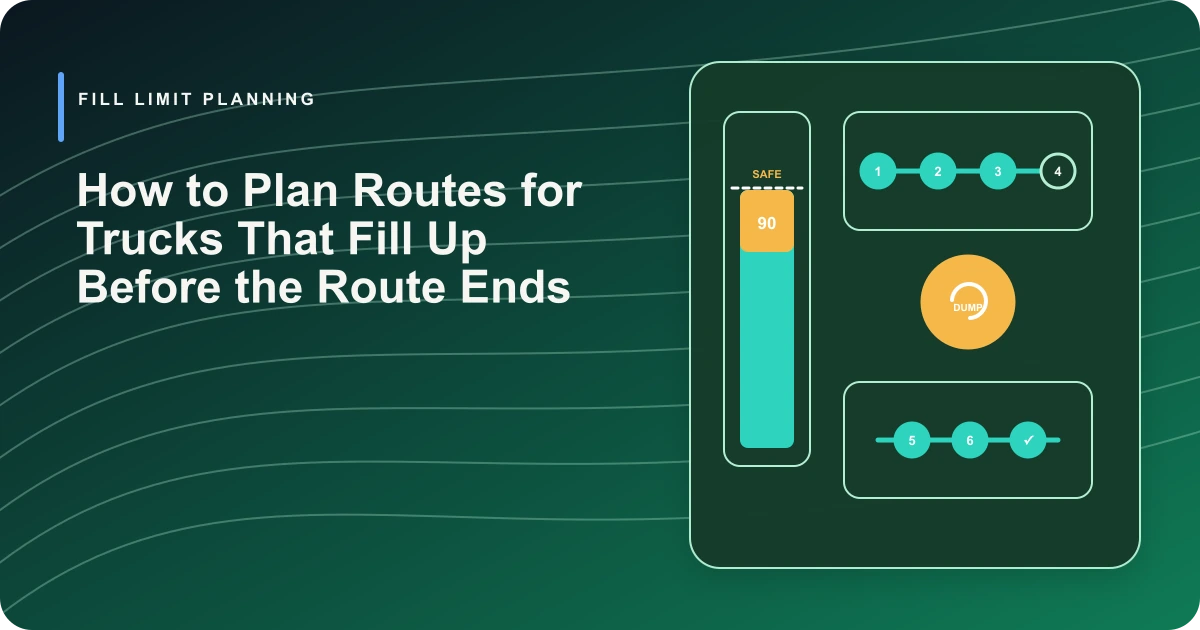
A truck that fills before the route ends turns a plan into improvisation: the driver freelances a dump run, the last stops slide to tomorrow, and the phone starts ringing. Planning routes around truck capacity means making four calls before the day starts: the binding limit, the per-stop load, the buffer, and whether a second trip fits the clock. This article is the operating math for those calls. Fleets that fill up or empty out mid-route are the operating pattern DynoRoute's capacity-based routing is built around (pricing is public) — I build that software, and I've spent this year on calls with the dispatchers who plan these days from spreadsheets and memory; what follows is the math the good ones already carry in their heads. For the definition of capacity-based planning and each trade's units, start with our capacity-based route planning guide.
Which limit will end the route first?
Every truck carries several rated limits, and on any given route one of them usually becomes binding first: tank or hopper volume, payload weight, a single axle's rating, container slots, or the driver's legal clock. Limits can tie or interact — a dense material can put an axle over before the tank looks full — but the route still ends on whichever gives out first. Capacity planning starts by naming that binding limit for each truck on each route pattern, then planning the whole day in that unit.
The hardware shows why you can't assume. Guzzler's Classic industrial vacuum line runs debris bodies from 12 to 21 cubic yards, with 18 standard. KeeVac builds grease-collection packages with tanks from roughly 1,500 to 5,000 gallons. FlowMark's vacuum tank-sizing guide pairs a roughly 33,000-lb GVWR chassis with about a 2,500-gallon tank. Three vacuum trucks, three different units doing the limiting, and every manufacturer number is a ceiling rather than an operating target.
Weight is the limit that hides. A body can be volume-bound on light material and weight-bound the same week on dense material, and a tank that looks half-full can already have an axle over its rating depending on where the load sits. So one rule with no exceptions: never convert gallons to pounds without a documented density for your actual material. Septage, brown grease, drilling mud, and wash water weigh different amounts per gallon, and a conversion borrowed from someone else's waste stream is how a legal-looking plan meets a scale. Routing software plans against the limits you give it; it does not weigh your truck. Scale tickets and your state's axle rules are the ground truth.
Finding the binding limit takes one look at history. Pull a month of route endings per truck. Routes that end because the body or tank is full mean you're volume-bound. Routes that end on scale tickets or axle math mean weight-bound. Trucks that come home with capacity to spare mean the clock is your binding limit, and the fix is route density, not a bigger tank.
Put a number on every stop before wheels roll
Estimate each stop's load from the best number available, in strict order: the last actual amount collected there, then the contracted quantity, then a forecast from that stop's history, and only then a conservative default. Accumulate the estimates in service order, because a route average hides the one 1,500-gallon stop that fills the truck by 10 a.m.
Your own pump-off and scale history beats any rated container size as a predictor. Where history is thin, the container sets the ceiling: a grease trap can't give you more than it holds, which is why knowing grease trap sizes and capacities cold turns an unknown stop into a bounded one. A nominally full 1,500-gallon trap is at most a 1,500-gallon stop — rated capacity is a ceiling, not a pump-off guarantee, and your own collection history tells you how close real visits run to it.
Cart routes carry a special trap. A thread on r/GarbageTruck asks how many 96-gallon carts fit in a 28-yard body, and the naive arithmetic is worth dissecting because it fails in a way that teaches. Divide 28 cubic yards by the roughly half cubic yard a 96-gallon cart holds and you get about 59 carts, a number any residential driver will laugh at. The cart holds loose waste and the body holds compacted waste, so the real count runs far higher and depends on material and packer. The cart's volume and the body's volume measure different states of the same waste. On cart routes, the honest per-stop number comes from measured history, carts serviced per full body or scale tickets per route, never from container arithmetic.
Whatever estimate you use, log the actual next to it at every stop. That planned-versus-actual delta is the raw material for the next decision.
A buffer sized from your own overruns
The right capacity buffer is an uncertainty reserve sized from your own overruns — the routes where the actual load came in above the projection. Route Optimization Consultants plans residential routes to 85–90% pack-out because set-out weight fluctuates; treat that as a consultant benchmark to test your own numbers against rather than a universal rule.
The method takes an evening. For each of your last 20 or 30 routes, take the overrun: actual end-of-route load minus projected, floored at zero, in the truck's binding unit. Only the overruns matter here — in an average miss, the routes you over-estimated cancel the routes you under-estimated, and the number that comes out hides exactly the days that filled a truck early. Sort the overruns and set the reserve at the 80th percentile; use the 90th where an overflow is expensive. Residual load — whatever is still in the tank or body from a partial dump or yesterday's last run — belongs in the onboard actual that the arithmetic below subtracts, not in the reserve. Count it in both places and you pay for the same gallons twice.
Two lines of arithmetic turn the buffer into a plan:
remaining usable capacity = safe operating limit − onboard actual
stops until full = remaining usable capacity ÷ conservative per-stop demand, rounded down
The safe operating limit is nameplate capacity minus the uncertainty reserve, in the binding unit from the first section. And on mixed routes, run the cumulative total in service order; dividing by an average breaks the moment stop sizes vary.
The percentile is where consequence enters. An overfull hopper means a callback. An overfilled grease tank means a spill and paperwork. Regulated waste is worse. The more expensive the overflow, the higher up the overrun distribution the reserve should sit.
A buffer tells you when the truck fills. It says nothing about whether the day survives the trip to empty it. That takes an equation.
The second-trip equation: when does the day break?
A second trip is feasible only when the whole loop fits the clock, and the test is a single inequality:
time now + remaining service + travel to disposal + queue/unload + continuation + return ≤ route deadline
The fill gauge only warns you a dump is coming; whether the rest of the day fits around that dump is what the inequality tests.
The terms are plain. Remaining service is the time to finish the stops the current load can still take. Continuation is the route you'll run after unloading. Return is the leg home. The route deadline is the earliest of three clocks: the disposal facility's last-load cutoff, your customer time windows, and the driver's legal limit, which under federal hours-of-service rules is 11 driving hours inside a 14-hour window after 10 consecutive hours off, where federal HOS applies. Many local operations run intrastate under state rules instead, so know which clock governs your trucks.
Here is the mechanics on an invented day; the numbers are illustrative, so rerun them with yours. It's 11:30 a.m. The truck reaches its safe limit after two more stops, 40 minutes of service. Disposal is 35 minutes away, the queue and unload typically take 45, the remaining route after returning runs 2 hours 10 minutes, and the run back to the yard is 30. Total: 4 hours 40 minutes. The day closes at 4:10 p.m. against a 5:00 p.m. deadline, so the second trip fits with 50 minutes of slack. Now rerun the same day on a Friday afternoon when the queue stretches to 90 minutes. The day closes at 4:55, with five minutes of slack, one slow gate or one heavy stop from breaking. The right move, cutting two stops from the continuation or pushing them to tomorrow, gets made at 11:30 while the truck is still working — not discovered at 4:50.
The same arithmetic explains why the Route Optimization Consultants audit caps a standard residential route at two dumps in eight hours or three in ten. Those are consultant benchmarks rather than laws, but the logic is the equation's: every disposal loop consumes an hour or more that stops can never get back. On grease routes, how many grease trap jobs fit in a working day walks through the day-count version of this same math.
Matching a job to a truck with room aboard is the easy half of dispatch; the hard half is catching that the truck with room can't make the disposal loop and still finish its route. That is the travel-impossible assignment DynoRoute's AI dispatcher flags before it ever reaches the schedule.
Place the unload before the first stop that no longer fits
Walk the route in service order, accumulating projected load, and slot the unload ahead of the first stop that would push the truck past its safe operating limit. Then verify the facility can actually receive you there: open hours, last-load cutoff, accepted materials, and a queue that fits the equation above.
Trigger the unload when the next stop no longer fits, which arrives earlier than "the truck is full." Waiting for full means the decision happens in the cab instead of on the plan, and drivers under time pressure pick the nearest gate, whatever it costs the rest of the route.
Facilities are the constraint operators forget to model. A dump planned against a closed gate is a broken day, and queue times swing by weekday and hour at many sites. Sometimes the right placement is earlier than the math strictly demands: when the facility sits between two stop clusters, unloading at 70% on the way through beats a 95% dump with a deadhead across town. Placement is a drive-time problem as much as a capacity problem, which is where route optimization meets the fill limit.
None of this is exotic. HERE's waste tour-planning model sends a full truck to unload and resumes collection afterward as a standard, modeled pattern. If your current tool can't represent a mid-route return, the route on paper isn't the day your drivers actually run.
The same-day job test: accept, reassign, or decline in five checks
When a customer calls at 11:40 wanting service today, the answer comes from five checks run against live numbers: material, capacity, time, facility, reassignment. Pass all five and take the job. Fail one and the answer is a different truck, a different day, or a polite no, delivered in minutes instead of discovered at 4 p.m.
- Material. Does the job match what's already aboard and what the planned facility accepts? A load your disposal site won't take is a second trip in disguise.
- Capacity. Is remaining usable capacity, safe limit minus onboard, at least the job's estimated load, using the estimate order from earlier?
- Time. Drop the job into the second-trip inequality. Does the day still close before the deadline?
- Facility. Does the addition force an extra disposal loop, and is the facility open and accepting when that loop would land?
- Reassignment. Is there another truck where checks 1 through 4 pass with more slack? The first truck with room aboard isn't automatically the right truck.
Five checks on paper. In a live morning it's five checks times every truck on the board, with the phone still ringing, and that is why this method survives in software and dies in a spreadsheet. It's the job DynoRoute was built for: each truck carries the fill limits you set in its own units, gallons, pounds, yards, or container slots; recurring routes get planned with the disposal return inside the route; and when the same-day call comes, the AI dispatcher recommends the truck by capacity, location, and availability, scores its own confidence, and flags the double-booking or the travel-impossible day before it hits the schedule. Jobs cancel or run late, and dispatch agents re-plan around them. Drivers confirm every stop with photo proof from the app, and dispatch analytics report utilization — how much of each day's capacity you actually used.
Frequently asked questions
How do I find which limit ends a route first?
Pull a month of route endings per truck. Routes that end with a full body or tank mean you are volume-bound; routes that end on scale tickets or axle math mean weight-bound; trucks that come home with capacity to spare mean the clock is the binding limit — and the fix is route density, not a bigger tank.
How big should the capacity buffer be?
Size it from your own overruns: for each of your last 20 or 30 routes, take the actual load minus projected, floored at zero, in the binding unit, and set the reserve at the 80th percentile of those overruns — the 90th where an overflow is expensive. Keep residual load in the onboard actual, not in the reserve, or you count the same gallons twice.
When does a second trip fit the day?
When one inequality clears: time now + remaining service + travel to disposal + queue/unload + continuation + return, all inside the route deadline — the earliest of the facility's last-load cutoff, your customer windows, and the driver's legal clock.
Where should the mid-route unload go?
Ahead of the first stop that would push the truck past its safe operating limit, which arrives earlier than "the truck is full." Sometimes earlier still: when the facility sits between two stop clusters, unloading at 70% on the way through beats a 95% dump with a deadhead across town.
Can I convert gallons to pounds to check weight?
Only with a documented density for your actual material. Septage, brown grease, drilling mud, and wash water weigh different amounts per gallon, and a conversion borrowed from someone else's waste stream is how a legal-looking plan meets a scale.
If your dispatcher is carrying this math in their head, get started with DynoRoute and hand it to the software. The limits stay yours. The arithmetic stops being a memory job.