Last updated: July 18, 2026 · By Riddhi, Founder at DynoRoute
Key takeaways
- Most operators service 6–10 grease traps per day and generate $800–1,500 in daily revenue per truck.
- Your own number is set by whichever ceiling hits first: the tank, the clock, or the disposal run.
- Small indoor traps (20–50 gallons) barely dent a tank, so those days are limited by service minutes and drive time.
- Large interceptors are tank math: two 1,000-gallon units fill a 2,500-gallon truck before lunch.
- Plan one to two hours for a standard restaurant stop; published service times run from about 20 minutes to 2–4 hours by trap size.
- Disposal runs pay nothing but consume stop time; count one every time the day crosses a tank-full moment.
- A month of your own stop counts, gallons, and durations beats every industry average.
Most vacuum truck operators service 6 to 10 grease traps per day, generating $800–1,500 in daily revenue per truck — the only stops-per-day figure published anywhere in the trade (Grease Trap Locator's business guide). Where your trucks land inside that range, or outside it, depends on the mix of small indoor traps and large interceptors on the day's list, the size of the tank collecting them, and how many disposal runs the day forces. Planning the route decides how much of that ceiling you reach, and dispatch decides how much survives the actual day. This article covers the layer underneath both: the capacity arithmetic.
You've probably hit the gap this page fills. You're pricing a contract with forty traps scattered across the metro, or deciding whether the next truck earns its payment, or looking at a schedule that promised twelve stops on a day the truck came home after seven. Manufacturers publish tank sizes, cost guides publish per-trap prices, and the number you need sits unstated between them.
I build route planning software for vacuum-truck fleets, and I've spent this year on calls with the operators who run them. What follows is the arithmetic those operators carry in their heads, worked out step by step with the published numbers attached.
What Makes a Daily Trap Count So Hard to Pin Down
Most service trades can quote a stops-per-day number and stand behind it. Grease trap pumping can't, because every stop subtracts from what the truck can still carry, and the subtraction varies by a factor of twenty between an under-sink trap and a grease interceptor. An operations lead at a national grease-trap and used-oil collection company summed up the whole category on a call with me: it's "easy to find routing software to drop stuff off," harder to find it for picking things up, and hardest of all when the material builds at a rate nobody measures.
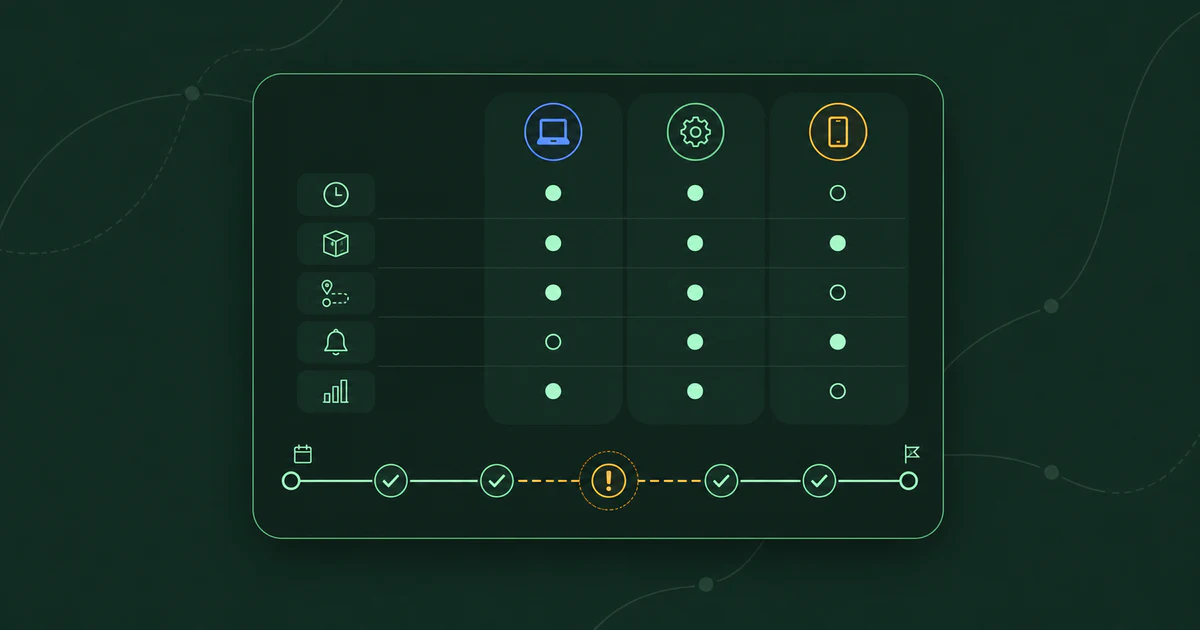
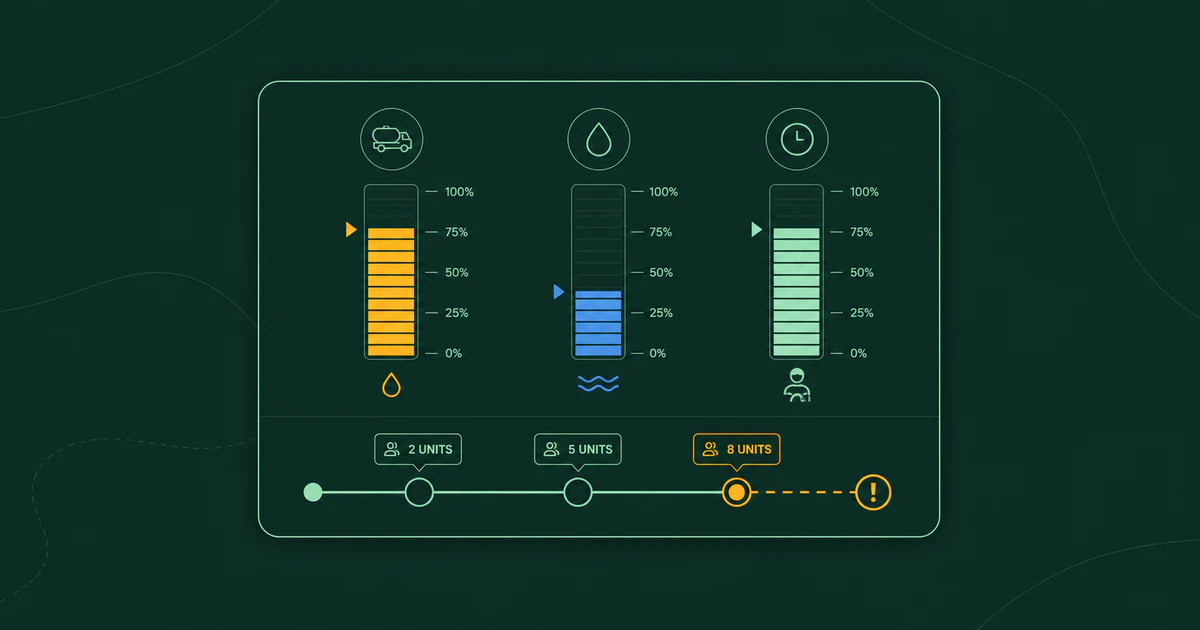
Three ceilings compete to end a pumping day, and the lowest one wins:
The tank. Dedicated grease trap truck packages run from 1,500 to 5,000 gallons (KeeVac). Every stop deposits its contents against that limit, and a full truck services nobody.
The clock. Each stop takes real time — pumping the full contents, scraping the baffles, inspecting, writing the service record — before any driving happens.
The disposal run. The tank only resets at a receiving facility, and the facility is wherever it is, keeping its own hours.
A day of small indoor traps never touches the tank ceiling and lives entirely under the clock. A day of 1,000-gallon interceptors barely notices the clock and hits the tank ceiling by mid-morning. That's why the honest answer to "how many traps per day" is a short method with four parts.
Key Aspects to Consider When Estimating Traps Serviced Per Day
Work four checks in order: count stops until the tank is full, budget service minutes per stop, place the disposal runs, then replace every estimate with your own recorded numbers.
Counting Stops Until the Tank Is Full
Divide usable tank capacity by expected gallons per stop; that quotient is your tank-limited stop count, and on interceptor-heavy days it is almost always smaller than the clock allows. A pump-out takes everything in the vessel, water included, since the full contents get transferred to the truck's tank before the trap is scraped and inspected. A 1,000-gallon interceptor is roughly 1,000 gallons against your limit.
The table below runs that division on common truck sizes. The numbers are rounded and illustrative; your own trap list will change them.
| Truck tank | 1,000-gal interceptors only | 50-gal indoor traps only | Mixed day: interceptors + indoor |
|---|---|---|---|
| 1,500 gal | 1 stop | 30 stops | 1 + 10 |
| 2,500 gal | 2 stops | 50 stops | 2 + 10 |
| 3,500 gal | 3 stops | 70 stops | 2 + 30 |
| 5,000 gal | 5 stops | 100 stops | 4 + 20 |
Two corrections before you trust any row. First, chassis limits are real: a small F550-class truck carries around 1,000 gallons, a 33,000 GVW chassis around 2,500, and a truck kept under the 26,000-pound GVW CDL threshold generally can't carry a tank much over 1,600 gallons (FlowMark's sizing guide). Second, working operators don't plan to the brim. The grease-collection operator I interviewed plans routes to roughly 80% of tank capacity and three-quarters of driver hours so the day can absorb a surprise; derate the table the same way before you quote anyone a schedule.
The indoor-only column is a fantasy on the road. Nobody strings fifty stops with driving between them, and that's the point: on small-trap days the tank stops being the constraint and hands the day to the clock.
Budgeting Service Time Per Stop
Plan one to two hours for a standard restaurant stop, then correct by size: published service times run from about 20 minutes for a small indoor trap to 2–4 hours with two workers on a 5,000-gallon unit (Greasecycle's pricing guide). The stop is more than suction. The contents come out, the walls and baffles get scraped, the trap gets inspected, and every service needs a written record, so the minutes are earned rather than padded.
Run that clock against an 8-hour day and the published 6–10 range explains itself. Ten stops fit only when most of them are fast indoor traps. A day of interceptors at two-plus hours each caps near four services even when the tank could hold five. The same operations lead at the national collector runs this arithmetic on his used-oil side: 4,000-gallon trucks, optimized to collect about 4,400 gallons across a 9-hour day (more than one tankful, which is what the offload run is for), landing around six stops. Different liquid, same shape of day.
Fitting Disposal Runs Into the Count
A disposal run is a stop that pays nothing, and any day that fills the tank contains at least one. When the truck hits capacity mid-route, the dump run lands in the middle of the working day, and its round-trip drive plus unload time comes straight out of the stop count. The 2,500-gallon truck in the table doesn't service four interceptors in a day; it services two, drives to the facility, and services two more only if the hours and the distance cooperate.
Distance decides what the run costs. The receiving facility is not always your yard: the used-oil side of that same national collector offloads at rail spurs sitting up to an hour from the branch, and routing software they had tried assumed home base and offload were the same place. Every mile between the last full stop and the facility is unpaid driving, twice. Building disposal returns into the route design is its own subject; for counting purposes, treat each run as one more stop with a duration you've measured.
Reading Your Own Numbers
Track three numbers per truck for a month — stops completed, gallons pumped, minutes on site — and your real traps-per-day figure appears without any industry average. The published 6–10 becomes a sanity check instead of a plan.
Expected gallons per stop is the input that drifts. The grease-collection operator corrects it constantly: when a stop that should yield 1,000 pounds of material gives 500, the estimate was off, and so was every tank calculation built on it. Durations drift the same way; the interceptor with the corroded lid takes forty minutes longer than its twin across town. A stops-per-day forecast is only as good as the per-stop numbers underneath it, and those come from records, not memory. Dispatching from those records is what keeps the count honest once the day starts moving.
The Numbers Behind a Truck's Daily Ceiling
The published economics stack up like this: most operators service 6–10 traps daily and gross $800–1,500 per truck, with small under-sink traps (20–50 gallons) commanding $100–150 per cleaning, large in-ground interceptors (1,000+ gallons) at $300–500, and hourly work averaging $75–125 (Grease Trap Locator).
Put those per-trap prices against the capacity table and the daily range stops looking arbitrary. Six interceptors at $300–500 would gross $1,800–3,000, but no 2,500-gallon truck completes six interceptors in a day; the tank forbids it. Using round numbers as an illustration: a mixed day of two interceptors ($600–1,000) plus four indoor traps ($400–600) bills $1,000–1,600 with one disposal run included, which is the published daily range derived from capacity. The revenue figure is what the tank arithmetic produces on a realistic trap list.
The septic side cross-checks it. A medium-capacity septic truck completes 4–6 residential jobs per day at an average ticket of $300–400 (Satellite Industries): fewer, bigger stops, same tank-first logic.
What this section leaves out on purpose is route economics — cost per stop, route density, and what a full week's plan earns are covered in the numbers section of the route planning guide. The daily count is the input; the route plan is where it turns into margin.
Choosing Software That Counts Against the Tank
A stops-per-day forecast lives or dies on whether your tools know the tank exists. Generic route optimization plans miles and minutes; a pumping fleet needs the gallons planned alongside them. Evaluate any tool against this list:
- Fill limits per truck — routes built against what each tank actually holds
- Expected volume per stop — trap size and typical gallons attached to every customer
- Over-capacity stops flagged — the stop that won't fit surfaces before the driver finds out
- Recurring cadences — weekly, biweekly, and monthly service that builds the day automatically
- Stop-level actuals — gallons, minutes, and photos captured at the stop, feeding next month's estimates
DynoRoute was built for exactly this arithmetic. Set each truck's fill limit and each customer's expected volume and service frequency, and it plans recurring routes that respect the tank, flags any stop that would push a truck past its limit, and captures gallons and photo proof per stop through the driver app, so next month's plan runs on actuals. Flat monthly plans are quoted for your operation, and you can load your own trap list and see what a week's realistic count looks like.
Frequently Asked Questions
(Google's People Also Ask panel could not be captured for this query today; the questions below come from search demand data.)
How long does it take to pump a grease trap?
Published service times run from about 20 minutes for a small indoor trap to 2–4 hours with two workers on a 5,000-gallon unit (Greasecycle). A standard restaurant stop lands between those poles; budgeting one to two hours including setup and records keeps a schedule honest.
How many gallons does a grease trap truck hold?
Dedicated grease trap truck packages run from 1,500 to 5,000 gallons (KeeVac). Chassis weight sets the practical limit: an F550-class truck carries around 1,000 gallons, a 33,000 GVW chassis around 2,500, and a truck kept under the 26,000-pound GVW CDL threshold generally tops out near a 1,600-gallon tank (FlowMark).
How much revenue does a grease trap truck generate per day?
The published figure is $800–1,500 per truck per day at 6–10 traps serviced (Grease Trap Locator), built from small traps at $100–150 and large interceptors at $300–500 per cleaning. Trap mix moves the number more than stop count does: two interceptors can out-bill six under-sink traps.
How many septic tanks can a vacuum truck pump per day?
A medium-capacity septic truck typically completes 4–6 residential jobs per day at an average ticket of $300–400 (Satellite Industries). Septic loads run larger per stop than most grease traps, so the tank fills in fewer stops and disposal runs anchor the day even harder.