Key takeaways
- Every waste oil account can carry its own pickup date once you know the tank size, a safe threshold, and how fast that shop actually generates oil.
- You compute a latest safe pickup date by projecting the tank's current volume forward at its measured fill rate, then stepping back by a buffer for forecast error and site access.
- Garages, dealerships, and fleet shops fill at genuinely different speeds, so accounts are segmented by measured activity rather than by an assumed per-bay average.
- Fixed cadences fit stable accounts and forecast-driven dates fit variable ones, and the right answer is chosen per account rather than fleet-wide.
- Whether a stop pays you or costs you depends on the oil's market value, its contamination, and how close the stop sits to the rest of the route.
- Federal used-oil rules put labeling duties on generators and EPA ID numbers plus a three-year acceptance-and-delivery record trail on transporters, and state programs, local transporter permits, and contracts can all go stricter.
Waste oil pickup scheduling works when each account's pickup is timed to its tank's fill cycle instead of a fixed calendar slot. My day job is building DynoRoute, capacity-based routing and dispatch software for waste oil fleets and other liquid-waste haulers — most of what follows comes from a year of interviews with the collectors who run these routes, and pricing is public. Every garage, dealership, and fleet shop fills its tank at a different speed, so a universal monthly route overflows your busiest accounts while burning stops on quarter-full tanks. The fix is arithmetic: set a safe threshold per tank, forecast daily generation from pickup history, compute the latest date you can safely arrive, and build capacity-feasible routes from the accounts actually approaching threshold, leaving the same-day surprises to dispatch.
Search this phrase and you mostly find pages for garages booking a pickup; the collector's side is barely written down anywhere, which is the gap this guide fills. Where a number is illustrative rather than sourced, I say so.
When should each waste oil tank be picked up?
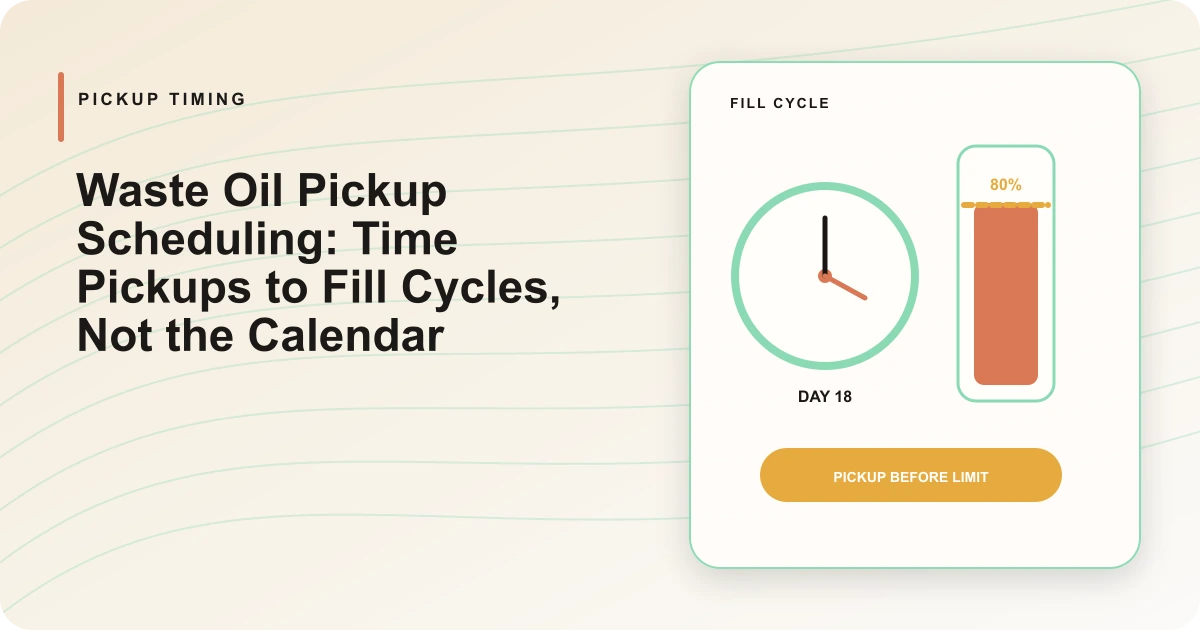
The answer is a date you can compute per account, not a slot on a rotation. You need three inputs: the tank's usable size, a safe threshold below its rim, and a forecast of daily generation. From there, days to threshold = (safe threshold gallons − current gallons) ÷ forecast daily generation. Project that many days forward from the last measurement and you have the date the tank crosses its threshold. Then step back: latest pickup date = projected threshold date − forecast-error and access buffer. The buffer covers forecast error plus access: a hotter month than projected, and the reality that you can only arrive when the shop's gate, dock, or service manager allows it. Size the buffer from your own logged overruns, not from a universal number.
The threshold sits below the rim on purpose. Oil keeps arriving between the day you plan and the day you drive, and the cost of arriving late is an overflowing tank, a spill response, and an account that starts shopping for another collector.
Here is the arithmetic with illustrative numbers. A shop runs a 250-gallon tank with its threshold set at 200 gallons. Your last pickup left it near empty on the 1st, and a level check on the 30th reads 105 gallons, which works out to about 5 gallons per working day. That gives (200 − 105) ÷ 5 = 19 working days to threshold, and with a five-day buffer, the latest safe pickup lands about 14 working days out. Any route through that zone in the next three weeks can carry the stop; the account only forces a dedicated visit once that window closes.
Tank sizes make the stakes concrete. EnergyLogic, a common supplier of shop tanks, sells 80, 250, and 500-gallon models and estimates the 250-gallon single-wall at 2,195 pounds full and the 500-gallon at 4,342. Nobody wheels that outside: once a tank tops out, the oil stops moving until your truck arrives, which is why you schedule on the latest safe date rather than the average interval. Those same gallons then ride in your truck, so per-stop volumes feed your route's capacity math too.
New accounts have no history, so treat the first visit as a measurement event as much as a collection event. Record the tank size, the level you found, and the date; ask roughly how many vehicles the shop services in a week and whether any of it is fleet work; and set a deliberately conservative first interval. After two measured pickups you have a real fill rate, and the account graduates from guesswork to the formula.
How do garage, dealership, and fleet-shop fill cycles differ?
They differ enough that one number for all of them misfires in both directions, so segment accounts by what the shop actually does and let measured pickups correct the segment. FoxInsights, which builds tank-monitoring hardware, puts the core point plainly in its waste oil routing guide: "A garage servicing fleet vehicles generates waste oil at a different rate than one doing retail customers."
The spread is wider than most rate cards assume. In a shop-talk thread on Reddit, a powersports dealer describes generating so little oil that a pickup every six months would do, while the big collectors quoted him pricing that assumed a twelve-bay dealership. One anecdote, but it captures the mismatch: motorcycles drain a couple of quarts each and the season ends in October, while a dealership's lanes drain five quarts a car all year. Fleet shops are different again, filling in steps rather than at a steady rate, because they change oil in batches as trucks cycle through preventive maintenance.
You would expect an industry gallons-per-bay benchmark to settle this; we went looking while researching this guide, and there is no credible national figure. Anyone quoting one is quoting their own book of accounts. The honest method is a starting segment based on activity type, replaced by the account's own measured fill rate within two or three pickups.
Should each account run a fixed cadence or a monitored forecast?
Match the method to the account, using four questions: how much oil value is at stake, how variable the generation is, what an overflow would cost, and how much history you hold. A high-volume dealership that fills predictably deserves a fixed cadence, because a standing biweekly or monthly slot is cheap to run and a forecast adds nothing. A shop whose volume swings with fleet contracts or seasons deserves the latest-safe-date treatment, re-computed after every pickup. Some collectors put third-party level sensors on their largest or riskiest tanks and let readings replace the forecast there; that hardware earns its cost exactly where a surprise would hurt most, and rarely anywhere else.
| Account profile | Scheduling method that fits |
|---|---|
| High volume, steady generation | Fixed weekly, biweekly, or monthly cadence |
| Meaningful volume, variable generation | Fill-rate forecast with a latest safe pickup date |
| Large tank where overflow is costly | Third-party level sensor feeding the schedule |
| Low volume, slow fill | Attached to a zone day, serviced when the truck is already near |
The zone-day row matters, because slow accounts are where calendar scheduling quietly bleeds money. That powersports dealer filling a tank twice a year should never generate a dedicated trip. Assign slow accounts to the day your truck already works their area for the anchor accounts, and serve them whenever their window overlaps that day; a six-month fill cycle leaves a latest-safe-date window weeks wide, so almost any zone day catches it.
However you schedule, some tank will eventually beat its forecast and need a truck this week. Which route absorbs that insertion, and whether today's truck has the capacity and hours for it, is dispatch work; we walk through that decision in dispatching waste oil trucks.
Does this stop pay for itself or cost the route?
Scheduling decides when a stop happens; economics decides whether it should happen at all, and with waste oil that answer can flip sign. Used motor oil is a commodity with a resale market, and in mechanics' discussions of what shops do with it, the recurring observation is that the same shop can be paid for its oil in one market and charged for the pickup in another, depending on oil prices, load quality, and region. Your side of the trade moves with the same variables: the gallons you collect are worth what your downstream outlet pays, minus whatever contamination takes off the top, minus the truck time the stop consumes.
Route density is the lever that turns marginal stops into paying ones. Take an invented pair of stops: a 40-gallon pickup twenty minutes off your route probably costs you money at any oil price, while the same pickup four minutes from an anchor account probably pays, because the incremental truck time approaches zero — rerun the pair with your own gallons and detour times. This makes zone-day logic as much an economic tool as a convenience, and it means the right response to a low-value account is usually re-pricing or re-zoning before dropping it. The full per-stop arithmetic is worked through in our guide to waste oil routes for garages and fleets; the scheduling consequence is simply that a stop's economics set how hard you should work to fit it inside someone else's route day.
What records must follow every pickup?
A scheduled pickup is not finished when the tank is empty; it is finished when the paper trail exists — and the trail has owners. The federal floor is EPA's used oil program, 40 CFR Part 279, and its guide for businesses splits the duties by role: generators must label storage containers and tanks "Used Oil" and use transporters holding a valid EPA ID number, transporters must hold that ID and track what they accept and deliver, and processors and burners carry their own tracking duties at the receiving end. For the transporter, the acceptance record is specific: under 40 CFR 279.46 it carries the providing party's name and address, its EPA ID number where one applies, the quantity, the date of acceptance, and a signature from that party's representative, with the same recorded for each delivery to the receiving facility or transporter, and everything kept at least three years, whether as a log, invoice, or shipping document. A cab note of per-stop gallons is a level reading, not that record. One carve-out matters at the small end: under 40 CFR 279.40, a generator hauling 55 gallons or less of its own oil to a collection center sits outside the transporter subpart, which is why the smallest shops can legally run jugs to a parts store and were never really your accounts. And federal is only the floor: several states run stricter used-oil programs, counties and cities can require their own transporter permits, and your contracts with generators and outlets can demand more than any of them.
The practical rule: the record is born at the stop, not reconstructed at the yard. Each pickup should leave the account's name and address, gallons collected, date, time, driver, destination, and the signature the federal record asks for attached to the account rather than living in a cab notebook. Those same measured gallons are what your fill-rate forecasts feed on, so the compliance record and the scheduling model improve together. The capture methods, from dip readings to photographed meter tickets, are the ones we cover for cooking-oil routes in UCO pickup proof and weights. Good records support your compliance paperwork; no routing system monitors your legal status for you, and you should be suspicious of any that claims to.
Running fill-cycle scheduling in one system
Everything above can run in a spreadsheet, and at a modest account count it genuinely does. What breaks is scale: every added account brings its own tank size, threshold, fill rate, and window, and at some point the arithmetic outgrows a planning sheet and a dispatcher's memory. We built DynoRoute's capacity-based routing for waste oil fleets to carry that load. Recurring schedules hold each account's cadence, weekly, biweekly, or monthly, while per-stop records with custom fields keep the tank size, threshold, and last measured level where your forecast can use them. Planned routes respect each truck's fill limit, with disposal returns built into the route rather than improvised, and the AI dispatcher recommends a truck for each surprise insertion by capacity, location, and availability, with a confidence score, flagging conflicts and travel-impossible assignments before they reach the schedule. Drivers attach timestamped, geotagged photo proof at every stop, so the record really is born there. Your account list arrives by CSV import, and dispatch analytics show which zone days stay dense enough to keep absorbing marginal stops.
If your pickup calendar still treats a twelve-bay dealership and a powersports shop as the same account, tell us what your fleet collects and start scheduling from the tanks instead.