Key takeaways
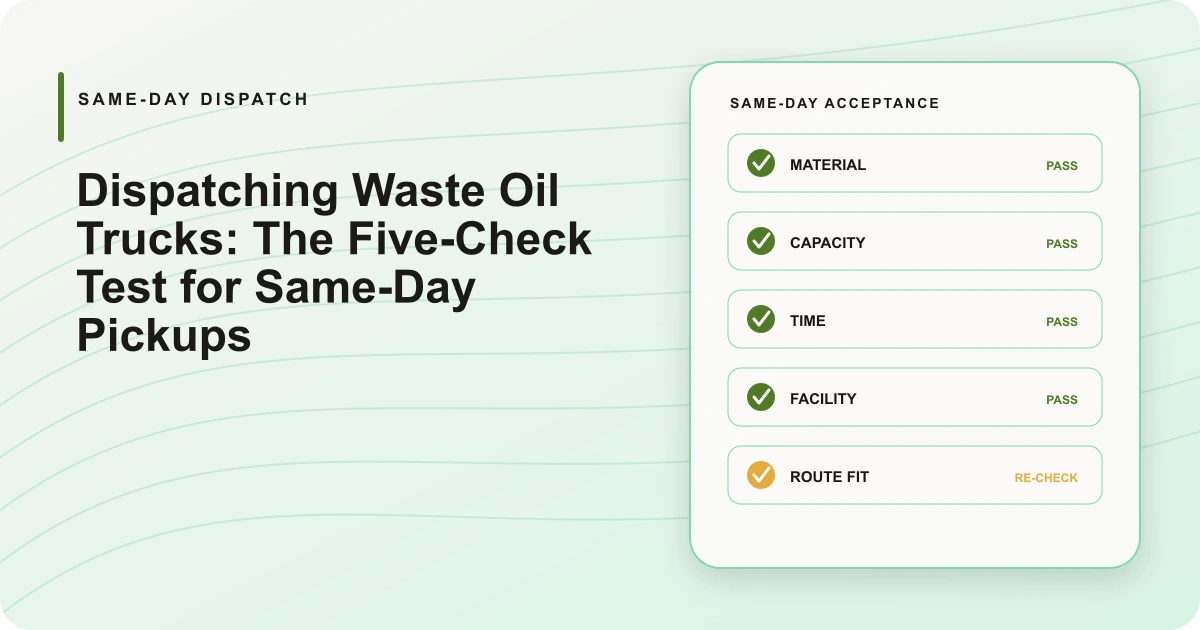
- A same-day pickup request is accepted or refused on five checks: material compatibility, remaining truck capacity, time left in the day, records and authorization, and the commitments already made to other accounts.
- One incompatible pickup can contaminate every gallon already in the tank, so the contamination question gets asked over the phone, before the truck rolls.
- The real cost of an urgent job is detour travel plus pumping plus paperwork plus any unload trip it forces, and the total has to fit the driver's remaining legal hours.
- The right truck for an urgent pickup is the one whose day takes the least damage, not simply the one closest to the caller.
- Federal rules require used-oil transporters to carry an EPA ID number and keep acceptance and delivery records for three years; a truck without its paper trail is not an available truck.
- Every urgent job you absorb should update that account's fill forecast, so the same tank stops arriving as an emergency.
A garage calls mid-morning with a nearly full tank and asks for pickup today. Dispatching waste oil trucks means answering that call in minutes without wrecking the rest of the day, and the answer comes down to five checks: material, capacity, time, records, and the commitments already on the board. I build DynoRoute, routing and dispatch software for the collectors pumping used motor oil out of garages, dealerships, and fleet shops — pricing is public — and I have spent much of this year interviewing the people who take these calls. This guide assumes your routes are planned around truck capacity and your regular accounts sit on the fill-cycle dates from waste oil pickup scheduling; dispatch is what happens when a tank beats those dates. Accept only when compatible capacity, route time, driver hours, and the slack on committed stops all stay non-negative, and the downstream outlet will take the load; everything below turns that rule into a test you can run before the caller hangs up.
Search this phrase and the results are tanker manufacturers and dispatcher job boards; the operator's decision process is barely written down anywhere. This guide writes it down.
What are the five checks before you say yes?
Every same-day request runs through five questions, and most take seconds against a current route plan.
- Will the material mix safely with what the truck is already carrying, and if not, is there an empty compartment for it?
- Does the truck have room for the caller's estimated gallons without forcing an unload trip that was never in the plan?
- Can the day absorb the detour, the pumping, the paperwork, and any new unload inside the driver's remaining legal hours?
- Are you authorized to haul the load and set up to document it, with a valid EPA transporter ID, any required state registration, and a destination that will accept the oil?
- Which committed stops does the insertion push, and can they slip without breaking a promise that costs you an account?
If all five come back clean, dispatch and quote the window. If one fails, you still have three good answers — reassign, defer to the next route through that zone, or plan a second trip — and one bad one: saying yes anyway and letting the driver discover the problem at the tank.
Ask the contamination question before the truck rolls
The material check comes first because it is the only one where a wrong answer follows the truck home. In a safety-focused thread about spent oils, the standing advice to garages is to keep antifreeze, gasoline, solvents, and paint out of the used-oil drum, because collectors check for exactly those things. EPA's used oil guidance for businesses says it plainly: "The only way to be sure your used oil does not become contaminated with hazardous waste is to store it separately from all solvents and chemicals and not to mix it with anything."
In one shop thread, a garage account describes losing a claimed 1,500 gallons of used oil after coolant got into storage. That is one shop's story, but the same risk rides in your truck: contamination caught at the stop costs one pickup, while contamination caught at the processor can put the whole truckload in question, because — to take invented round numbers — 2,000 clean gallons plus 300 suspect ones is one 2,300-gallon load your outlet now has to judge.
So ask on the phone: what goes into this tank, has coolant or solvent ever ended up in it, when was it last pumped, who else has access to it. For accounts you already serve, your own pickup records answer most of that. For a first-time caller who wants a truck today, the interview runs longer, and it is fair to have your driver look in the tank before the hose connects.
Does the truck have the gallons left?
A truck that looks available on the dispatch map can have no room left in the tank. The capacity check compares the caller's estimated volume against the truck's remaining compatible space — what it started with minus what the morning's stops have already pumped in.
The equipment is why this check bites harder than it looks. On combination service trucks, the used-oil compartment is a fraction of the vehicle: Sage Oil Vac's Class 7 lube body lists a 120-gallon used-oil tank alongside its fresh-oil and DEF tanks, and Stellar's fuel-and-lube configurations list used-oil tanks at 120 or 250 gallons. A truck like that can be an hour into its day with no meaningful used-oil space left. Dedicated tankers run far larger and fill from the other direction: a driver hauling contaminated oil describes visiting several locations to fill out one load, so how much room is left depends on how many stops the truck has already made.
When the gallons do not fit, the insertion question becomes a trip question: can this truck unload mid-day and come back out, and does the day still work with that disposal run added? That trip-versus-clock math is worked through in how to plan routes for trucks that fill up, and it applies to an urgent insertion exactly as to a planned route.
Will the pickup fit inside the day?
Cost the job in minutes before you promise an hour: insertion time = detour travel + pickup service + documentation + any new unload. Detour travel is both legs of the deviation from the truck's planned path, not the straight-line distance to the caller. Pickup service covers access, setup, and pumping — a few hundred gallons through a garage's back lot takes what it takes. Documentation is the acceptance record made at the stop, which the next check makes non-optional. And if the pickup fills the truck, the insertion also buys an unload trip that was never on the schedule.
That total has to fit twice: inside the slack between the truck's remaining committed windows, and inside the driver's remaining legal hours of service — a pickup that fits the tank but pushes the driver over their hours still fails. When the total barely fits, treat it as not fitting and quote tomorrow.
Verify the records and the destination before the truck moves
An urgent pickup runs on the same records floor as a scheduled one; urgency changes the timeline, never the paperwork. Under EPA's used-oil rules, transporters hauling used oil must have a valid EPA ID number, apart from narrow small-volume exceptions, and generators must use transporters that have one — the truck you dispatch is also a credential you present. The transporter's record of each shipment accepted is specific under 40 CFR 279.46: the providing party's name and address, its EPA ID number where one applies, the quantity, the date of acceptance, and a signature from its representative, with the same recorded for each delivery to the receiving facility or transporter, as a log, invoice, or shipping document kept at least three years — a gallons figure scribbled at the stop is a level reading, not that record. The transporter standards sit in 40 CFR Part 279, Subpart E; states can go stricter, counties and cities can require their own transporter permits, and your hauling contracts can demand more still, so federal is only the first layer to verify against. Software can keep these records attached to the stop where they were made; it does not determine whether a load is legal to haul or guarantee compliance.
The second half of this check is the destination. A load you may legally carry still needs a processor or transfer facility willing to accept it, and their acceptance criteria — contamination above all — are part of your dispatch decision. If the material interview came back shaky, tell the caller the load gets tested before it is bought, and price the visit so a rejection at the outlet does not turn it into a charity run.
Which truck should get the job?
Give the job to the truck whose whole day absorbs it most cheaply; on plenty of days that is not the truck closest to the caller. The nearest dot on the map can be nearest with, say, 40 gallons of space left, nearest with an appointment across town in an hour, or nearest with a driver who clocked in before dawn. Run each candidate through the same five checks and compare total disruption: detour minutes, capacity margin after the pickup, hours margin, and what happens to committed stops.
Commitments are not equally protected. A recurring garage stop with a wide window slides an hour with a courtesy call; a dealership whose service manager locks up at 4:30, or an account already at its overflow threshold, does not slide at all. The truck with the most slack against protected commitments usually wins even from farther away: price the trade from your own day, but fifteen extra minutes of detour is almost always cheaper than a broken promise to an account you fought to win.
Then set the window from the winning truck's arithmetic. Same-day service is a commercial promise, not an industry rule; there is no credible industry response-time benchmark to point to, so the standard you meet is the one you write into your agreements. Brief the driver just as completely: expected gallons, tank location and access, the site contact, and what the caller said when you asked the contamination question.
How does an urgent job stop being urgent?
Every insertion you accept is also a measurement. The tank that beat its forecast just told you its real fill rate, so update the account's numbers — tank size, threshold, gallons collected, date — and let the latest-safe-date method in waste oil pickup scheduling move it onto a calendar that gets there first. A caller with no cadence at all is really a sales conversation; put them on a schedule and the emergencies go with it.
Patterns across insertions tell you more. A zone that keeps generating urgent calls has no slack left in its route day and needs rebuilding. An account that is urgent twice a quarter and marginal at the same time raises a different question, whether the stop pays for itself at all, and the per-stop math lives in waste oil routes for garages and fleets.
Frequently asked questions
Should I send the closest truck to an urgent waste oil pickup?
Not automatically. The nearest truck can be nearest with almost no compatible tank space left, with an appointment it cannot miss, or with a driver short on remaining legal hours. Run every candidate through the same five checks and give the job to the truck whose whole day absorbs it most cheaply — detour minutes, capacity margin after the pickup, hours margin, and what happens to committed stops.
What should I ask a shop before dispatching a same-day oil pickup?
Ask what goes into the tank, whether coolant or solvent has ever ended up in it, when it was last pumped, and who else has access to it. Then get the estimated gallons, the tank's location and access, and a site contact, and brief the driver on all of it. For a first-time caller, it is fair to have the driver look in the tank before the hose connects.
Can one contaminated pickup really put a whole truckload in question?
Yes, which is why the material check runs first. Contamination caught at the stop costs one pickup, while contamination caught at the processor forces your outlet to judge the entire mixed load, clean gallons included. Keep antifreeze, gasoline, solvents, and paint out of the used-oil stream, and ask the contamination question over the phone before the truck rolls.
What records does a used-oil transporter need for a same-day pickup?
The same as for a scheduled one: a valid EPA ID number, and a record of each acceptance and delivery carrying the providing party's name and address, its EPA ID number where one applies, the quantity, the date, and a signature from its representative, kept at least three years under the federal used-oil rules. States, local transporter permits, and your own contracts can add requirements on top. The destination matters as much as the paperwork, because a load you may legally carry still needs a facility willing to accept it.
How do I stop the same account from calling in emergencies?
Treat every urgent job as a measurement. The tank that beat its forecast just showed you its real fill rate, so update the account's tank size, threshold, gallons collected, and date, and move it onto a latest-safe-date schedule that gets there first. A caller with no cadence at all is really a sales conversation — put them on a schedule and the emergencies go with it.
Running the five checks in one system
Plenty of fleets run this test with a route sheet, a phone, and a dispatcher who holds the whole operation in their head. What software changes is how many of the five answers are already on the screen when the phone rings. We built DynoRoute's capacity-based routing to carry each truck's fill limit and what the day's planned stops have committed against it, which turns the gallons check into a glance. The AI dispatcher recommends a truck for an urgent job by capacity, location, and availability, shows how confident it is in each match, and catches double-bookings and travel-impossible assignments before they reach the schedule; when a job cancels or runs late, an operator-configured agent can surface the gap so you re-plan around it. Per-stop records with custom fields keep each account's material answers and pickup history on file for the next urgent call, drivers attach timestamped, geotagged photo proof at the stop, and disposal returns are planned into the route instead of improvised. The contamination question stays yours to ask and the driver's hours stay yours to manage; the software holds the history and the math.
If a same-day call still starts a scramble across a spreadsheet, a whiteboard, and a group text, tell us what your fleet hauls and start dispatching from a plan that already knows what every truck has left.