Key takeaways
- A waste oil route holds together when its stops share one material stream, one patch of the map, open service windows, a common downstream outlet, and commercial terms the day can afford.
- Garages, dealerships, and fleet shops generate oil in three different patterns, so each stop type gets its own profile for volume, tank access, and the side streams that show up next to the oil.
- The gallons you plan for should come from a percentile of that account's own pickup history, because tank size only sets a ceiling and no credible public dataset maps bays to gallons.
- Every stop's value is computable from six inputs, and a stop that pays you this quarter can cost you money next quarter, because oil value moves with the market while your labor and miles do not.
- A slow account belongs on a zone day, and it joins the route whenever its latest safe pickup date falls inside a day your truck already spends in its area.
- One incompatible stop can put a whole truckload in question, so loads are grouped by material stream and every pickup leaves its records behind.
Planning waste oil pickup routes is mostly a grouping problem. I build DynoRoute, capacity-based routing and dispatch software for waste oil and liquid-waste fleets — pricing is public — and I have spent this year interviewing the collectors who run these routes. A garage, a dealership, and a fleet shop fill their tanks at different speeds, open their gates at different hours, and sit on different sides of the pay-or-charge line, so a workable plan groups stops by material, geography, readiness, and commercial terms, forecasts each stop's gallons from its own history, and then judges every stop by what it contributes to the route. Whether the route day as a whole earns its hours is a density question, and a tank that beats its forecast becomes same-day dispatch work; everything between those two is what this guide covers.
Almost nothing written on this topic is written for you: search the phrase and you get pages helping a garage book its own pickup, not helping the collector plan twenty of them. What follows is the collector's version, and where a number is invented to illustrate, I say so.
Which waste oil stops belong on the same route?
Stops belong on the same route when they share five things: one material stream, one part of the map, service windows that overlap the route day, a common downstream outlet, and commercial terms that make sense together. Miss on any of the five and the route leaks: dead miles, refused gates, a questioned load, or stops that cost more than they return.
Material comes first because it is binary. Used motor oil is one stream; used cooking oil, coolant, and solvents are others, and a truck tank that mixes them turns a resale load into a disposal problem. Geography and windows are the familiar part: build recurring zone days rather than scattering the map, and treat a shop's real receiving hours — the gate, the dock, the service manager's patience — as constraints as hard as distance. Readiness is less obvious: a stop is ready when its tank holds enough gallons to justify the pump time, so the route pulls from accounts approaching their pickup dates, not from a fixed rotation.
The last two are where waste oil differs from most collection work. Your day ends, and sometimes pauses, at the outlet that takes the oil, so the route is planned backward from that unload the way any route with disposal stops is planned around its returns. And commercial terms set visit priority: an account you pay for its oil should be visited near full, because you are buying gallons, while an account that pays you a service fee can flex to whichever day suits the route.
Garages, dealerships, and fleet shops are three different stops
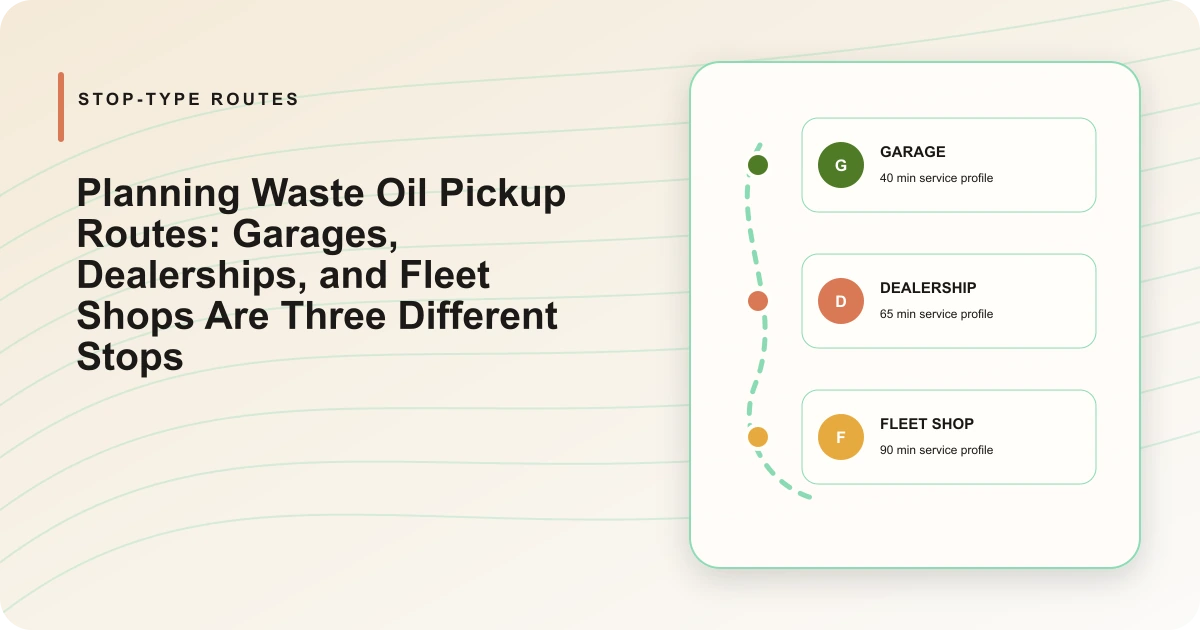
The three common generator types, meaning the shops whose oil you collect, differ on four axes: how the oil arrives in the tank, what tank and access you find on site, how much volume swings between visits, and what other streams sit next to the oil. Profile each account on those four at signing, then let measured pickups correct the profile.
A garage lives on retail repair work, so oil arrives one crankcase at a time and volume follows the neighborhood's driving, the season, and whoever walked in this week. Tanks skew small; EnergyLogic, a common supplier of shop tanks, sells 80, 250, and 500-gallon models, and in a garage you are usually meeting the smaller end of that range. Access varies most here: tanks in back corners, hose pulls across a working bay. The side streams are drums of used filters and antifreeze, valuable to bundle and dangerous to mix.
A dealership runs its service lanes on appointments and factory maintenance schedules, which makes its gallons steadier than a garage's and its windows tighter: the service manager wants your truck gone before customers arrive, so the stop is predictable in volume and demanding in timing. When the fill rate holds, a fixed cadence fits; recalls and seasonal service pushes still bend it, which is what the measured history is for.
A fleet shop fills its tank in steps rather than at a steady rate, because it changes oil in batches as its own trucks cycle through preventive maintenance; say thirty units go through the bays in one week, and the tank can jump a quarter at once. Fleet shops bring the biggest tanks and the widest set of adjacent streams — filters, coolant, sometimes hydraulic fluid — so more gallons per visit and more contamination surface per visit.
| Stop type | How the oil arrives | Typical tank | Watch for |
|---|---|---|---|
| Garage | One crankcase at a time, with retail demand | 80–250 gal | Tight access; filter and antifreeze drums |
| Dealership | Steadily, on appointments and factory schedules | 250–500 gal | Narrow service-lane windows |
| Fleet shop | In batches tied to the fleet's PM cycle | 500 gal class | Step jumps in volume; many fluids on site |
The tank column above extends EnergyLogic's 80, 250, and 500-gallon lineup into starting profiles, not measured benchmarks; your own accounts will redraw the bands. Forecast each stop's next pickup as a percentile of that account's own history, planning truck space against, say, its 80th percentile rather than its average, and set the percentile from your own logged overruns. Tank size is a ceiling, not a forecast, and rate cards priced off bay counts are guesses: no credible public dataset maps bays or lifts to gallons per month. A new account borrows its stop type's profile, conservatively, until two or three measured pickups replace the guess.
What is each stop worth? Run the contribution math
Price every stop with one line of arithmetic: stop contribution = service fee + recoverable oil value − generator payment − labor − mileage − downstream/quality cost. Recoverable oil value is your expected gallons times what your outlet actually pays after quality adjustment; generator payment is whatever you pay the shop for its oil; the rest are your own costs. The formula sorts your whole book into three commercial shapes. The numbers below are invented round figures to show those shapes; real stops are messier, with short-pays, disputed weights, and testing that moves by load, so run the formula on your recorded numbers, not category averages.
First shape: you pay the generator. A dealership yields 400 clean gallons, your outlet pays $1.00 a gallon, and you pay the shop $0.30. Contribution is $400 − $120 − $30 labor − $15 mileage = $235. This is the account everyone competes for, which is exactly why you pay for it.
Second shape: you charge for the pickup. A small garage yields 50 gallons, worth $50 downstream, and pays you an $85 service fee. Contribution is $85 + $50 − $25 labor − $20 mileage − $10 testing = $80. Quality checks cost about the same on 50 gallons as on 400, which is why small stops need a fee even when the oil has value.
Third shape: the free pickup. A fleet shop yields 250 gallons at no fee and no payment, and contribution is $250 − $35 labor − $10 in-zone mileage − $25 quality holdback = $180. Free pickup is not generosity; it is the price point where oil value alone carries the stop.
The shapes are not permanent. Drop the outlet price to $0.40 and that first dealership becomes $160 − $120 − $30 − $15 = −$5 per visit: the account you fought to win now loses money on every visit, until you renegotiate the payment or add a fee floor. Mechanics see the same swing from the other side; in a long thread on what shops do with used motor oil, shops compare being paid for oil in one market and charged for pickup in another.
The route-level check is route contribution per hour = sum of stop contributions ÷ door-to-door route hours, where door-to-door includes the unload and the drive home. With the same invented round figures, twelve stops contributing $1,080 across nine hours is $120 per hour, and that rate is the bar a marginal stop must clear: a $40 stop on that route earns its place only if it costs less than 20 minutes all-in.
When does a slow account join the route?
A slow account joins the route when its latest safe pickup date falls inside a zone day's window. A zone day is the recurring day a truck already works an area for its anchor accounts; the slow stop rides along whenever its date range overlaps that day, and its cadence falls out of that overlap rather than out of a monthly habit.
Some accounts run far slower than any rate card assumes. In a shop-talk thread on used fluids, a powersports dealer describes generating so little oil that a pickup every six months would cover it, while the pricing he was quoted assumed a much busier shop. As a dedicated trip that account fails the contribution test at almost any oil price, but a six-month fill cycle leaves a pickup window weeks wide, wide enough to cross many zone days; on one of them the mileage term collapses to the detour and the same stop clears the bar. Computing the latest safe date takes the tank size, a threshold, and a measured fill rate; that arithmetic lives in our guide to waste oil pickup scheduling.
When a slow account's window never overlaps a zone day at acceptable cost, you have a pricing conversation rather than a routing problem: a minimum pickup fee that makes the dedicated trip whole, or an agreement that the account waits for the next truck through. Either way, calendar habit should not send a truck every month to a tank that fills twice a year.
Keep the load compatible and documented
A route plan is also a load plan: every stop you group shares the truck's tank unless the truck is compartmented, so compatibility is decided when the route is built, and one shop's coolant or solvent habit can put the whole day's load in question at your outlet. Group stops by stream, flag accounts with many fluids on site, and leave same-day judgment calls to dispatch.
The records floor is federal — 40 CFR Part 279, EPA's used oil program — and it assigns duties by role. Under EPA's used oil rules, generators must use transporters that carry a valid EPA ID number, and the transporter — you — must hold that ID and record each acceptance and each delivery of used oil, keeping those records at least three years; processors and re-refiners keep their own tracking records at the receiving end. The transporter's acceptance record is more than a gallons figure: the federal transporter rules (40 CFR 279.46) ask for the providing party's name and address, its EPA ID number where one applies, the quantity, the date of acceptance, and a signature from its representative, with the same recorded for each delivery to a receiving facility. Above that floor, states can run stricter used-oil programs, counties and cities can require their own transporter permits, and your contracts with generators and outlets can demand more than any of them. For route planning the point is simpler: the record is born at the stop, and the per-stop quantities inside those records are the raw material for your forecast percentiles and your contribution spreadsheet. Routing software can carry the records and the constraints; it does not determine a load's legal status or guarantee compliance. A route that captures nothing per stop is throwing away next quarter's plan.
Planning stop-type routes in one system
All of this runs in a spreadsheet at first, and at a modest account count it genuinely should. What outgrows the sheet is the interaction: three stop types on different terms, pickup windows that move with fill rates, per-truck gallon limits, and an unload sitting in the middle of the day. That interaction is the part we built DynoRoute to carry. Capacity-based routing holds each truck's fill limit and plans in-route disposal returns instead of leaving them improvised; recurring schedules hold each account's cadence; per-stop records with custom fields keep the tank size, commercial shape, and side-stream flags where planning can use them. Drivers attach timestamped, geotagged photo proof at every stop, account lists arrive by CSV import, the AI dispatcher recommends a truck for each urgent insertion by capacity, location, and availability, with a confidence score and conflict flags before anything reaches the schedule, and dispatch analytics report route density for each truck, which feeds the hours side of your contribution math. The contribution spreadsheet itself stays yours; DynoRoute's job is to feed it clean per-stop records and keep every route inside truck capacity.
If you are weighing tools more broadly, we compared the credible options, with dated prices and who each tool is wrong for, in our guide to the best waste oil collection software. And if your route sheet still treats every shop as the same stop, start with your stop list; a CSV is enough.