Key takeaways
- A grease route is schedulable only when four constraints agree: the pump-out due date, the customer's service window, remaining truck capacity, and a receiving site that will accept the load before cutoff.
- The 25%/90-day rule is local ordinance, not national law. Schedule each account against its own jurisdiction's trigger and its measured buildup, whichever is stricter.
- Keep a written record for every receiving site: hours, last intake time, accepted waste, fees, permit status, typical queue, discharge procedure, and a named fallback.
- Compute a leave-by time for every full load: facility cutoff minus travel, minus a queue buffer, minus unload time.
- A disposal run costs the route its outbound leg plus queue plus unload plus return. Plan it as a scheduled stop, not slack in the day.
- Multi-stop loads need per-stop records, so every generator on the manifest maps to the load that carried its waste.
- When the day slips: resequence, move the dump run, divert to the fallback, or hold the load legally. Never improvise a discharge.
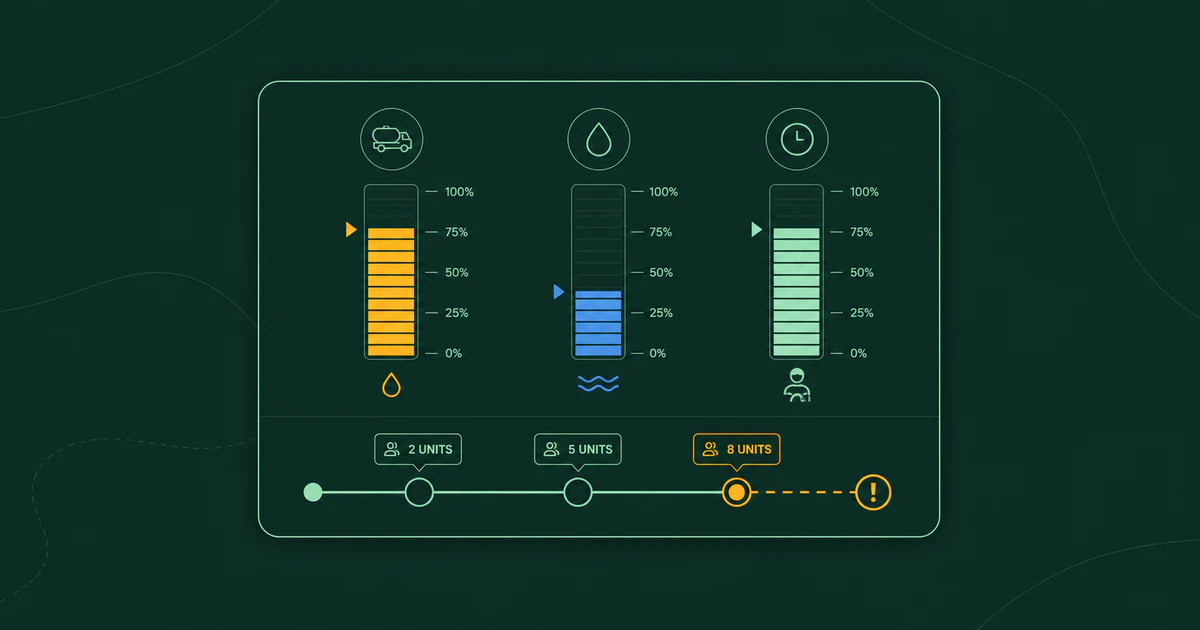
Scheduling grease trap routes means getting four constraints to agree on the same day: each trap's pump-out due date, the customer's service window, the truck's remaining tank capacity, and a receiving facility that will still accept the load when the truck shows up. Most schedules track the first two and carry the other two in someone's head — which is why a route that looks fine at 7 a.m. misses the cutoff at 3 p.m. The fix is to write all four down and plan pump-out frequency and route order against them together — the job DynoRoute's capacity-based routing for grease trap fleets is built around.
If you dispatch a grease fleet, you probably run it the way most operators I talk to do: due dates in a spreadsheet, capacity math in your head, and the receiving site's quirks in the memory of whichever driver dumps there most. That holds up until a trap at its legal limit, a truck near full, and a facility that stops taking loads at 4:30 all land on the same afternoon.
I build routing software for vacuum-truck fleets, and a lot of my year has gone into calls with the pumpers who run these routes. What follows is the scheduling method those conversations keep circling back to.
What has to be true for a grease trap route to be schedulable?
A grease trap route is schedulable when four constraints agree at once: the pump-out due date, the customer's service window, the truck's remaining capacity, and a receiving site that will accept the load before its cutoff. Miss any one and the stop moves, no matter how clean the drive order looks.
The due date comes from local ordinance and the trap's actual buildup rate; the next section covers how to turn those into calendar dates. Slip past it and your customer is the one holding the violation.
The service window is whatever access the site allows. A downtown kitchen that only permits pumping before it opens, a shared lot that blocks the trap lid during deliveries, a property manager who wants trucks gone by eight.
Truck capacity is the constraint that turns a stop list into a load plan. Every trap adds gallons toward the tank's limit, and the limit decides where in the day the disposal run lands.
Receiving-site acceptance is the one almost nobody has written down. A receiving facility runs a regulated program with its own rules: federal guidance for POTWs (publicly owned treatment works) that accept trucked waste tells them to control discharges through hauler permits and manifest systems. Greasezilla, a disposal-technology vendor, describes its hauler customers' core pain as long hauls and trouble finding a site that will take a load promptly. That is a vendor's framing of the market.
The first two constraints are per-account. The last two are per-day, and they interact: how full the truck is decides when it has to head for the facility, and the facility's hours decide whether the rest of the route survives that trip.
How do you turn the 25% rule into recurring service dates?
Where it applies, the 25% rule says a trap is due for pumping once floating grease and settled solids occupy a quarter of the trap's liquid depth, and many programs pair it with a 90-day maximum, whichever comes first. The pattern comes from local ordinance rather than one national law, so the jurisdiction each account sits in sets the numbers you actually schedule against.
Florida's compliance summaries show the 25%/90-day framing and how much it varies by locality, and Miami-Dade's liquid waste transporter guide shows how much rule detail a single county can attach to hauling that waste. Some programs run stricter than 90 days. Treat any "90 days" you find as that program's documented maximum, never as a default you can assume across accounts.
Converting the rule into recurring dates takes four steps:
- Record the rule per account. Which jurisdiction, and which trigger: measured depth, fixed calendar, or both.
- Measure buildup at every service. The depth you pump out and the weeks since the last visit give you a fill rate per trap.
- Set the cadence at the stricter of the two. A trap that reaches 25% in six weeks is a six-week account even where the ordinance would allow 90 days. Trap size drives this: a small trap under a busy fryer line hits a quarter of its depth far sooner than an oversized one at a slow site.
- Recompute the next-due date after every completed service. This is where spreadsheets quietly fail. A static date column is correct until the first reschedule, and then every date downstream of it is fiction unless someone edits by hand.
Do this once across the book of accounts and the recurring schedule stops being a guess. Each stop has a defensible date, and you know exactly which stops have slack when a day gets tight.
What belongs in a receiving-site record?
Every receiving site your trucks depend on should have a written record with seven fields: hours and last intake time, accepted waste types, fee basis, your permit status, typical queue, discharge procedure, and a named fallback with its cutoff. If those facts live only in a driver's memory, your schedule depends on that driver.
| Field | What to record | Why it moves the schedule |
|---|---|---|
| Hours and last intake | Posted hours and the real cutoff for the last truck | The cutoff is often earlier than closing time, and it anchors every leave-by calculation |
| Accepted waste | What this site takes and refuses (trap grease, interceptor waste, grit) | A refused load becomes an unplanned second haul |
| Fee basis | Per gallon or per load, current rates, date checked | Fees decide whether a half-full dump run is worth making |
| Permit status | Your hauler permit number and expiry | An expired permit stops the truck at the gate |
| Typical queue | Average wait, and the worst weekday | This is the queue buffer in your leave-by math |
| Discharge procedure | Sampling, inspection, paperwork at intake | Adds fixed minutes to every single visit |
| Fallback site | Nearest alternative accepting the same waste, and its cutoff | The plan when this facility is down, full, or missed |
Colorado Springs Utilities' liquid waste hauler manual is a good picture of how much structure sits behind one intake bay: permits, manifests, acceptance rules, and a defined discharge procedure. Fairfax County publishes its hauled-wastewater program and fee basis online. Municipal fees and hours change, so confirm each entry by phone and put a checked-on date next to it.
None of this needs software. An afternoon of calls fills the table for every facility you use. Keeping it current is the discipline.
When must a full truck leave for the disposal site?
Work backwards from the facility, not forward from the route. A loaded truck's leave-by time is the facility cutoff minus travel to the site, minus a queue buffer, minus intake and unload time:
leave-by = facility cutoff − travel to site − queue buffer − intake/unload time
Here is a worked example with illustrative numbers; swap in your own facility's figures. Cutoff at 4:30 p.m., 45 minutes of travel from the last stop, a 30-minute queue buffer, 20 minutes for intake and discharge: the truck leaves its last stop by 2:55 p.m. Any trap pumped after 2:55 belongs to a different load or a different day.
The disposal run also carries a total cost to the route: outbound travel plus queue plus unload plus return travel. With two 25-minute legs, the same 30-minute queue, and 20 minutes of discharge, the round trip consumes 100 minutes of route time. Those inputs are invented for the arithmetic. The two formulas are what carry over to your day. And that 100-minute hole in the middle of the schedule is a big piece of how many traps a truck actually clears in a day.
Mainstream logistics tooling treats this the same way. HERE's waste-collection tour planning models a dump site as a reload location with a fixed unload duration, a scheduled stop the route is planned around rather than a gap between pickups. Your schedule should give it the same standing: the dump run gets a time on the board, computed from the facility record, before the day starts.
Use your record's typical queue for the buffer and pad it on the facility's busy day, instead of inventing a number under pressure at 2 p.m.
How do manifests follow a multi-stop load?
A manifest ties a generator's waste to a quantity, a vehicle, and a destination. When one tank holds five traps' worth of grease, your records have to show which stops are in that tank, per stop rather than per day.
EPA guidance calls the manifest the primary mechanism by which a receiving plant knows the quantity and quality of what you discharged, and recommends manifest systems plus hauler permits as its core controls. Colorado Springs requires a manifest for every pump-out of a connected trap or interceptor, even when the load is disposed of somewhere else, and its minimum fields run from hauler identity and vehicle ID through generator, waste, and disposal details. York County's FOG best-management manual expects maintenance records to be retained and available for inspection; retention periods are local, so verify yours before you set a records policy.
The scheduling implication: capture the record at the stop, not at the end of the day. Time in and out, the generator, the gallons pumped, logged while the truck is still parked at the trap. End-of-day paperwork becomes transcription instead of reconstruction, and when a facility questions a load, you can show exactly which generators are in it. The full field-by-field breakdown is in our grease trap manifest requirements guide.
One product aside, because it comes straight from these calls: operators kept describing end-of-day paperwork as rebuilding the day from memory, so we built DynoRoute's driver app to keep a per-stop service record with a timestamped, geotagged photo at every trap. It does not create or file manifests. It gives you the per-stop route record that backs up your manifest paperwork when a facility or an inspector asks.
What should dispatch do when the day slips?
When stops run long, escalate in a fixed order: resequence the remaining stops, move the disposal run, divert to your fallback facility, then hold the load under your permit's storage rules and replan. An improvised discharge is never on the list. It is the one mistake in this article that can end a hauling business.
- Recompute the leave-by time first. Before touching the stop list, ask the only question that matters: does the current load still make the cutoff?
- Resequence the remaining stops. Push the accounts with slack to tomorrow and protect the ones at their legal maximum. Your per-account due dates tell you which is which; without them, whoever complains loudest wins.
- Move the disposal run. Dumping earlier and lighter costs a partial-load fee. Missing the cutoff costs the whole evening and tomorrow's first hour too.
- Divert to the fallback. This is why the fallback and its cutoff sit in the facility record instead of in a driver's head.
- Hold and replan. Where your permit and local rules allow secured overnight storage, park the load legally and give it tomorrow's first intake slot.
Every step above is a data lookup followed by arithmetic. The hard part at 1:40 p.m. is that the data lives in a spreadsheet and three people's memories. In one r/wastemanagement thread, a hauler shopping for software asks about route planning, driver tracking, billing, and compliance in a single breath — in practice the four constraints land as one problem, and the tooling has to treat them that way.
That one-problem shape is what DynoRoute is built around for grease fleets: recurring service schedules (weekly, biweekly, monthly) that do not slip, capacity-based routing with per-truck fill limits, and multi-trip planning that places the disposal return inside the route instead of leaving it to the driver's judgment. A receiving site's hours and rules can live on its record in DynoRoute, the AI dispatcher matches jobs to trucks and catches travel-impossible assignments before they reach the schedule, and your customer list comes in from the spreadsheet you already keep via CSV import.
If your due dates, capacity math, and facility rules currently live in three different places, start with DynoRoute and put them in one.