Key takeaways
- The date that governs a septic property is the earliest of five candidates: the jurisdiction's deadline, the permit or service contract, the measured-condition forecast, your own risk margin, and whatever you promised the customer.
- EPA's three-to-five-year household pumping range is general care guidance rather than a local compliance rule. Wisconsin separately requires an inspection at least every three years and condition-based servicing under its maintenance program.
- A reminder program on a multi-year cycle attaches to the property, because houses sell mid-cycle and the tank stays behind.
- In states where counties send their own maintenance notices, your reminder has to land before the county's letter does, or the booking goes to whoever answers the homeowner's search.
- Bookings only become dense routes when the reminder steers each customer toward the days your truck already works their zone.
- Judge the program by cohorts — eligible, reached, booked, completed, retained — and never by how many reminders went out.
Search "septic pumping scheduling" and nearly everything you find is homeowner advice: pump every three to five years, call a professional. You are the professional, and your version of the problem has to reconnect a property years later to the gallons a truck can take, the truck available when the job comes due, and the disposal leg that completes the route. A multi-year cycle can outlive the spreadsheet that tracks it, the person who built the spreadsheet, and sometimes the customer's ownership of the house. I build DynoRoute, routing and dispatch software for fleets whose trucks fill up as they work, including septic pumping software; septic pumpers sit near the center of that pattern, and I have spent this year interviewing the operators who run these fleets. The scheduling failure in this trade is rarely forgetting a customer this month. It is a cycle that quietly broke somewhere between an ownership change, an office turnover, and a county rule change, years after the job was last done.
This guide works through the five questions a septic scheduling system has to answer: which date governs each property, how measured condition beats a blanket interval, when reminders start and escalate, how bookings become dense routes, and how you know the program made money.
Which date actually governs each property?
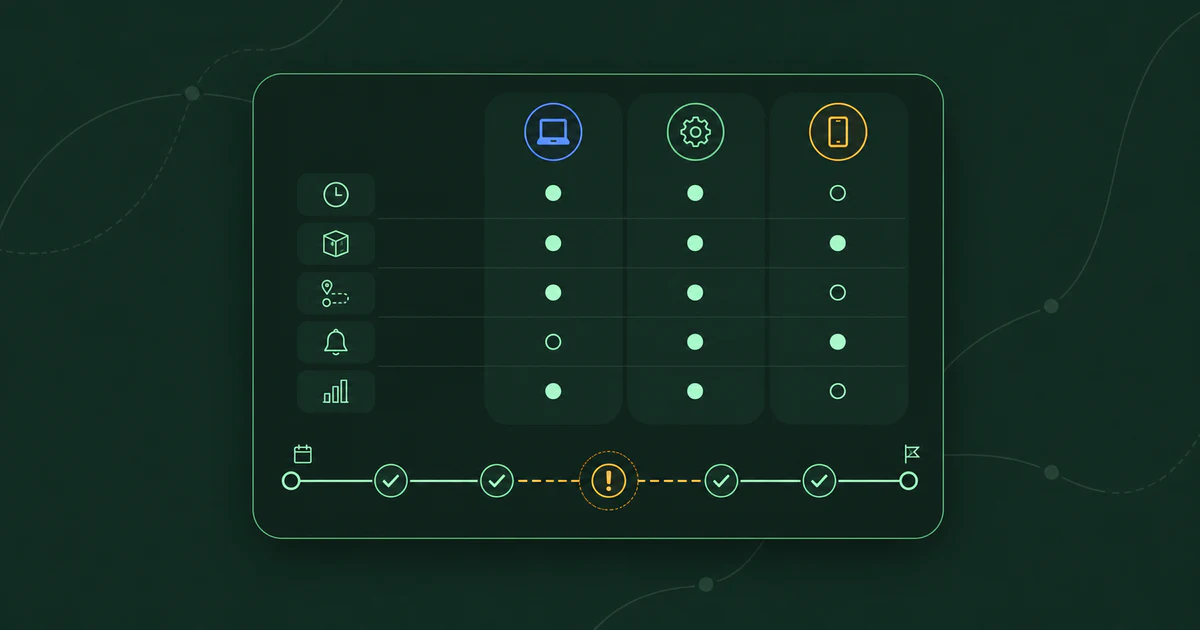
The next required action for a septic property is the earliest of five candidate dates: the deadline in the local code, the requirement attached to the system's permit or contract, the forecast from measured tank condition, the risk margin you set for the account, and the commitment the customer has already made. Written as a rule for the dispatch desk: next action = the earliest of the jurisdiction deadline, the permit or contract requirement, the measured-condition forecast, the risk date, and the customer's request. The action may be an inspection, pump-out, maintenance visit, or customer follow-up; those are not interchangeable jobs.
It takes five candidates because national guidance is not a local schedule. The EPA's septic care guidance says the average household system should be inspected at least every three years and generally pumped every three to five years, with more frequent attention for systems with electrical or mechanical components. That is homeowner guidance, not a statement of what a given county enforces. The moment a customer list crosses a county line, "every three to five years" stops being one rule and becomes several.
The layers underneath are concrete. Wisconsin's state maintenance program requires private onsite systems to be visually inspected at least once every three years and tracked through county programs covering more than 750,000 systems statewide. Florida's current onsite-sewage permit portal lists operating permits for aerobic treatment units, performance-based treatment systems, and commercial or industrial systems. EPA also notes that alternative systems with electrical or mechanical components should generally be inspected once a year. System type therefore changes both the permit record and the service clock.
| Layer | Verified example | What it sets for your schedule |
|---|---|---|
| National guidance | EPA: inspect at least every three years, pump every three to five | The default when nothing stricter applies |
| State code | Wisconsin: visual inspection at least once every three years, reported to the county | The legal floor and the paperwork trail |
| System type and permit | Florida: operating permits for aerobic, performance-based, commercial, and industrial systems | Which properties carry hard deadlines at all |
| Measured condition | Wisconsin's pump trigger: combined sludge and scum at one-third of tank volume | When the tank actually needs pumping |
| Customer commitment | A prepaid contract or a requested month | The date you promised, whatever the code allows |
One more distinction keeps schedules honest: a reminder date, an inspection deadline, a pump forecast, and a booked job are four different dates. A spreadsheet with a single "due date" column collapses them into one, which is how an inspection-only visit gets logged as a pump-out and a tank silently gains two extra years it never earned. The property record needs all four, kept apart, because they move independently.
Scheduling from tank condition, not a blanket interval
A blanket pump-every-three-years blast over-serves light tanks and under-serves heavy ones, and Wisconsin's state brochure names the practice directly: "a common misconception is that every three years, the tank must be pumped. That is incorrect." The code requires the inspection; the pump-out is triggered when combined sludge and scum reach one-third of tank volume. EPA lists the four factors that drive the real interval — household size, total wastewater generated, volume of solids, and tank size — and every one of them is measurable per property.
The scheduling move is to record condition at every touch. When a technician opens a lid, the combined sludge and scum level against tank volume goes into the property record as a number, with a date next to it. Two numbers give a rate, a rate gives a forecast, and a forecast is a schedule you can defend to a customer who asks why you are back — or why you stayed away. The honest catch: most techs today eyeball the tank and pump it, and no number ever gets written down. The entire ask is one number per visit, recorded where the next visit will find it, and it is worth drilling precisely because almost nobody does it.
The math is short enough to run at the kitchen table, and the figures here are illustrative, not measurements. A 1,000-gallon tank last pumped three years ago shows combined solids at 15 percent of volume at inspection: call it five points a year, which puts the one-third threshold a bit under four years out and the honest due date around year six or seven. The same size tank at a house that added two occupants and a garbage disposal might accumulate at double that rate and cross the threshold before year four. A blanket three-year blast is wrong on both properties, in opposite directions.
Measured forecasts never override compliance. The clamp is simple: next action date = the earlier of the measured-condition forecast and the jurisdiction's applicable deadline. Where a county requires an inspection every three years, that inspection happens regardless; the measurement and local rule then determine whether pumping or another service is also required. Those are different tickets, prices, and loads on the truck. A material change in occupancy should trigger a forecast review, so the reminder message is a useful place to ask whether anything changed at the property.
When reminders should start, and how they escalate
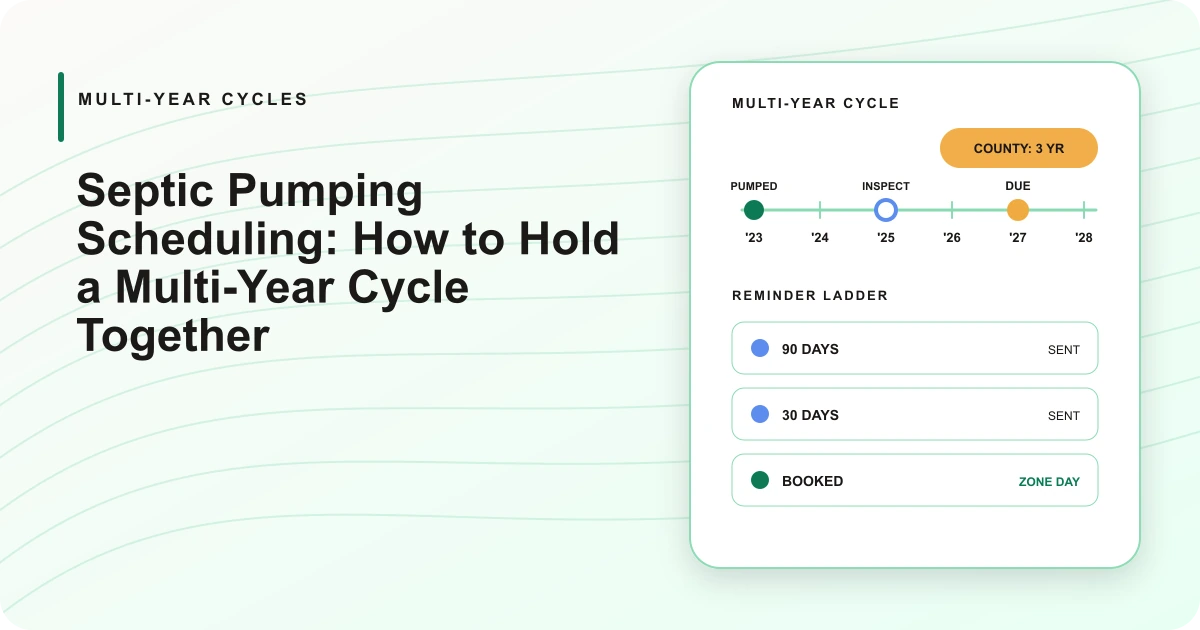
On a multi-year cycle, start the first notice about 90 days before the governing date, send a booking nudge at 30 days, put a phone call behind the silence, and keep a separate overdue lane once the date passes. That ladder is my synthesis from how operators describe chasing due tanks, not a published standard, but each rung has a job. The 90-day notice explains what is due and why: an inspection the county requires, or a pump-out the last measurement forecast. The 30-day nudge offers concrete days, which the next section turns into route density. The call catches the customers who never open email. The overdue lane matters because a multi-year cycle means an overdue tank can stay quietly overdue for years with no one noticing, because there is no next week's missed visit to trigger the question.
Where counties run their own notice programs, timing is competitive. Wisconsin's program obliges counties to send maintenance reminders to landowners and follow up on delinquent properties. A county letter does not book a job with you; it sends a homeowner to a search box, and the search box does not remember who pumped the tank last time. If your 90-day notice lands before the county's letter, you get the first shot at the booking instead of competing in the search results.
The deeper design decision is what the reminder attaches to. A five-year cadence is long enough for the house to sell out from under the cycle, and when it does, the person on your list leaves while the tank stays behind. Schedule the property, not the person: keep the system type, the measurements, and the cycle on the property record, and treat the owner as the current contact for it. When ownership changes, the cycle survives; you re-introduce yourself to the new owner with the tank's actual history in hand, which is a better opening line than any coupon. Consent runs the same way: collect channel permission at service time, honor every opt-out immediately, and remember that an opt-out removes a contact from a channel while the tank stays on its clock.
Turning booked pump-outs into dense route days
A reminder program that lets every tank book its own day scatters your fleet; the fix is zone-days. Divide the territory into zones, give each zone standing service days, and make the reminder's booking options exactly those days. Multi-year cycles make this nearly free for the customer: a tank due "around June" is genuinely fine any week of June, so steering the booking toward the Tuesday a truck already works that zone costs the homeowner nothing.
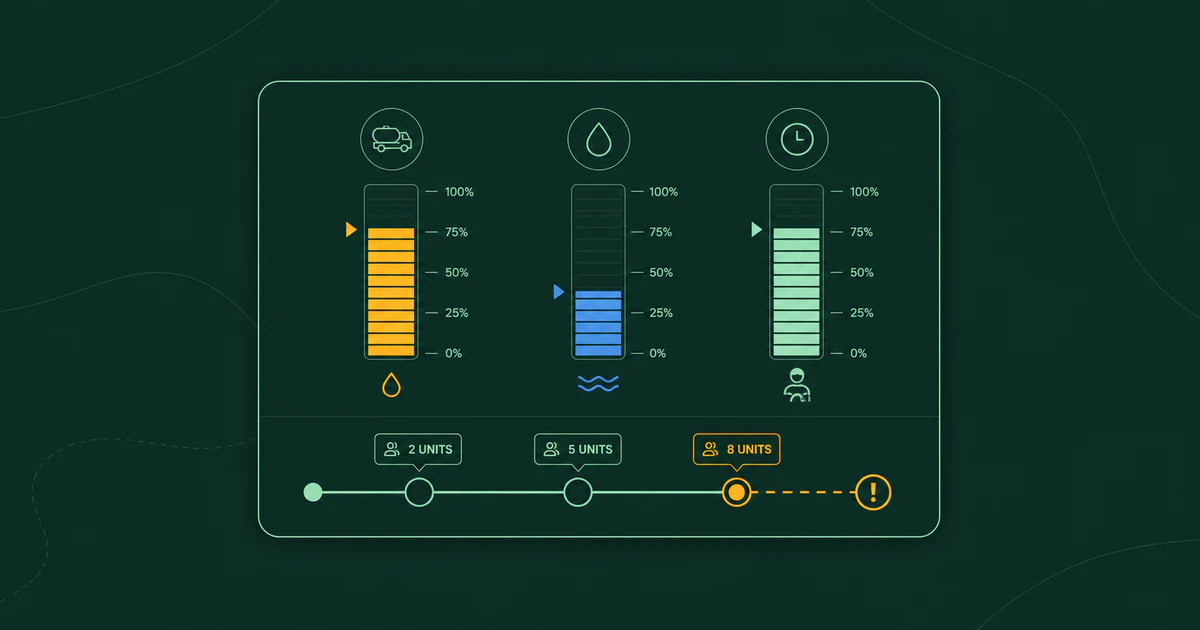
Density is the whole economics of this trade. Stops that share a zone-day share drive time, and on vacuum work the payoff compounds because the truck's tank fills in a handful of stops. The gallons math for how many tanks fit in a day is its own article in how many septic tanks per day, and the mid-day trips it forces are covered in route planning with disposal stops. What zone-day booking adds is that the demand arrives pre-clustered, so the density you are trying to build is designed in at booking time, and the person assigning trucks on the morning of starts from a day that already makes geographic sense.
This is also the seam DynoRoute exists to close: the chain behind the booking. Reminder, booking, job, and route are typically four separate systems (a mail tool, a calendar link, a job board, a routing app), and the seams between them are where duplicate calls come from. DynoRoute wires them as one record: when a homeowner books from a reminder, the job lands in the dispatch queue already attached to its property and its zone-day, so nobody in the office calls a customer who booked an hour ago, and the day's route fills instead of a calendar.
Measuring whether the reminder program made money
No credible public study puts a number on reminder-program revenue for septic work. I looked, and what turns up is software vendors quoting their own customers. So the honest measurement is a cohort funnel you run on your own book: eligible → reached → booked → completed → retained, with unsubscribes tracked alongside.
Eligible is every tank whose governing date fell in the quarter. Reached means the reminder actually arrived — delivered, not sent. Booked and completed are the jobs; retained means the property is still consented and cycling when the next reminder is due, years later. Two ratios do most of the diagnostic work. Booked-over-reached tells you whether the message and the offered days are any good. Reached-over-eligible tells you whether the records are any good — dead phone numbers, sold houses, and stale addresses all live in that gap, and on a multi-year cycle that gap grows silently between touches.
The number never to report is reminders sent. Sending is free and proves nothing; a program can send thousands of reminders into dead inboxes and look busy doing it. And when you compare cohorts, remember the jobs have different shapes: reminder-booked work accepts your zone-days, while the inbound "my drains are backing up" call dictates its own. The reminder program's value shows up partly as revenue and partly as routes that cost less to run.
Choosing a scheduling system that holds the cycle
Whatever software you pick, hold it to the shape of the problem. It has to keep property-centric records that carry system type, tank size, the jurisdiction's rule, permit status, and measured condition. It has to preserve long recurrence intervals without a human rebuilding the schedule and keep reminder ladders, booking, and consent attached to those records. It has to know that a booked pump-out is a stop with gallons on a truck with limits. And it has to export the fields your regulator actually requires. Ventura County, for example, requires pumper trucks to submit monthly reports documenting pumping locations and amounts and ties reporting to annual permit renewal. Your county may require different fields or nothing similar, so test the exact report rather than assuming a proof-of-service record is sufficient.
DynoRoute can hold this shape with custom property and permit records, structured job forms, workflow reminders, online booking, service-area zones, capacity-based dispatch, disposal legs, photo proof, CSV import, and QuickBooks sync. The product explicitly supports weekly, biweekly, monthly, and custom recurring jobs; before importing multi-year cycles, test the chosen custom cadence through creation, reminder, reschedule, and next-generation behavior rather than inferring that “custom” automatically covers every year-scale rule. County reporting also needs a field-by-field export test. Plans are published at $199, $499, or $999 a month with included credits and technician caps, no per-truck fees. This is still a vendor describing its own product, so weigh it accordingly; best septic pumping software compares the wider field with dated pricing and stated evidence gaps.
A pump-out cycle measured in years deserves a system that will still remember it in year four. If yours lives in a spreadsheet older than some of the intervals on it, tell us what your fleet hauls and how your territory is laid out, and start next season with a schedule that holds.