Key takeaways
- A septic pumping day ends at the first binding limit: usable truck capacity, legal payload, working minutes, road time, or the receiving facility's window. The dump leg often decides how many customer jobs fit.
- Plan in expected gallons removed rather than tanks on the list. Nominal tank size is a starting estimate; a prior per-job gallon record is stronger when the service conditions are comparable.
- Septic pumpers comparing workloads in an operators' thread called three jobs a comfortable day and five or six the ceiling of a 12-hour day with access, maintenance, and traffic all cooperating. Those are scenarios to test your plan against, not an industry standard.
- One fleet-wide average job time will keep distorting the schedule because access, digging, hose pull, tank condition, and site work can make two residential pump-outs very different jobs. Use a few job classes instead.
- A deliberately early dump can protect the chance of finishing another job when it moves the disposal leg ahead of traffic, a facility closing time, or a job that will not fit in the truck's remaining planned headroom.
- Percentiles have direction: use an upper-percentile duration for a conservative time promise, but a lower-percentile completed-job count for a conservative volume commitment. An 80th-percentile jobs-per-day count is an aggressive day, not a safe promise.
Every septic fleet runs a version of the same argument: the board says five tanks today, the driver says the truck will be full by noon, and both can be right under different inputs. The jobs-per-day math below is the septic case of capacity-based route planning, a day measured in gallons removed and planned around non-customer disposal stops that still consume working time. Homeowner guidance answers how often a tank may need attention; the person filling tomorrow's route board needs different math. I build DynoRoute, routing and dispatch software for fleets whose trucks fill up as they work, including septic pumping software for pump-truck fleets, and I've spent this year interviewing the operators who run them. What follows is the arithmetic those conversations keep circling back to, with sourced numbers linked and illustrative numbers labeled.
Plan the day in gallons removed, not tanks on the list
A septic pumping day is planned in gallons because the truck carries what is removed from each tank until the next disposal stop. Two jobs that each count as one stop can consume very different shares of the truck's usable capacity. That is why "how many tanks per day" has no honest one-number answer.
State sizing rules provide a starting planning band, not the gallons a crew will actually remove. Washington requires at least 1,000 gallons of tank for homes up to four bedrooms, plus 250 gallons for each additional bedroom. Virginia's sizing table runs from 750 gallons for one- and two-bedroom homes to 1,500 gallons at five bedrooms, with 750 gallons as the minimum. These are two state construction rules, not a national pump-out distribution. They show why a residential address may begin with a nominal estimate in the 750-to-1,500-gallon range while still requiring a measured service record for better forecasting.
The label is only the starting estimate. The EPA names household size, total wastewater, solids volume, and tank size as factors in pumping frequency, and site conditions can also change what a crew encounters. The stronger forecast is the address's prior per-job gallon record, when one exists, adjusted for a known change in tank, use, access, or condition. A disposal ticket that records only a combined truck load cannot supply that stop-level number. How often each tank comes due again is a separate planning problem, covered in septic pumping scheduling; this article assumes the day's list already exists and asks how much of it one truck can finish.
Which limit ends the day first?
Five limits compete to end a septic pumping day: the truck's usable volume, its legal payload and axle limits, the crew's working minutes, the road time between stops, and the receiving facility's hours. Capacity can bind early in septic work, but the first limit reached depends on the equipment, territory, outlet, and jobs. The plan therefore needs the disposal leg and the customer stops in the same calculation.
Start with the truck's manufacturer ratings and your own operating policy. Pumper magazine's profile of one Ohio operation gives a useful scale example: a 5,000-gallon steel tank replaced a 3,600-gallon unit that had been the fleet's biggest. Nominal volume is not automatically usable route capacity. Residual load, foam, forecast error, payload, axle ratings, and local weight limits can all require headroom. Set that reserve from your equipment, load records, and forecast error rather than copying a universal percentage. One operations lead in the supplied vacuum-route research plans to roughly 80 percent of tank capacity and three-quarters of driver hours; that is one operator's control rule, not an industry benchmark.
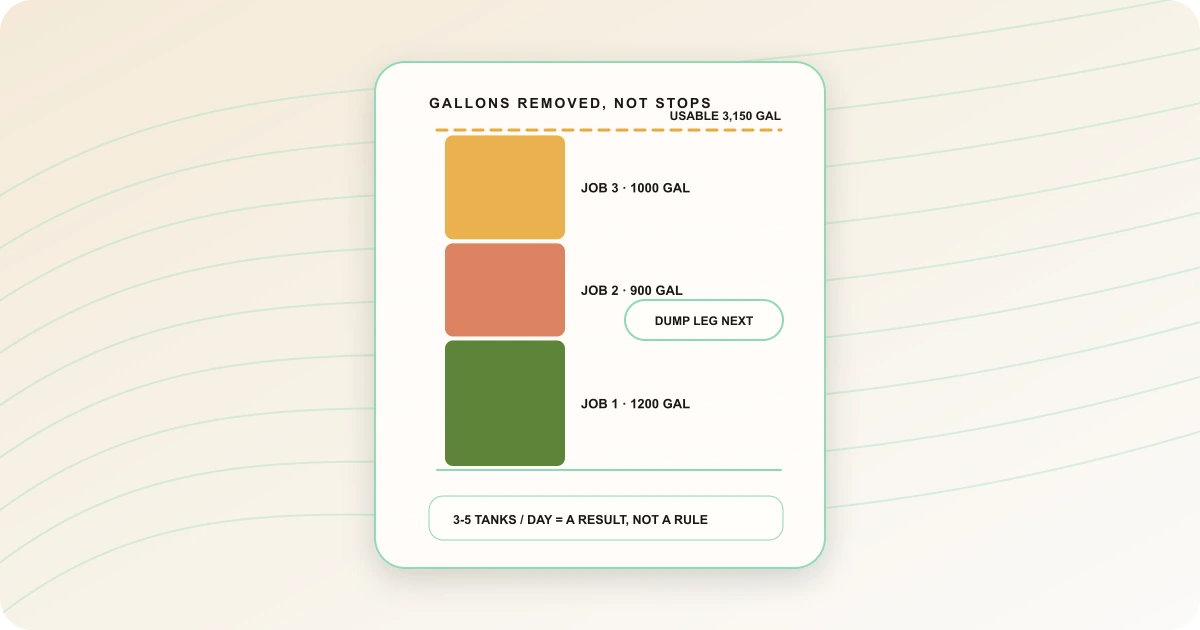
Now run the division. The table uses a hypothetical 3,500-gallon truck with an operator-set 350-gallon reserve, leaving 3,150 planned gallons. The reserve is illustrative, not a recommended percentage. For one load, the calculation is whole jobs before disposal = floor(planned usable gallons ÷ expected gallons removed per job).
| Average gallons removed per job | Jobs before the truck must dump |
|---|---|
| 700 | 4 |
| 1,000 | 3 |
| 1,300 | 2 |
In this illustration, the 1,000-gallon row permits three whole jobs before disposal; the 1,300-gallon row permits two. A second load might make four to six completed jobs possible, but only if service time, drive time, legal weight, outlet access, and working hours also fit. The grease-side version of this arithmetic, with smaller per-stop volumes, lands somewhere else, which is why grease fleets count traps per day on different math.
Two more limits deserve a line each. Weight can bind before volume. Water weighs 8.34 pounds per gallon, a useful rough reference rather than an assumed septage density, and the profiled 5,000-gallon rig weighed 30,000 pounds empty and about 70,000 pounds loaded. Manufacturer ratings, actual load characteristics, gross and axle limits, and applicable road rules decide whether the next job is legal; an unfilled tank does not answer that question. The receiving window is also a hard stop: Raleigh's septage receiving station runs Monday through Friday, 5 a.m. to 7 p.m., with weekends by special arrangement. A route must reach an approved outlet inside its current acceptance window.
Why buried and neglected tanks wreck the average
An average septic job time misleads because the work at the tank varies far more than the driving between tanks. An exposed-lid, regularly serviced 1,000-gallon tank and the same tank under a decade of sod are different jobs that happen to share a name, and a schedule built on their average will be wrong at both addresses.
The fix is to stop averaging and start itemizing what a stop contains: locate the tank and expose the lid, pull hose from where the truck can park, service each compartment, deal with compacted solids as the approved procedure requires, inspect or record the items included in the work order, close up, restore the site, and complete payment or signature steps. Access, hose distance, tank condition, and the contracted scope each move the duration. Record those drivers instead of assigning every residential job the same minutes.
The operator accounts show how wide the result can be. In a thread on r/septictanks asking how many clients a septic company handles per day (captured July 2026), one pumper called three jobs a comfortable day and said five or six fit only into a 12-hour day where access, tank condition, and traffic all cooperated. Another reported two 5,000-gallon trucks completing around 20 jobs a day between them. These are two self-reported accounts, not comparable measurements: neither supplies the complete mix of gallons removed, disposal distance, job class, or non-pumping work needed to normalize the result. Use them to challenge a route assumption, never to set a quota.
So sort your book into job classes instead of averaging across it: known-lid tanks on a maintenance cadence, standard residential pump-outs, and dig-and-find first visits. Three classes with honest time ranges will schedule a week better than one precise-looking average that no actual job matches.
When does dumping early buy back a job?
A deliberately early dump run earns its place when the minutes it costs now are fewer than the minutes and jobs it protects later in the day. It is a non-customer stop with real work: drive to the facility, queue, discharge, complete paperwork, and return to the route. Treat it as a stop with a measured duration and the decision becomes arithmetic you can check.
Three situations flip the answer toward dumping early. The first is the job that will not fit inside planned headroom: if 900 gallons remain and the next comparable address expects 1,200, dispatch needs a disposal leg, a different truck, or a different sequence. The second is the facility window: where receiving closes at 7 p.m. and the late-afternoon queue varies, an earlier dump may protect the last leg. The third is geography, because an outlet near an afternoon cluster changes the detour completely. Dispatching septic pump trucks covers how to test those feasibility gates when the day changes.
At the two facilities cited here, the posted disposal charge is based on quantity rather than the number of visits. Raleigh lists $0.09 per gallon, effective July 2025, while King County, Washington lists a 2026 equivalent rate of $0.1745 per gallon for accepted domestic septage up to 2 percent solids, plus annual and setup truck fees. At those posted rates, 3,500 accepted gallons would be about $315 in Raleigh or $611 in King County, subject to each facility's current rules and measurement method. Splitting the same accepted quantity across two visits would not change that simple quantity calculation, but other outlets may impose minimums or trip-specific fees. The second trip always adds time, so record the door-to-door disposal duration and verify every approved outlet's current fees, hours, waste rules, and permit requirements directly.
This decision is also what DynoRoute's multi-trip planning is built around: the disposal site is a route stop with a location, duration, and time window, and the sequence can account for the truck's planned load before and after it. The operator still owns the usable-capacity rule, approved outlet list, expected gallons, and disposal duration; software cannot make missing or stale inputs true.
What is a defensible jobs-per-day number?
The defensible answer to "how many tanks per day" is a range computed from your own completed work, split by job class, territory, truck, and disposal pattern. Keep time percentiles and throughput percentiles separate. A P80 service duration is slower than the median and can support a conservative time allowance. A P20 completed-job count is lower than the median and means 80 percent of comparable days completed at least that many jobs. A P80 completed-job count is a strong day, so it is the wrong number for a safe commitment.
Start with at least arrival and departure times, per-job gallons when measured, job class, access or digging notes, and the door-to-door duration of every disposal trip. Thirty days can start the worksheet, but a sparse class or seasonal territory needs more history before a percentile is stable. Use median and upper-percentile durations to understand normal and slow service; use median and lower-percentile daily job counts to understand expected and conservative throughput. Keep travel separate from tank time, and do not blend job classes that have different work. UCO fleets use the same percentile discipline on restaurant stops; the direction of each metric still matters.
The pumpers' numbers quoted earlier, three comfortable jobs and five or six in a stretched day, have one legitimate use: they are scenarios against which to question your inputs, not benchmarks. If your comparable days land far above or below them, inspect gallons, job class, disposal distance, and non-pumping work before assuming either your operation or the forum account is wrong.
Choosing software that plans in gallons
Whatever tool plans your routes, hold it to the arithmetic in this article. It should carry an operator-set fill limit for each truck and flag work that exceeds planned headroom. It should let you attach expected gallons to a job from that address's own history when the record exists. It should place disposal trips inside the route as stops with current hours and durations, preserve the recurrence rules you have tested, and capture the actual fields you need after service, including gallons and minutes where the workflow records them. Photo proof can support the service record, but it does not measure gallons by itself.
That list is DynoRoute's home ground. Fill limits per truck and entered job quantities drive the plan, multi-trip routing includes disposal returns, and the AI dispatcher recommends a truck and driver using capacity, location, availability, workload, travel time, service areas, and skills. A confidence score explains recommendation strength; it is not a probability that the job will succeed. DynoRoute does not read a physical tank sensor, so planned load depends on current estimates and completed-work entries. Drivers can capture timestamped, geotagged photo proof alongside the service record. Plans are published at $199, $499, and $999 a month with included credits, overage rates, and technician caps, with no per-truck fee.
If your jobs-per-day number is still an argument between the board and the driver, tell us what your trucks haul and use the first month's complete records to start replacing the argument with measured inputs.