Key takeaways
- Septic software falls into three buying categories: pump-truck specialists, broad field-service suites, and route-first dispatch systems. Compare tools inside the problem you need solved.
- Only Tank Track, Orderry, and DynoRoute published usable prices when this comparison was checked on August 13, 2026. Recheck every price, plan, and review count on publication day.
- Subscription price is only one cost. Model implementation, onboarding, required add-ons, payment and messaging fees, usage overages, employee or truck growth, contract length, and exit terms over three years.
- Make each vendor close one real pump job using your data, including expected gallons, a mid-route disposal return, an offline field step, the required disposal record, invoicing, accounting sync, and the next recurring visit.
- Public reviews are not evenly comparable: some tools have hundreds of cross-trade reviews, some have a small specialist sample, and several have no useful independent corpus. Missing evidence calls for testing and customer references, not confident complaint summaries.
- DynoRoute belongs on the shortlist when capacity, disposal returns, dispatch, and route proof are the expensive failures. It is not a replacement for every septic billing, financing, repair-estimating, or compliance workflow.
Seven tools realistically compete for a septic pumping company's software budget in 2026. Two were built around pump trucks from the start (Tank Track and ServiceCore). Four are general field-service platforms that added septic pages (ServiceTitan, FieldPulse, Successware, Orderry). The seventh is DynoRoute, which I build: septic pumping software for routing and dispatch that treats tank gallons as the limit the whole route is planned around and puts the trip to the disposal site inside the plan instead of leaving it to the driver's judgment at 1pm. Only three of the seven publish prices.
Since my own product sits on this list, here are the terms of the comparison. I build DynoRoute for fleets whose trucks fill up as they work, septic tankers among them, and I've spent this year interviewing the operators who run those fleets. In exchange for that bias, you get an evidence bar: every price below comes from the vendor's own public page, checked on August 13, 2026; every review figure carries its date and sample size; and where the public record is too thin to judge, I write "insufficient public reviews" instead of inventing complaints. Those figures are a dated snapshot, not a promise that the vendor will hold them until publication. DynoRoute gets no exemption, and it is not the right buy for every reader of this page. The last section says plainly who should pick something else.
Which of these tools is actually built for septic pumping?
Septic-first software means the vendor built its central workflows around pump-truck or sanitation operations rather than adapting a general work-order system. By that bar, Tank Track and ServiceCore qualify. ServiceTitan, FieldPulse, Successware, and Orderry are general field-service systems with septic marketing pages. DynoRoute occupies a third category: capacity-aware routing and dispatch for septic work rather than a complete septic office suite.
1. Tank Track
Tank Track is built exclusively for septic pumping, grease trap, and portable toilet businesses, and it is the rare specialist that publishes its price: $180 per month for the first truck and $150 per month for each truck after that, with unlimited users, monthly billing, and no annual contract, as of August 2026. There is no free trial; the company offers a 60-day money-back guarantee instead. Its FAQ describes QuickBooks Online integration and pitches the product as the whole office: scheduling, dispatch, invoicing, payments, and compliance reporting. The caution is the evidence gap. Tank Track shows zero reviews on Capterra as of August 2026, which leaves nothing independent to weigh, so every claim above stays a vendor claim until your own trial run confirms it.
2. ServiceCore
ServiceCore was built for septic, portable toilet, and dumpster businesses, which makes it a natural shortlist entry when your routes mix tanks with cans and roll-offs. It connects to QuickBooks, and its QuickBooks feed appears in its reviews in both positive and negative accounts. Pricing was quote-only on August 13, 2026: the pricing page was a demo request, not a price list. Its 4.0 out of 5 score across 51 Capterra reviews was the largest dated public sample among the specialists here, although the sample should not be treated as 51 septic-only reviews. The recurring complaints are covered below.
3. ServiceTitan
ServiceTitan is the enterprise home-services suite, with a dedicated septic industry page. Pricing is per technician and quote-only, across three plans (Starter, Essentials, The Works), each behind a "Request Pricing" button. What you get for the weight is real: on-site estimates, consumer financing, marketing and reputation tools, service agreements, and accounting integration with QuickBooks Online and Desktop. If your septic company is really a full home-services company, pumping plus installs, repairs, and inspections, and you want call booking, financing, and marketing under one contract, this is that product. Its review record says to budget carefully for the ride; the dated figures are below.
4. FieldPulse
FieldPulse is a broad field-service platform, covering scheduling, dispatch, estimates, invoicing, and inventory, with a septic solutions page that leads on real-time scheduling and emergency prioritization. Pricing was seat-based and quote-only; the pricing page offered a custom quote across Essentials, Professional, and Enterprise tiers. The review record was large and positive overall: 4.6 out of 5 across 488 Capterra reviews on August 13, 2026. The review base is not septic-specific, so treat reported sync and mobile/offline concerns as test cases for your actual routes rather than a septic verdict.
5. Successware
Successware grew up as the back office for HVAC, plumbing, and electrical shops and now lists septic among its industries; its septic page pitches call-handling scripts, tiered repair options, dispatch, and integrated accounting with pricebook management. There is no public pricing and no pricing page at all: the path is a phone call or a demo form. I found no clean, dated, septic-relevant review sample for it either, so there is no honest way to characterize its track record here. Shortlist it only if you are already an HVAC-or-plumbing-shaped business adding septic work, and make the demo do the proving.
6. Orderry
Orderry is general service and repair-shop management software that surfaces in septic searches mostly on price. It does publish pricing: plans from $39 per month (two employees, 100 work orders per 30 days) through $69, $99, and $199-and-up tiers, with extra employees billed $6 to $19 per month each depending on tier, all as of August 2026, plus a 7-day trial. It carries a 4.7 out of 5 Capterra rating, but across only 36 reviews, and that reviewer base skews toward IT and repair businesses. I found no septic-specific evidence for it at all. It is the cheapest published sticker on this page and the weakest septic case.
7. DynoRoute (ours)
DynoRoute is routing and dispatch software for fleets whose trucks fill up as they work. For a septic operation that means truck capacity in gallons as a planning limit, disposal-site returns planned into the route, AI dispatch recommendations that consider capacity, location, availability, workload, travel time, service areas, and skills, custom recurring work, timestamped and geotagged photo proof, QuickBooks sync, and published plans at $199, $499, or $999 per month. Pricing includes credits, overage rates, and technician caps; it has no per-truck fee or implementation fee. Verify the exact multi-year cadence you need by generating and rescheduling a test series, because the capability record supports custom recurrence but does not print a universal maximum interval. DynoRoute also depends on entered expected quantities and completed-work updates; it does not read a live physical tank sensor. What it is not: a complete septic field-service suite. If consumer financing, repair estimating, or office administration is your main pain, one of the suites above may fit better. If the route itself keeps breaking, DynoRoute belongs on the shortlist.
What each option costs, verified in August 2026
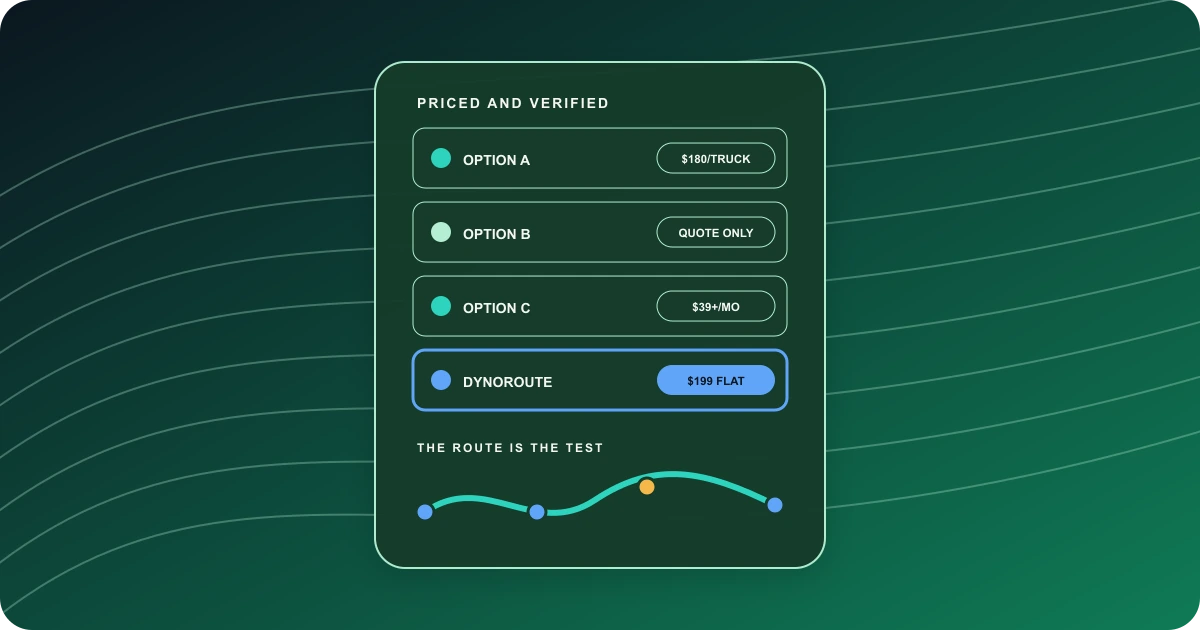
As of August 2026, three of the seven publish prices: Tank Track at $180 per month for the first truck and $150 for each additional truck, Orderry from $39 to $199-plus per month with per-employee fees, and DynoRoute at $199, $499, or $999 per month flat. ServiceCore, ServiceTitan, FieldPulse, and Successware are quote-only. Every figure in this table came from the vendor's own public page, fetched in August 2026, because the July snapshots I started from had already drifted.
| Tool | Public pricing (checked August 2026) | Pricing model |
|---|---|---|
| Tank Track | $180/month first truck, $150/month each additional | Per truck, unlimited users |
| ServiceCore | Quote-only | Demo first |
| ServiceTitan | Quote-only | Per technician |
| FieldPulse | Quote-only | Per seat (full and limited field seats) |
| Successware | Quote-only | Not disclosed |
| Orderry | $39 to $199+/month, extra employees $6 to $19/month each | Plan tier plus per employee |
| DynoRoute | $199 / $499 / $999 per month, published | Flat plans, credit-based optimization, no per-seat fees |
The sticker matters less than the shape. Per-truck pricing grows when you add a truck; per-technician and per-seat pricing grows with the covered roster; a flat plan can still change through tier caps, included usage, and overages. On Tank Track's August 13 list rates, four trucks held constant for 36 months would be $180 plus three times $150, or $630 per month and $22,680 over three years before any discount or price change. That is illustrative list-price math, not a quote. DynoRoute Starter held at $199 for 36 months would be $7,164 before credit overages, and only if its credit and technician limits fit the operation. Those numbers buy different scopes: Tank Track is bidding to run the septic office, while DynoRoute is the routing, dispatch, and field-proof layer alongside accounting. DynoRoute's plans, caps, included credits, and overage model are published on the pricing page.
For the quote-only four, protect yourself with one written question: what is the all-in cost over three years, at my exact headcount and truck count, including implementation, onboarding, required add-ons, payment processing, and messaging fees, and what does it cost to leave? The formula worth holding vendors to is three-year cost = (monthly price × 36) + implementation and onboarding + add-ons + payment and messaging fees + exit costs. One ServiceTitan reviewer in the August 13 Capterra capture reported roughly $22,000 in early-exit fees. That is one account, not a benchmark or a verified quote for your contract, but it is a good reason to get every tool's exit terms in writing before signing.
Held to its own formula, DynoRoute's line starts with plan price times 36 and no implementation or onboarding charge. Each plan has a technician cap and included credits; optimization usage beyond the allowance creates overage or may make a higher plan the better fit. A route optimization costs one credit, a real-time re-optimization two, and a full schedule build five. Adding a truck is not itself a billing unit, but the added technicians and optimization usage can change which plan or credit volume fits. That is the comparison to make against a true per-truck price.
Before you buy: make one tool close one real pump job
One of the most useful tests of septic software is whether a real pump-out can travel through the system, start to finish, without an unplanned workaround. Run that round trip during the trial or the sales engineer's screen-share, in this order:
- Create a real customer with the tank on record: size in gallons, compartments, lid location, access notes, and the service history you'd want the next driver to see.
- Schedule the job into a real route day, alongside other stops, against a truck with a stated gallon limit, and watch what the plan does as it approaches planned headroom. How many tanks a truck can service in a day depends on capacity, payload, working time, travel, and the receiving facility, so a plan that ignores disposal is incomplete.
- Run the field half on a phone where coverage dies: record gallons pumped, tank condition, a timestamped photo, and see what survives the dead zone and syncs back.
- Close the paperwork your state, county, and receiving facility actually require. Check each required field, which may include quantity, origin, hauler, vehicle, and destination, and find out whether it is structured data or a note that someone must retype.
- Push the finished job into an invoice and on into your accounting file, and reconcile it.
- Schedule the next visit three years out, move one generated visit, and confirm what happens to the rest of the series. The EPA says household tanks are typically pumped every three to five years, although the actual next action depends on the system and service record. If the software cannot preserve the custom cycle you verified, the long interval still needs an external reminder process.
Step two is the piece DynoRoute is built around. A capacity-aware plan contains the drive to the receiving facility, its duration and window, and the route back to customer work; an address sequencer may leave that leg outside the model. Run the test rather than inferring the answer from a feature label. That is where a route built for trucks that fill up separates from one that only orders stops.
What verified reviewers repeatedly dislike, and where the evidence is missing
Across the tools with a reviewable public record, three complaint patterns repeat as of August 2026: reporting and customization limits at ServiceCore, sync and mobile reliability at FieldPulse, and total cost with hard exits at ServiceTitan. Just as important is where no pattern can honestly be claimed, because 51 reviews and zero reviews are not comparable samples.
ServiceCore's 51 Capterra reviews (4.0 out of 5, August 2026) recur on three themes: reporting that resists customization, a QuickBooks payment feed one reviewer describes as dropping payments on the way across, and requests for better routing, with another writing that "the routing could be improved significantly." FieldPulse's 488 reviews (4.6 out of 5, August 2026) are largely positive, with the recurring reservations being bugs and glitches, sync and connectivity trouble including the QuickBooks link, a mobile app short on offline capability, and essential features gated behind paid add-ons. ServiceTitan's 339 reviews (4.3 out of 5, August 2026) score value for money at 3.8, and the recurring themes are cost and unexpected fees, onboarding and training quality, and punishing exit terms; note that this corpus comes overwhelmingly from adjacent trades like HVAC and plumbing, so treat it as a caution about the platform's weight, not a septic-specific verdict.
Tank Track and Successware both land in the insufficient-evidence column: zero Capterra reviews for Tank Track as of August 2026, and no clean, dated, septic-relevant sample I could find for Successware's field-service product. Orderry's 36 reviews are real but come from a different industry. And DynoRoute belongs in this column too: we are the newest entrant on this page, and there is no independent septic review corpus on us. I am not going to manufacture one out of adjectives. Judge us the same way I've told you to judge Tank Track: run one real pump job through the trial and let the round trip decide.
Which tool fits which operation
Rather than declare a winner, here is the fit-based read.
- Pick Tank Track if you want a septic-built office system with a price you can read before the demo, you are comfortable being the one to verify its claims (the review record is empty), and per-truck pricing suits how your fleet grows.
- Pick ServiceCore if you run septic alongside portable toilets or dumpsters and want the incumbent specialist with the largest septic-relevant review record, and you can live with quote-only pricing and its reported reporting and QuickBooks-feed rough edges.
- Pick ServiceTitan if you are buying a full home-services operating system, financing, marketing, call booking and all, have the implementation bandwidth to absorb it, and negotiate the three-year all-in cost and exit terms in writing first.
- Pick FieldPulse if you want a broad generalist with a large, positive cross-trade review sample and office features beyond dispatch, then test its sync and offline behavior on the weakest-coverage route you actually run.
- Consider Successware only if you are an HVAC-or-plumbing-shaped shop adding septic; consider Orderry only if the software budget is the binding constraint and septic-specific workflow genuinely doesn't matter to you.
- Pick DynoRoute if the broken part of your operation is the route itself: days that collapse when planned volume is wrong, disposal runs improvised from the cab, recurring follow-up leaking from the schedule, or dispatch living in one person's head. DynoRoute plans around entered tank gallons and disposal returns, gives dispatchers confidence-scored assignment recommendations, captures field proof, syncs completed work to QuickBooks, and publishes its pricing. Test the exact custom cadence and data fields you need before treating either as configured.
If that last description sounds like your fleet, tell us what your trucks haul and how your day breaks, and run the one-job test on us first.