Key takeaways
- Treat an emergency insert as a capacity decision first: planned gallons already on board, the new job's forecast range, legal weight headroom, required equipment and skills, and an approved outlet that will still be open.
- The nearest truck is not automatically the fastest feasible truck. A farther truck with headroom may beat a nearby truck that must dump first.
- Forecast emergency volume as a range and size the reserve from your own intake error; a nominal tank size is not a guaranteed pickup volume.
- When an emergency displaces scheduled work, move the job with the lowest escalation, compliance, contract, route, and customer consequences, then notify that customer before the original window fails.
- Price the disruption as visible components — dispatch premium, labor, pumping, access, disposal, materials, and repair — and support them with the field record.
- DynoRoute has no tank sensor. “Current load” must come from planned job quantities, completed work, or dispatcher updates, and the recommendation is only as current as those inputs.
An emergency septic call is a capacity decision before it is a customer decision. The truck that takes the insert has to hold the job: the gallons already on board plus the emergency's likely load, inside both usable tank volume and legal weight, with the right hose and crew for the site and an outlet still open on the far side of the work. If you plan routes for trucks that fill up, you already run this math the night before, and route planning with disposal stops covers the scheduled version. The emergency version is the same arithmetic compressed into one phone call, with a customer listening to sewage climb the shower drain while you decide.
Both wrong answers cost money. Send a truck that is already three-quarters full and a ninety-minute job turns into a dump run and a blown afternoon of scheduled work. Decline, and the caller reaches the next pumper in the county and takes the maintenance contract with them.
I build DynoRoute, dispatch and routing software for fleets whose trucks fill up as they work, with septic pumping software for septic fleets among them, and I have spent much of this year interviewing the operators who run these trucks. What follows is the emergency-insert decision in the order dispatch actually faces it: what intake must capture, which truck is feasible, which scheduled job moves, whether the insert forces a dump run, and how to price the disruption.
What intake has to capture before you promise a truck
An emergency septic call becomes dispatchable when intake captures seven things: the symptom, the system, the likely gallons, the access, the contamination risk, the exact tank location, and the company's approved instructions for the caller until the truck arrives. Miss one and the dispatch decision runs on guesses, which is how the wrong truck gets sent.
The symptom sorts the job. Sewage backing up into the lowest drain, a tank alarm, effluent surfacing over the drainfield, and a riser overflowing after heavy rain are four different jobs. One may be a blocked line that needs a jetter rather than a vacuum truck; another may be a failed pump and a repair visit. The symptom decides what the truck must carry, and guessing it wrong usually means a second truck rolling to a job you quoted once.
The system and its history set the gallons forecast. A conventional 1,000-gallon tank, an aerobic unit, and a holding tank on a service cadence are different loads and different work. For a repeat customer, your own tickets are the best forecast available: what came out last time, how long ago, how many people in the house since. For a new caller, tank size plus symptom gives a working estimate, and it should be a range with a cushion, never a single tidy number.
Access sets time and equipment: where the truck can park, how long the pull from truck to lids, whether the lids are exposed or buried under a flowerbed, gates, dogs, slope. A 150-foot uphill hose run is a different job from a 30-foot pull beside a driveway, and "the lids are somewhere near the back fence" quietly adds an hour of locating and digging.
Contamination matters twice. Anything beyond ordinary domestic septage, such as reported solvents or a flooded system carrying silt, is a crew-safety question first and a disposal question second, because the receiving outlet accepts defined waste streams. The last two fields close the call: the tank's actual location on the property rather than the mailing address, and the company's approved safety and water-use guidance for the meantime. Do not improvise repair advice at intake. State the ETA and any after-hours premium before dispatch so the caller understands both the immediate instruction and the price.
Which truck can actually take the job
Feasibility for an emergency septic insert comes down to four checks run in under five minutes: volume headroom, legal weight headroom, equipment and crew, and an outlet that will still be open after the job. The nearest truck passes none of them by default.
The capacity check is one line: available pickup = the smaller of (usable tank capacity − gallons already on board) and (legal weight headroom ÷ planning pounds per gallon). Usable tank capacity is the governing physical and legal limit minus an operator-set reserve for foam, slosh, measurement error, and load variance. Set both the reserve and planning density from the truck's own documented loads; one universal percentage or density does not fit every waste stream and vehicle.
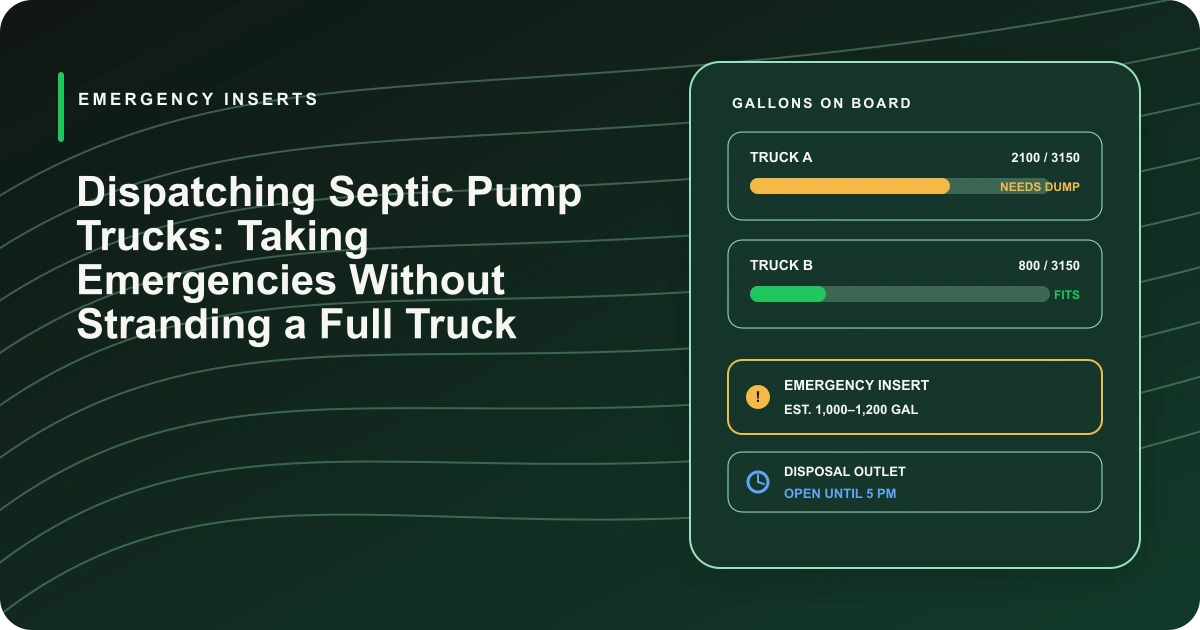
Here is the shape of it, with round illustrative numbers rather than anyone's real tickets. A 3,500-gallon truck has an operator-set 350-gallon reserve, leaving 3,150 usable gallons for this planning example. After two morning stops it carries 2,100, leaving 1,050 gallons of headroom. Intake describes the emergency as a "1,000-gallon tank," but nominal tank size is not a guaranteed pickup volume: standing liquid in lines, continued inflow, uncertain system details, or a bad caller estimate can move the job. If this fleet's history says comparable intake estimates can run 20% high, dispatch plans for up to 1,200 gallons. The nearby truck now needs a dump run before it can say yes, and a truck 25 minutes away carrying only 800 gallons may be the faster answer. Forecasting gallons per job from your own ticket history (the same numbers behind how many septic tanks a truck can service per day) makes this check sharper every month.
Weight is the check that catches up with the bigger rigs, and here the numbers are real. Pumper magazine profiled a 5,000-gallon truck, replacing the fleet's previous 3,600-gallon unit, that weighs about 30,000 pounds empty and 70,000 pounds loaded — a 40,000-pound difference, or roughly 8 pounds per gallon if attributed entirely to the load. Use the truck's actual scale weights rather than that example density. The federal Interstate limits are 80,000 pounds gross, 20,000 on a single axle, and 34,000 on a tandem, and the Bridge Formula can cap an axle group before the gross number binds. State, local, permit, and non-Interstate rules may differ. A tank with volume to spare can still be a truck with no legal headroom left.
Dispatchers usually resolve the choice with one of three instincts, and each has a failure mode. The same triage runs in other vacuum trades; dispatching grease trap service trucks walks the FOG version.
| Instinct | Where it wins | Where it breaks |
|---|---|---|
| Nearest truck | Small, well-understood loads where minutes matter | A near-full tank forces a mid-emergency dump run |
| Emptiest truck | Large or uncertain loads | Often the longest drive, and it may lack the jetter, camera, or crew the symptom calls for |
| Best-equipped truck | Unclear symptoms that smell like a blockage or a repair | Ties up your most versatile rig on what turns out to be a routine pump-out |
Equipment and crew are the third check, and intake already gathered what you need to run it. A straight pump-out needs tank space and hose. A suspected line blockage needs a jetter. A mystery symptom needs a camera and someone qualified to diagnose as well as pump — and sending a pump-only crew to a diagnosis job creates the most expensive outcome available: two emergency responses for one emergency.
DynoRoute's AI dispatcher is designed for this lookup. Its job-to-truck recommendations consider capacity, location, availability, workload, travel time, service areas, and crew skills, then show the reasoning. Conflict checks flag overlaps and insufficient travel time, so the four checks become a suggestion a dispatcher can accept, reject, or overrule instead of a whiteboard argument.
The fourth check, the open outlet, is where enough emergencies go wrong that it gets its own section below.
Which scheduled job moves, and which never does
When an emergency insert displaces planned septic work, move the job with the cheapest consequences. Five tests find it: escalation risk, compliance dates, contract clocks, route damage, and the customer's tolerance for the call.
Escalation risk rules first. A holding tank near its cadence, an alarm follow-up, any job whose customer already mentioned slow drains: these never move, because a bumped job that becomes tomorrow's emergency has doubled your emergency count and converted scheduled margin into after-hours labor. The natural donor is the routine maintenance pump booked from a reminder weeks ago on a system with no symptoms; how those reminder-driven jobs and their jurisdiction windows work is covered in septic pumping scheduling.
Compliance and contracts are hard edges. A county-mandated pump-by date can slide only inside its window, and a commercial account with a service-window agreement (a restaurant, a campground, a care facility) costs more in penalties and trust than the emergency premium earns. Route damage is the quieter test: the moved job has to land somewhere, and dropping it into a day your trucks already spend in that zone costs almost nothing, while re-driving across the county for one orphaned stop can cost more than the emergency brought in.
Something may have to move because planned loads, disposal legs, access time, and driving can consume most of a septic day. Operators describe the same pressure in their own numbers — in a septic operators' workload thread captured in July 2026, one pumper described three jobs as comfortable, with five or six possible only across a long day when access, maintenance, and traffic cooperate. That is one operator's account, not a benchmark. When no feasible slack remains, the discipline is choosing the displaced job on purpose, then calling that customer with a new time before the original window fails.
The dump-run question: before, after, or not at all
Every emergency insert lands in one of three shapes: it fits inside the truck's current headroom, it forces a dump run before the emergency, or it fills the truck and pulls the day's disposal leg earlier. Each shape carries a different ETA and a different cost, and you want to know which one you are promising before you quote a time.
The fit case is clean: take the job and keep the planned dump leg. The dump-first case changes the ETA arithmetic — drive to the outlet, queue, discharge, paperwork, then drive to the emergency. If that chain runs 90 minutes, the "nearest" truck is nowhere near the fastest, and a farther truck with headroom wins. The fill-after case is the sneaky one: the emergency fits, but the truck leaves the job full, so every remaining stop and the dump timing have to replan around it. The standing, non-emergency method is route planning with disposal stops.
Receiving hours are the check that keeps a full truck off the shoulder. Raleigh's septage receiving station, to take one published example, accepts loads Monday through Friday, 5 a.m. to 7 p.m., with weekends by special arrangement only. Run a Friday insert against that window: the call lands at 4:30 p.m., the job takes two hours plus drive time, and the truck comes off it full at 7:15 with the plant closed. If no arranged alternative exists, that truck spends the weekend loaded — out of service for Saturday's schedule, Monday's first hours spent dumping instead of earning. Thirty seconds spent checking outlet hours before saying yes is what that scenario costs to avoid.
Fees and acceptance rules ride along on the same check. Disposal pass-through varies widely by outlet: Raleigh charges $0.09 per gallon at that station, while King County in Washington charges $0.1745 per gallon in 2026 plus a $200 annual fee per truck. An unfamiliar backup outlet may also require hauler approval and load paperwork you have not set up. Keep a working directory of outlet rates, hours, and acceptance rules; the septic day-capacity guide shows how those fees and disposal trips affect the route. The emergency-relevant point is that the directory has to exist before the phone rings, because you cannot build it at 4:30 on a Friday.
Pricing the disruption without an argument
An emergency septic invoice survives review when every source of cost is its own line: a dispatch premium, labor at the disclosed rate, the pumping charge, access work, disposal pass-through, and any materials or repair. A single mysterious "emergency rate" invites exactly the argument that itemization prevents.
Some operators publish exactly this shape. Mac Septic, an Austin, TX pumper, lists after-hours labor at $263 an hour against a $175 normal-hours rate, a 1.5× multiplier with a one-hour minimum, as of August 2026. What you will not find is a national benchmark: published emergency rates are individual operators' price pages, not an industry standard, so anchor your premium on what the disruption actually costs you — the moved jobs, the after-hours crew, the extra dump leg — rather than on a going rate that does not exist.
The other line items come straight from the earlier checks. Access work (locating, digging, a long hose pull) was estimated at intake, so quote it there instead of discovering it on the invoice. Disposal pass-through is the outlet's posted per-gallon rate applied to actual gallons removed. If the crew diagnosed or repaired beyond pumping, that is labor and materials on their own lines. Then close the loop with proof: timestamped photos before and after, gallons removed, arrival and departure times. An emergency customer agreed to a premium under stress; the record is what keeps the number defensible after the stress has passed.
Making it a five-minute decision instead of a gamble
Everything above compresses into what dispatch can see when the phone rings. To run the four feasibility checks and the three dump-run shapes inside five minutes, one surface has to show: each truck's current load against its usable capacity, the day's remaining stops with expected gallons, each crew's equipment and skills, every approved outlet's hours and rates, and the drive times between all of it. On a whiteboard, that is a morning's bookkeeping that goes stale by 10 a.m. In a spreadsheet, it is a tab somebody forgets to update on the day it matters.
This is the operating pattern DynoRoute is built for. Fill limits are set per truck, and planned headroom can be recalculated from estimated job quantities and completed work. DynoRoute uses the phones drivers already carry; it does not read a physical tank sensor, so dispatch must keep load inputs current. Disposal returns are planned as route legs, and the AI dispatcher recommends a truck and driver based on capacity, location, availability, workload, travel time, service areas, and skills, then flags conflicts in the changed day. Drivers can capture timestamped, geotagged photo proof, which supports the service and pricing record without replacing required gallon, disposal, or invoice fields. Plans are published at $199, $499, or $999 a month with included credits and technician caps, no per-truck fees.
If your emergency inserts are currently decided by memory and hope, tell us what your trucks haul and how your days break, and take the next 4:30 call with the math already on screen.