Key takeaways
- An AI dispatcher ranks feasible ways to assign jobs and absorb day-of changes; it does not set your service priorities, and it should never apply a change you have not agreed to let it apply.
- A recommendation is only as trustworthy as the constraint data behind it, so truck capacities, driver hours, certifications, disposal outlet hours, and time windows have to be in the system before any suggestion means much.
- Every suggestion worth accepting arrives with a reason. If the product also shows a confidence score, the vendor must define what that score measures before it can support a decision.
- Overriding has to be cheap: one action, a reason attached, and a system that learns from the rejection instead of re-arguing it tomorrow.
- Measure the payoff as the time from the first disruption to an accepted plan on drivers' phones, and pair every speed number with a service number so a faster plan never hides missed stops.
- Treat broad vendor savings claims as unproven until your own before-and-after log shows faster replanning without worse service.
Ask a dispatcher what worries them about AI dispatching and you will mostly hear about control: who approves the changes, and what happens to routes built carefully around fill limits, disposal returns, and a capacity-planned day when software starts moving jobs on its own. That worry deserves a straight answer. I build DynoRoute, routing and dispatch software for fleets whose trucks fill up as they work, and I have spent this year interviewing the operators and dispatchers who run those fleets. The pricing is published, so nothing in this guide is softening you up for a sales call. The realistic fear is specific: software that is confidently wrong at 6:40 on a Tuesday morning, a driver out sick, an emergency pumpout on the board, and nobody able to tell why. So that is the standard this guide holds AI dispatching to: what it genuinely decides, what makes a suggestion feasible, why the reason line matters more than the ranking, how override should work, and how to prove the whole thing pays without letting a fast plan cover for a bad one.
What an AI dispatcher actually decides — and what it never decides alone
An AI dispatcher for a waste fleet commonly makes four kinds of moves. It ranks which truck and driver should take a job. It flags conflicts, like double-bookings and assignments a truck cannot physically reach in time, before they land on a driver's phone. It identifies feasible places for unassigned work in the schedule. And when the day changes, it recommends adjustments to the work that remains. Strategy, service promises, and the question of which customer gets disappointed when something has to give still belong to the operation.
It helps to be clear about what this improves. Nearest-truck logic answers one question, distance, and ignores the ones that ruin days: how full the truck already is, whether the driver holds the right certification, whether the next commitment still fits. Simple if/then rules can screen individual constraints, while weighted optimization and recommendation systems can also rank feasible trade-offs. When three trucks qualify, the useful output is not merely "all three pass" but which assignment best fits the capacity, workload, travel, priority, and timing inputs the operation has chosen.
The boundary that matters is between recommending and applying. A suggestion is free; an applied change moves a real truck. Decisions that trade one customer's promise against another's, push a driver into overtime, or touch a compliance-sensitive load should reach a human with authority every time, because the software does not carry the relationship and it does not sign the consent order. Automatic application has a place, covered further down, but it is a setting you grow into deliberately, never a default you discover after the fact.
The constraints that make a recommendation feasible
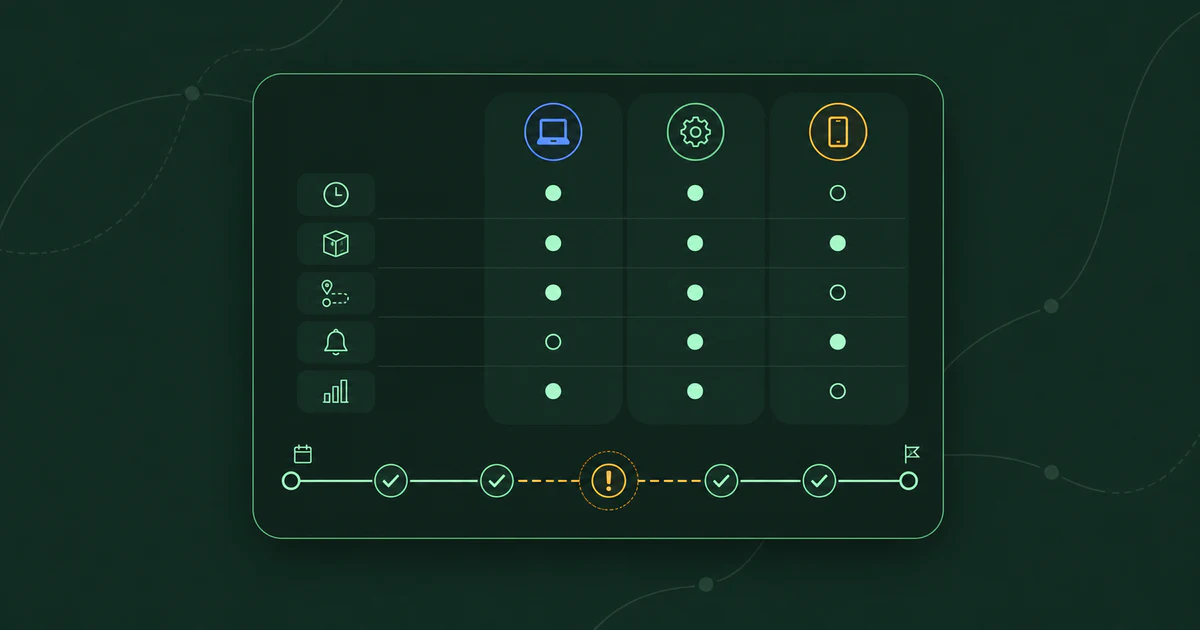
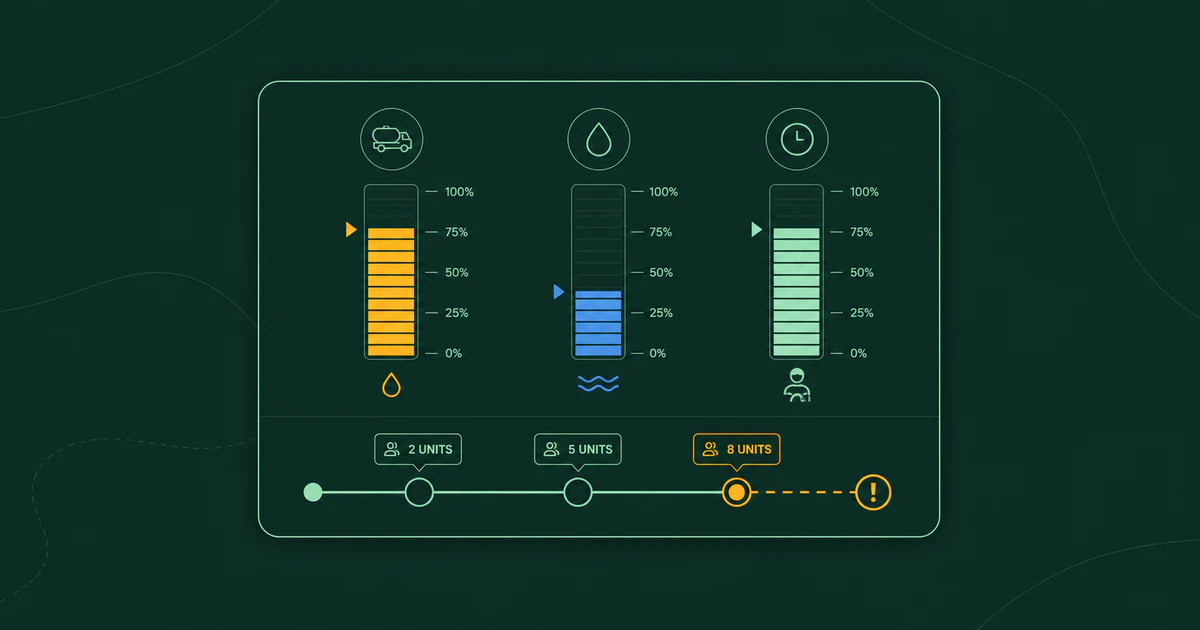
A dispatch recommendation is feasible when it clears every hard constraint the operation actually runs on: what the truck can still hold after its earlier stops, who is allowed and available to do the work, when the site will let a truck in, and where the load can legally go afterward. Miss any one of those and the suggestion is just homework for whoever catches the mistake.
The textbook core here is the capacitated vehicle routing problem: Google's solver documentation defines it as routing in which the total quantity a vehicle carries can never exceed its capacity. A waste fleet's day is that problem plus everything the textbook leaves out — disposal outlet hours, waste-stream compatibility, gate codes, and contracts that promise a specific driver. None of the list below will be news to you; the evaluation question is whether the software models all of it, because a recommendation engine only protects you from the failures it can see.
| Constraint | What "feasible" has to mean | What stale data produces |
|---|---|---|
| Truck capacity | Gallons, pounds, or yards still free after every stop already routed | A nearly full truck sent to a job it cannot finish |
| Driver hours and shifts | The assignment fits inside the shift, including the drive back | Quiet overtime, or a route abandoned mid-afternoon |
| Skills and certifications | The driver is qualified for this waste stream and this site | A turned-away truck and a burned service window |
| Waste-stream compatibility | The load on board can share a tank with what this job adds | A contaminated load the outlet refuses |
| Time windows and site access | Arrival inside the window, truck fits the site, codes on file | A truck idling outside a locked gate |
| Disposal outlet | The planned outlet is open, reachable, and accepts the stream | A full truck with nowhere legal to empty |
| Contract terms | Promised cadence and dedicated-driver commitments hold | A serviced stop that still generates a complaint |
This table is also the honest answer to "why are the suggestions bad": the ranking is only as good as what feeds it. Before trusting a single recommendation, three data sets need to be true. Vehicle capacities as they actually are, not the brochure figure. Driver schedules including the exceptions everyone carries in their head. And service durations taken from history rather than optimism, because insertion decisions live or die on how long a stop really takes. Getting that knowledge out of the dispatcher's head and into the model is most of the value, before any AI cleverness starts.
Why did it pick that truck? Reasons, confidence, and the rejected alternatives
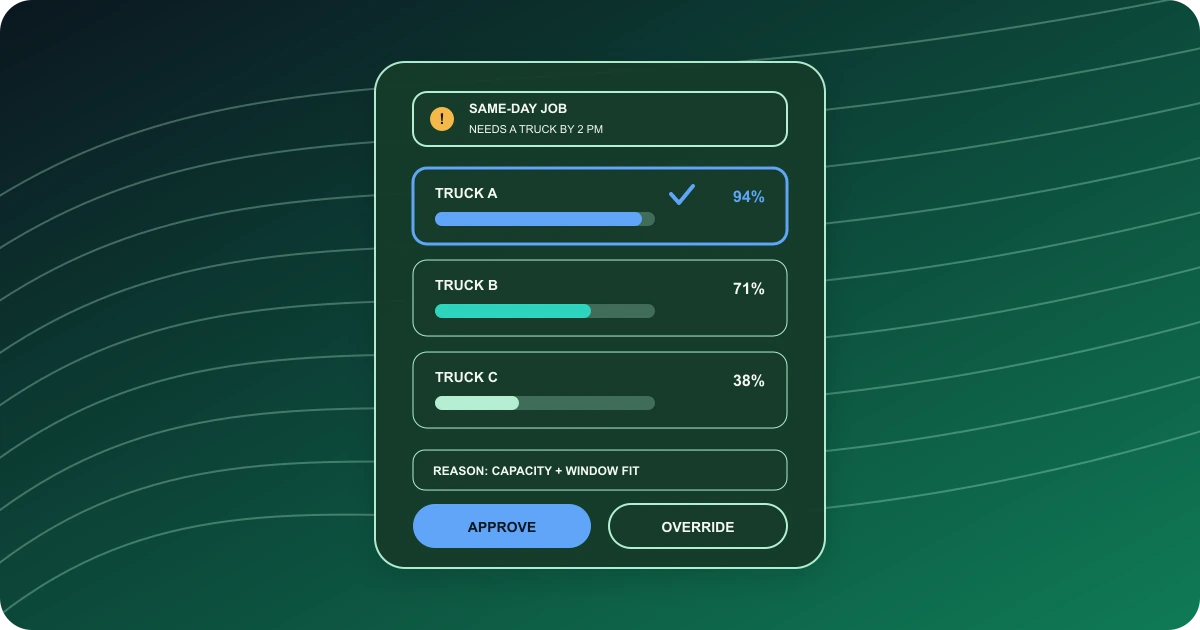
A recommendation you can trust shows three things next to the pick: the reason, meaning which constraints drove the choice; a confidence score whose meaning the vendor defines; and the downstream effect, meaning what else moves if you accept. A suggestion missing that context is asking you to approve on faith.
There is standards-body weight behind that instinct. NIST's AI Risk Management Framework guidance on human-AI interaction notes that representing complex situations with mathematical models "can come at the cost of removing necessary context," and that people read AI output very differently once that context is gone. Translated to a dispatch desk: a bare "send truck 4" strips out exactly the information a dispatcher needs to judge whether truck 4 makes sense.
Do not assume a confidence score is a probability or a measure of spare capacity. Ask what it measures, how it was calibrated, and whether similar scores have produced similar outcomes in your own operation. A high number with no definition is decoration. The reason line and downstream effect make the score testable: if truck 3 ranked lower because the plan projected overtime, the dispatcher can check that assumption against the shift record and the customer commitments the model may not fully capture.
Overriding the machine without breaking the day
Safe override rests on three mechanics. No change applies until someone with authority accepts it. Rejecting a suggestion is one action that carries a reason. And every accepted change lands in an activity log somebody can audit later. If any of the three is missing, the dispatcher is not overseeing the system; the system is quietly overseeing the dispatcher.
The same NIST guidance describes operational AI as running on a spectrum: a system may decide autonomously, defer the decision to a human expert, or serve as an additional opinion, with the right point set by the stakes involved. On a dispatch desk that spectrum becomes two working modes. Plan review is the deferring end: every suggestion queues, you accept or reject, nothing moves without you. Auto mode is the autonomous end, and it belongs only to disruptions with one obvious right answer. The mode is a choice you make per situation, and it should always be revocable.
DynoRoute supports that control model. Rejecting a suggestion records the reason, and rejection history feeds later recommendations. Routes you have hand-tuned can be locked so optimization leaves them alone. Plan Review queues suggestions for acceptance, while Auto Mode and recovery agents can handle late-running jobs, cancellations, and schedule gaps under guardrails you choose. The important point is that automation is a mode you enable deliberately, not an assumption built into the word "AI."
As for undo, the cheapest undo is the change that never auto-applied in the first place, which is what plan review is for. When you accept something and regret it, reassignment stays a manual, immediate act, and the activity log answers the question that actually causes fights later: what changed, when, and on whose say-so.
Proving it saves time without hiding service damage
Measure planning speed as one interval: from the first sign of a disruption to an accepted plan pushed to drivers' phones. Then pair it with service metrics — missed stops, late windows, unplanned disposal runs — so a fast plan never takes credit while service quietly degrades.
Start with the honest limit: a vendor's savings number is not proof for your fleet. Log two ordinary weeks before changing anything: minutes spent replanning after each disruption, missed or late stops, overtime hours, unplanned disposal runs, and miles against collected volume in the spirit of a route density check. Then run the same log after under comparable conditions.
Two of the after-numbers deserve special attention. The first is the interval above, disruption to accepted-plan-pushed, because it captures the whole job rather than a demo moment. The second is override outcomes: every time you reject or change a suggestion, note what happened next. If your overrides keep beating the machine, inspect the constraint data and ranking logic. If accepted suggestions keep performing well, you may have evidence to automate more. A falling override rate means little unless missed stops, late windows, overtime, and unplanned disposal runs are stable or improving too.
For scale, one illustrative example with round numbers, not a measured result: if re-planning after a driver call-out eats forty-five minutes of dispatcher attention today and reviewing an AI plan takes ten, that is thirty-five minutes back per disruption, and at three disruptions a week, roughly ninety hours of dispatcher time a year. Swap in your own minutes: the arithmetic is the point, and the two-week log supplies the real inputs.
What to demand before you hand over the accept button
Whatever software you evaluate, mine included, the checklist is the same:
- It models your real constraints (capacity remaining after each stop, disposal outlets, certifications, time windows) rather than distance alone.
- Every suggestion arrives with a reason and a confidence score you can interrogate.
- Conflict detection runs before a plan reaches a driver, not after.
- Review and auto modes are your choice per situation, and rejecting is one action that teaches the system.
- Every change lands in a log, and routes you have hand-tuned can be locked.
- It runs on the phones your drivers already carry, with no hardware install.
- The pricing is readable before anyone makes you sit through a demo.
DynoRoute is designed for fleets whose trucks fill up or empty out as they work. Its documented AI Dispatcher matches work using capacity, location, availability, workload, travel time, service areas, skills, priority, and business hours, then returns confidence-scored recommendations with reasoning. It checks double-bookings and insufficient travel time, shows the fleet's day on a live dispatch map and timeline, and includes a voice assistant for dispatch questions and schedule changes. Plans are $199, $499, and $999 a month with credit-based optimization and no per-seat pricing; included credits and plan limits determine which tier fits.
Log your next two weeks either way; and if you decide the call-outs should run through a system that shows its work, tell us what your fleet hauls and how your dispatch day breaks.