Key takeaways
- If routes fully exist only in one person's memory, the business carries a single point of failure and the undocumented change history can compound over time.
- A gate code belongs on the customer's record, a repeatable decision belongs in a tested rule, and a rare emergency procedure belongs in a short playbook. Tacit judgment and relationship knowledge also require shadowing, practice, and named ownership.
- Capture can work in the seams of normal operations through sit-alongs at planning time, short incident reviews, and route-note cleanups. Larger documentation projects need narrow scope, owners, and an operating cadence if they are to finish.
- Written route facts can go stale after their author leaves, so each material fact needs an owner, source, last-confirmed date, scope, and review trigger appropriate to its risk.
- Shadowing transfers tacit judgment; drills against records test what the business itself holds. A drill failure may expose a documentation, training, tool, or decision-policy gap.
Somewhere in your operation may be a person who knows which customer's gate code changed in March, which scale house backs up after 1 p.m., and which street the big truck cannot turn onto. If that person plans your routes, this article is about the day they are unavailable or leave. I build DynoRoute, routing and dispatch software for fleets whose trucks fill up as they work. Across capacity-constrained operations, capacity math, disposal-site timing, and customer quirks can accumulate in one dispatcher's head. What follows is a continuity plan: what is at risk, where explicit knowledge should live, how to capture tacit judgment without stopping the operation, and how to test whether a backup can run the day.
What walks out the door when a dispatcher leaves?
When a long-serving dispatcher leaves, the fleet may lose access to eight kinds of knowledge at once: customer facts, site quirks, route exceptions, vehicle limits, driver capabilities, disposal-site rhythms, contract terms, and recovery moves. Some may be written down, some may exist only as habit, and some may sit in disconnected systems. The continuity risk is the gap between what the operation needs and what another person can retrieve and apply.
Consider a hypothetical first Monday after the departure. The new planner builds routes that look fine on the map. Then a truck sits twenty minutes at a locked transfer-station gate, because nobody else knew the northside facility shuts its inbound lane for cleaning on Monday mornings. A driver calls in: the plan has him at an industrial account he has never serviced, and the old dispatcher would never have sent him there, because the site requires a safety credential he does not hold. A property manager calls the office: the truck arrived at 6:40 a.m., and the one thing that account cares about is the contract line that says nothing before 7. Every miss is small. Ten of them a day is chaos, and none of it is the new planner's fault. They were handed a map for a job that runs on a memory.
The cost rarely arrives as one invoice. It can appear across training time, slower planning, preventable misses and rework, customer credits, overtime, and serviced work that did not reach billing. Measure those categories before and after a transition rather than relying on a national turnover estimate.
I went looking for a published number to put on all this, and I'll save you the search: there isn't one. The Bureau of Labor Statistics' May 2025 table counts 202,810 dispatchers outside police, fire, and ambulance work, at a mean wage of $26.32 an hour, yet publishes no turnover rate for the occupation and nothing waste-specific. Any vendor quoting you a precise national cost of dispatcher turnover is decorating. The measurable version lives on your side of the fence: your own callbacks, credits, and overtime in the ninety days after a departure.
Records, rules, and playbooks: where each route fact belongs
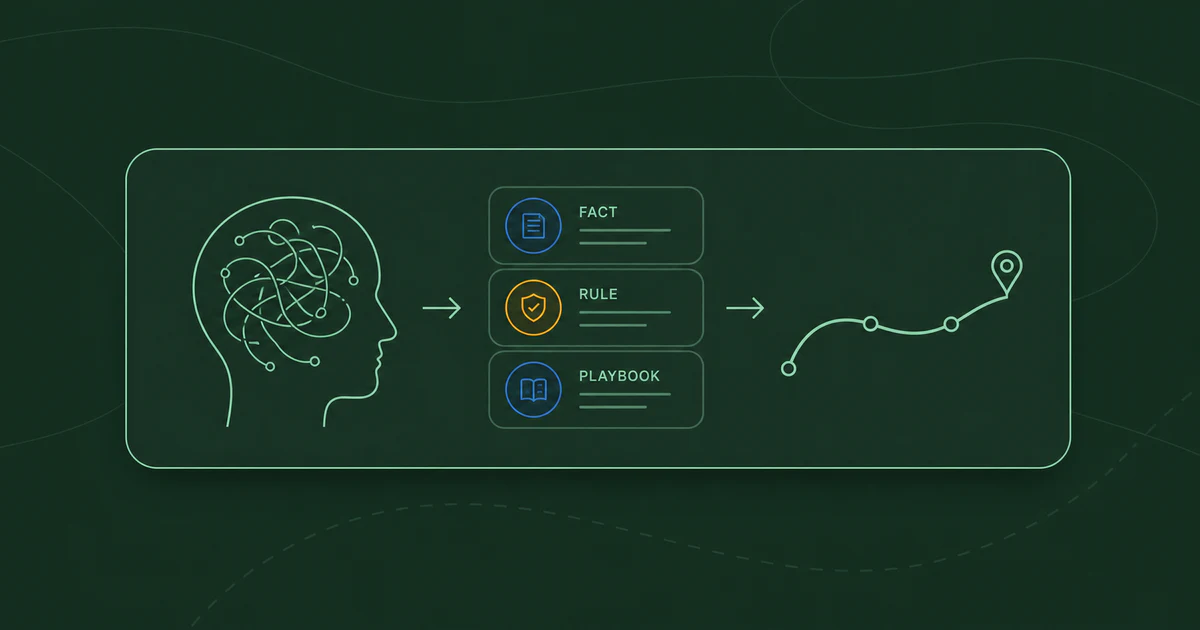
Most explicit route knowledge has three practical homes. A fact about a thing—a customer, site, truck, or disposal outlet—belongs on that thing's record as a field that can be found and reviewed. A decision made consistently belongs in a rule the planning workflow can enforce or flag. A rare sequence belongs in a playbook short enough to use during the incident. Tacit judgment, negotiation history, and relationships do not reduce neatly to fields; preserve them through shadowing, scenario practice, and clear ownership as well as documentation.
| Knowledge domain | Example facts | Where they belong |
|---|---|---|
| Customers | Gate codes, "never before 7 a.m.," who answers when the yard is locked | Fields on the customer record |
| Sites | Approach side, overhead clearance, where the container hides behind the building | Site record plus per-stop notes the driver sees |
| Routes | Streets that need the short truck, school-zone hours, seasonal closures | Restricted zones and route rules the optimizer respects |
| Vehicles | Real usable capacity, the liftgate that fails in the cold, height limits | Truck profiles with capacity and restriction settings |
| Drivers | Endorsements and certifications, who can run the industrial accounts | Driver records with skills the dispatcher matches against |
| Disposal outlets | Hours, ticket process, when the scale line peaks, the backup site | Facility records plus scheduled reset visits or an explicit reset playbook |
| Contracts | Service frequency, must-hit windows, what triggers a credit | Service schedules and time windows on the account |
| Recovery moves | Truck-down reshuffle, missed-stop protocol, storm-day plan | One-page playbooks |
The failure mode is letting everything default into free text. A gate code buried in a notes column is better than a gate code in a head, but it is hard to audit systematically, nothing enforces it, and when it changes, the stale copy keeps circulating. The line DynoRoute refuses to blur is the one between the first two homes. Free text travels: an access note or a gate code typed on a stop shows up on the driver's phone at that exact stop. But anything the plan depends on goes in as structure: tank capacity on the truck profile, restricted streets as zones a route cannot cross, service windows on the account, a skill requirement that keeps an unqualified driver out of the recommendation set. A note advises whoever happens to read it. A constraint binds even a planner who started yesterday.
Playbooks cover what's left: the rare, high-stakes sequences like a truck down at 6 a.m. or a primary disposal outlet closed without notice. Keep each one to a single page with the first three moves and the phone numbers, and write them from real incidents rather than imagination.
How do you capture the knowledge without stopping the operation?
Extract route knowledge during normal work: a sit-along while routes are planned, a short review after material incidents, a cleanup pass over existing notes, and a rule that meaningful exceptions get a reason recorded. A larger knowledge-base project can work, but only with defined scope, owners, review dates, and integration into the operating workflow. A kickoff meeting is neither the problem nor the solution; continued use and maintenance decide whether the record survives.
A planning sit-along can expose decisions that a route sheet does not. Ride-alongs show the physical route; sitting beside the dispatcher while tomorrow is planned shows the trade-offs. Ask them to narrate important overrides—a moved stop, swapped truck, or resequenced morning—and capture the reason. With informed permission and an appropriate retention policy, recording the session may make extraction easier. Validate each candidate rule before structuring it; one remembered example may be an exception rather than policy.
Incident reviews are the second seam. Review material callbacks, missed stops, and outlet turnaways soon enough to preserve context, asking what the plan lacked and whether the issue was data, policy, execution, or an external change. Put a validated fact into its proper home and assign any follow-up. The review length and threshold should fit the incident risk.
The third seam is cleanup. The notes column of your route sheet is an archaeological dig: living facts worth promoting into real fields, questionable ones worth dating and verifying on the next visit, and dead ones ("ask for Carl" when Carl retired years ago) worth deleting so drivers stop reading around them. Meanwhile, let the field feed you: when a driver skips or fails a stop, the app should ask for a reason and a note from the cab, which turns every exception into field-verified knowledge arriving daily instead of a story that evaporates on the drive home.
Explain the continuity project in the open. Documentation can be perceived as monitoring or role redesign regardless of anyone's motive, so state who will use the material, what will be recorded, and how it supports coverage, training, and time away. Obtain permission before recording conversations and avoid turning informal customer context into unrestricted notes.
Keeping route documentation alive after its author leaves
Documentation is easier to trust when material route facts carry an owner, source, last-verified date, explicit scope, and review trigger. Apply the controls in proportion to risk: a temporary road closure needs tighter review than a stable customer identifier.
Decay follows a predictable path. The author leaves, and the notes freeze on their last day. The world keeps moving: an outlet changes its hours, a customer moves the container, a road closes. A driver follows a note and hits a wrong gate code twice, and after the second time he stops reading notes altogether — and tells the other drivers. Trust in the written record collapses fleet-wide, everyone reverts to memory, and within a year you hold stale documentation and a new crop of memory-only knowledge at the same time, which is strictly worse than where you started.
The five parts of the fact schema are each doing a specific job against that slide. The owner is a role, never a person — "the dispatcher on duty" survives turnover, a name does not. The source records where the fact came from (a driver report, a customer call, a facility notice) so conflicting versions can be adjudicated instead of argued. The last-verified date tells a reader how much to trust it, and gets refreshed any time someone confirms it in the field. The scope draws the boundary: "no entry before 9" on school days only is a different fact from "no entry before 9," and obeying the wrong version costs stops. The review trigger is what replaces the departed author's ongoing attention: temporary facts get an expiry date ("construction detour until October"), seasonal facts get a calendar check, and everything else gets re-verified when its parent entity changes — an account renegotiates, a truck is sold, or a disposal site the route depends on posts new hours.
Close the loop with a short recurring sweep: facts past their review date, facts contradicted by recent field reports, and notes with no owner. Weekly may fit a changing operation; monthly or event-triggered review may fit slower facts. Keep the queue small enough to resolve and track completion so stale items do not simply roll forward.
How do you know a backup dispatcher is ready?
A backup dispatcher is ready when they can plan a real day cold — from the records, without calling the regular dispatcher — and the plan survives four checks: the routes are feasible, the service commitments are protected, the right people were told, and the trail they left can be audited by a third person.
Run a drill often enough to match the continuity risk—monthly is one example for a high-change operation. Hand the backup a prior day's jobs with the plan withheld, or use a scenario such as a truck down at 6 a.m., the primary outlet closed, drivers unavailable, or a weather surge. Score feasibility, service protection, communication, and audit quality. Feasibility asks whether the routes respect what each truck can actually hold and when it must break for the outlet, rather than whether the map looks tidy. Service protection asks how contractual priorities were handled. Communication asks who was told. Audit quality asks whether someone could later reconstruct what was decided and why.
Score a failure the right way. If the backup routed a truck to the northside outlet on a Monday morning, the interesting question is whether the Monday closure was findable in the records. If it wasn't, the drill just located a documentation gap at the cheapest price it will ever have. Fix the record, then re-run the scenario next month.
Shadowing is useful for tacit judgment and relationships, but it is incomplete when knowledge remains only in the trainee's memory. Pair it with records, tested rules, and scenario drills. The drill tests what the business can retrieve and apply; shadowing teaches the nuance the documentation may not yet capture.
Moving route knowledge into a system the fleet owns
Whatever software runs your routes — ours included, which is what the rest of this section describes — judge it as a knowledge container before you judge its map colors. The test has five parts: facts must land as structure, with custom fields on customers, sites, trucks, and stops rather than one long notes column; rules must bind, enforced by the routing engine instead of merely displayed; notes must travel, reaching the driver's phone at the stop where they apply; proof must flow back, so the field corrects the record daily; and the whole trail must be auditable by someone who wasn't there.
DynoRoute documents custom records and fields, customer and stop notes, vehicle capacity and restrictions, service windows, skills, service areas, CSV import, and mobile proof with timestamped photos, signatures, notes, and failed-stop details that can sync after offline work. The AI dispatcher evaluates capacity, location, availability, workload, travel time, service areas, skills, and other inputs, then shows reasoning with each recommendation. Workflow rules, custom agents, and the documented stale-work detector may support a review queue, but a knowledge-staleness process must be configured and tested; a human still owns corrections and the source of truth. Playbooks, judgment, consent, and relationship context remain human work.
None of this makes a great dispatcher less valuable. It makes the business survive the day you lose one. If your routes live in one person's head today, book an intro call and start the extraction while it's still a project instead of an emergency.