Key takeaways
- A porta potty is due at the earliest applicable trigger: the contract date, current rules or standards for that use, measured condition or use, and any event requirement on the site. A weekly label by itself is not enough.
- Public-use and workplace units sit under different adopted PSAI standards: ANSI/PSAI Z4.4-2025 for general public use and ANSI/PSAI Z4.3-2025 for places of employment. Use the current text for the applicable scope.
- Construction service is often cadence-locked but flexible on the exact day unless a contract or site rule says otherwise; event work is usually locked to dates and hours.
- Adding units and adding visits are related but not interchangeable controls: concentrated use, access, sanitation condition, contract terms, and current standards determine which combination is acceptable.
- Moving one occurrence should not unintentionally edit the whole series; shutdowns, holidays, skips, and series changes need distinct recorded actions.
- Every completed visit should preserve the information needed to determine the next due date under the series' governing anchor; completion does not automatically restart every clock.
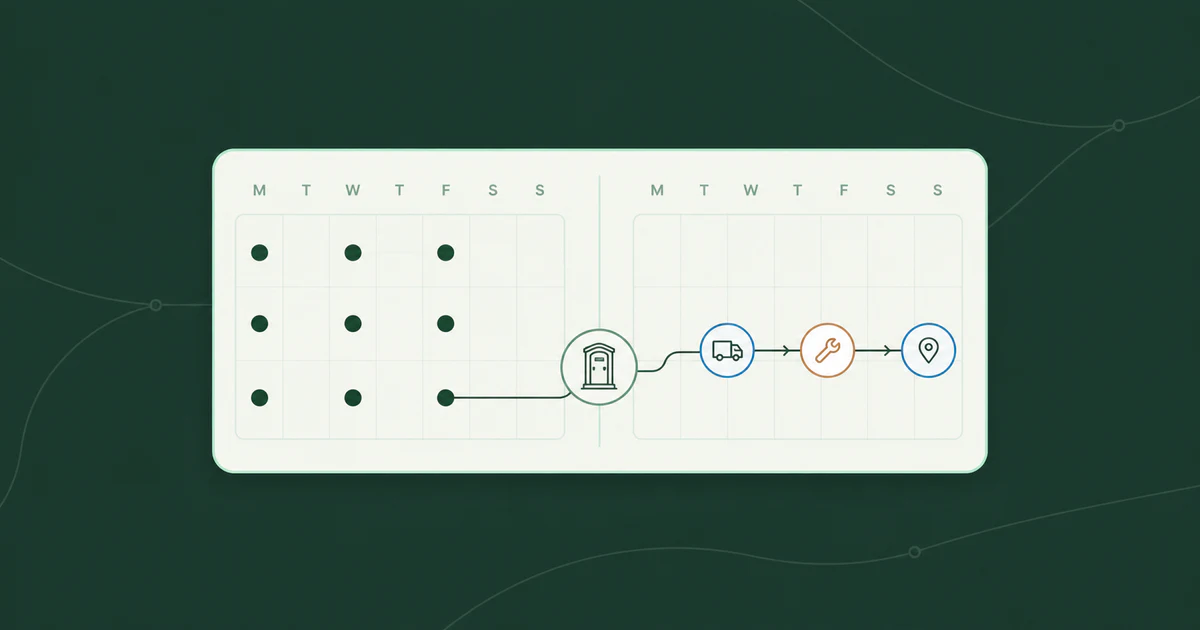
Porta potty service scheduling becomes two linked schedules when an operator serves both construction and events. Construction units often follow a recurring cadence, while event units may require exact dates: deliver Thursday, service Saturday before gates open, pick up Monday. Both compete for the same trucks whose tanks fill up as they work, so a surge in one book can disrupt the other. I build DynoRoute, routing and dispatch software for capacity-constrained fleets, including porta potty software for portable sanitation operations. This guide covers due-date inputs, construction and event work, the trade-off between unit count and service visits, occurrence changes, and the service record. The capacity math of the truck day runs underneath all of it.
Invented numbers below are labeled illustrative; every standard cited is linked to its source.
When is a porta potty unit actually due for service?
A unit is due at whichever applicable trigger arrives first: the date the contract promises, the current rule or standard for that use, the measured sanitary condition or use, and any requirement attached to an event. As a scheduling rule, service due = the earliest applicable contract, compliance, condition, and event trigger. Weekly is a common cadence, not a universal substitute for checking scope and actual use.
The Portable Sanitation Association International (PSAI) announced ANSI approval in April 2025 of ANSI/PSAI Z4.3-2025, for nonsewered systems at places of employment, and ANSI/PSAI Z4.4-2025, for general public use. PSAI's current standards page summarizes the separate scopes and directs readers to the adopted texts. The earlier 2024 revision draft is not the publication to use for current numeric service or capacity requirements. Obtain the applicable 2025 standard and check it alongside the contract and federal, state, and local rules before setting a compliance cadence.
State rules add a trigger by refusing to name a number at all. Illinois's portable toilet rule, a useful example, requires servicing at whatever frequency keeps units sanitary and free of odors. That is a performance standard: if the unit smells on Thursday, a Monday appointment is not a defense.
Crew size affects use, but fixture-count rules do not set the pump schedule. OSHA's construction sanitation rule (29 CFR 1926.51, Table D-1) requires one facility for crews of 20 or fewer, then one toilet seat and one urinal per 40 workers, moving to one per 50 workers for crews of 200 or more. Those minimums govern worker access. Job-site service frequency belongs to the current Z4.3 standard, the service contract, applicable local rules, and field condition. Record crew size, units on site, condition at service, and any early-service calls; that history tells you whether a weekly site needs more units, a shorter interval, or both without borrowing a public-event threshold.
Construction cadence and event turnarounds are different jobs on the same trucks
Construction work and event work fail differently, so they need distinct schedule attributes. A construction unit on recurring service may have some date flexibility, but only inside the contract, current standard, site-access rules, and observed condition. Event work is often date- and time-bound; a late delivery can breach the event commitment. Flatten both into one undifferentiated stop list and the schedule loses the information a dispatcher needs when the day gets tight: which visits can move, by how much, and under whose authority.
An event can generate several related jobs, each with its own timing rule. Delivery places the units with enough margin to correct a short load or access problem. Pre-event prep may be needed close to start time. During-event service depends on duration, use, sanitation condition, and safe access. Schedule service in controlled access periods wherever the current standard, site plan, and safety assessment require it; do not route a service vehicle through a crowd merely to preserve cadence. Pickup closes the chain and returns units to controlled custody and available inventory.
The two rhythms collide on the truck list, and the resolution has a direction: anchor the date-locked work first, then test which date-flexible visits can move around it without crossing a contract, compliance, or condition trigger. A festival weekend may be absorbed by pulling eligible visits forward, but only after that check. The failure mode is deciding this on Friday afternoon; the schedule should model the surge when the event books.
More units or more frequent service?
When the same unit count works at one site and fails at another, concentration of use may be part of the difference. A week's use spread evenly presents a different service problem from the same use packed into six hours. Unit count and service frequency are related controls, but the acceptable combination comes from the applicable standard, contract, site access, observed condition, and risk—not cost alone.
| Factor | Favors more units | Favors more frequent service |
|---|---|---|
| Use pattern | Concentrated bursts a truck cannot service mid-event | Steady daily use that accumulates predictably |
| Yard inventory | Units sitting idle in the yard | Fleet stretched thin in peak season |
| Site access | Trucks cannot reach the placement during use hours | Truck access is easy at off-hours |
| Truck time | Routes already full; no slack for extra visits | Spare tank capacity and hours on existing routes |
| Money | Delivery is one trip; the unit rents for the duration | Extra visits cost tank space and drive time every week |
During a concentrated burst, safe service access may be unavailable. Where a service truck cannot enter under the event's access and safety plan, adequate capacity has to be in place before gates open or service must occur during a controlled interval. Concentration can favor more units; frequency helps only where service can occur lawfully and safely.
Quoting only a fixture minimum can miss the site's operating conditions: shifts, use concentration, accessibility, cleaning needs, weather, vandalism, and tip-over risk can all change the service plan. How many units one truck can handle in a day is covered separately in how many porta potty units fit on one route.
Holidays, weather, and shutdowns: moving one visit without breaking the series
A weekly visit can slide only when the applicable compliance, contract, and condition triggers still hold on the new date. A lightly used unit may carry slack; a unit already generating early-service calls does not. Know which sites run near their actual trigger and let only the others move.
How the move is recorded matters as much as whether it happens. One failure is the silent skip: a holiday lands on Monday, the visit disappears, and nobody owns the decision. Another is cadence drift: a one-day exception unintentionally rewrites future dates. At minimum, distinguish a single-occurrence move, a pause with a restart instruction, a documented skip or failed visit, and a deliberate series change with an effective date. The governing anchor determines what happens to the next occurrence.
A rain week is the classic double exception: it empties the construction site, which drops use counts and buys slack, and it turns the access road to mud, which can take the visit away from you anyway. Wind is an asset problem more than a schedule problem, but it lands on the schedule as unplanned visits to right and re-stake tipped units. As for seasonality, I looked for an authoritative published seasonal demand curve for US portable sanitation and there isn't one; your own service history is the only defensible model, which is one more reason the records in the next section matter beyond billing.
Generating a weekly series is easy; what matters is everything afterward. Any system should let an individual visit move without silently rewriting the underlying cadence, keep pauses explicit with a restart date, and surface unassigned or overdue visits instead of deleting them. DynoRoute supports recurring jobs with linked visits, an unscheduled queue, and overdue alerts. Before importing a live schedule, test the exact single-occurrence move, pause, and restart behavior you intend to use; the operating rule should not depend on an assumption about series semantics.
What proves every scheduled unit was serviced?
A more defensible service record answers six questions: which unit, at which site, at what time, with what outcome, supported by what evidence, and how the next due date will be determined. Depending on the operation, that can include unit ID, site, timestamp, location where supported and required, outcome code, photo or exception reason, measured waste and water quantities, and the series anchor. The contract, policy, and dispute decide which fields matter; no fixed set makes a record automatically conclusive.
Identity ties the visit to a unit rather than only to an address, which matters when a site holds several units; keeping identity trustworthy at fleet scale is covered in porta potty unit tracking. Time and supported location evidence can corroborate presence but do not settle every dispute alone. Outcome and exception fields preserve attempted or incomplete work. Waste and water volumes, where measured, can support billing and improve load forecasts; they do not directly prove a use count.
The service record should feed the next scheduling decision without silently changing the series. A surprisingly full tank is evidence to review cadence, unit count, access, or measurement; it is not proof by itself that the interval must change. For completion-anchored work, the qualifying service event may restart the clock. For fixed-calendar work, preserve the original series unless an authorized series edit is made.
Running both rhythms on one system
Whatever you run your schedule on, it has to clear six bars: recurring series and date-locked event chains on one board; visibility into which visits can flex when a surge lands; truck days planned against tank capacity and hours, not just stop counts; single-occurrence moves, pauses, and restarts that do not corrupt a series; proof capture in the driver's hand; and service records that flow to invoices without retyping. A disciplined spreadsheet can cover parts of that model, but keeping recurrence, capacity, field proof, and billing synchronized becomes fragile as the number of changes grows.
DynoRoute documents weekly, biweekly, monthly, and custom recurring jobs with individual visits; dated jobs for event deliveries, services, and pickups; AI assignment suggestions using capacity, location, availability, workload, travel time, skills, priorities, and business hours; and conflict checks before assignment. Drivers can capture timestamped photos, signatures, notes, forms, and failed-stop details with offline sync. Job records can feed invoicing and QuickBooks, and mapped customer and job fields can start through CSV import. Test occurrence moves, pauses, restarts, unit identity, dual-capacity inputs, and disposal or refill resets with real workflows before relying on them. Plans are $199, $499, and $999 a month with included optimization credits and technician caps and no per-seat pricing.
If your board is carrying weekly cadences and event dates in the same spreadsheet, book an intro call and start next season with a schedule that can hold both.