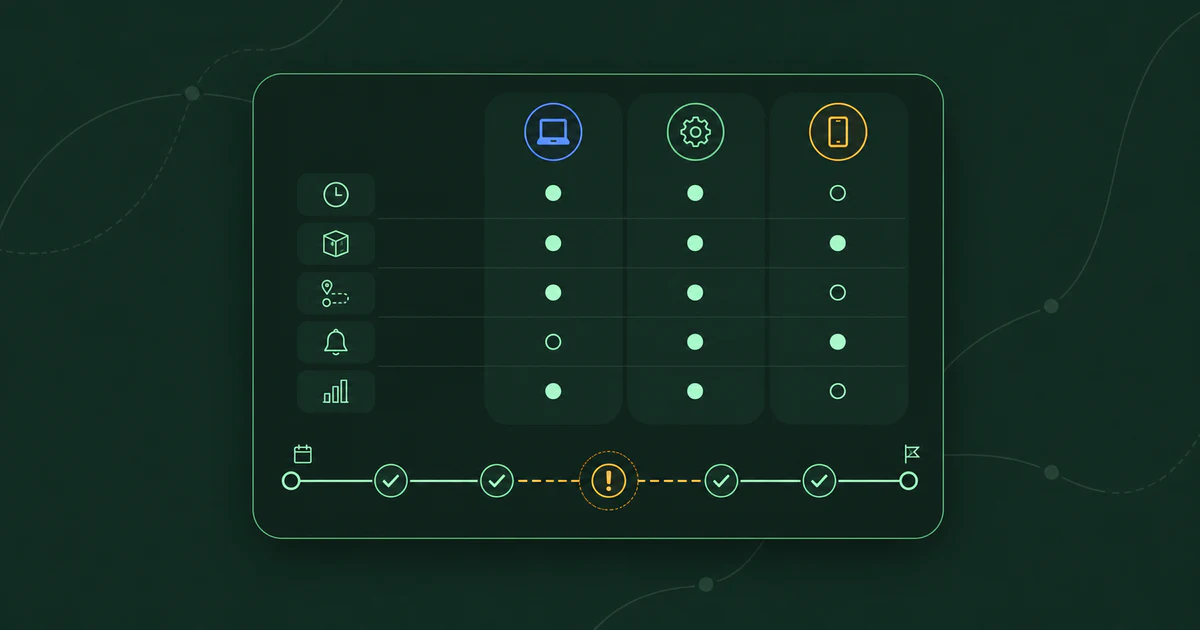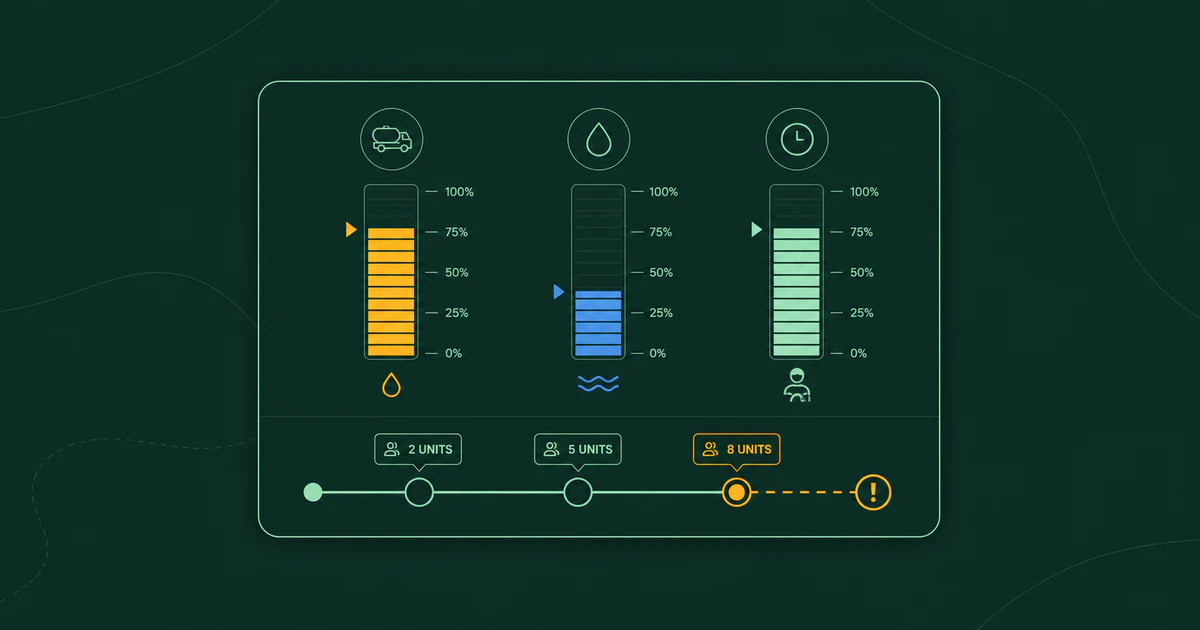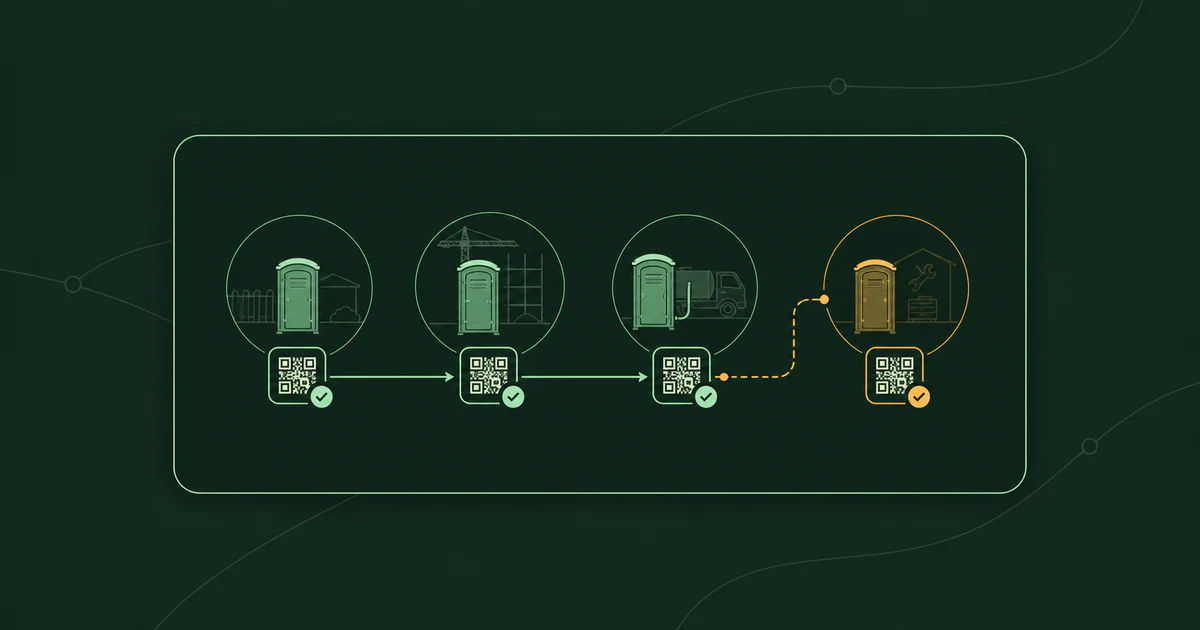
Key takeaways
- Track one record per unit when condition, custody, service history, or billing depends on knowing which physical asset moved; derive site counts from those records.
- A site's assigned unit list is a claim, while the latest scan, photo, or custody event is the evidence that confirms it.
- Durable QR or barcode labels are a low-cost identity option when scan compliance is practical. GPS belongs where asset value, loss history, recovery needs, and coverage justify its total annual cost.
- Pickup and yard intake are separate events: pickup ends field custody and possibly rent, while intake records condition and sends the unit to cleaning or repair.
- Reconcile contracts, deployed-unit records, completed services, yard states, and quiet units as an exception list every week rather than waiting for a fleet-wide count.
- The most expensive “missing” unit may be sitting in the yard under the wrong state and earning nothing, a failure that more tracking hardware will not fix.
Porta potty unit tracking starts with two commitments: one authoritative record per serialized unit, covering identity, type, ownership, assigned site, contract, state, condition, and service history; and a custody or service event whenever a material change occurs. In manually managed fleets, unit numbers may live on doors while location, rental, next-due, and route data sit in separate sheets or in people's memories. I build DynoRoute, routing and dispatch software for capacity-constrained fleets, including porta potty software for portable restroom operators. This guide covers the unit record, identification options, custody events, reconciliation, and the math for deciding when active tracking earns its subscription.
What a porta potty unit record has to contain
A complete porta potty unit record answers eight questions about any unit in under a minute: which unit it is (a durable ID), what kind (type and model), whose it is (owned, leased, or customer-supplied), where it stands (assigned site and position), under which deal (the contract or order line), what state it is in (one status from a closed list), what shape it is in (condition, with photos), and what has been done to it (service and repair history, with the next service due). If your records cannot answer all eight, the sections below are the repair plan.
The first decision is what you are actually tracking: serialized units or counts by site. If condition, custody, service history, or unit-level billing matters, use serialized units and derive the counts from them. "Twelve standards at the fairgrounds" is a report; unit 214 at the fairgrounds since June 6, serviced Tuesdays, cracked vent noted at the last visit, is a record. Counts cannot carry unit-specific damage, custody, or service history, and the moment two identical units cross paths on a trailer, a count-based system has nothing to say about which is which.
Identity has to survive pressure washing, sun, tip-overs, and repaints. Painted numbers fade and get duplicated when fleets merge; a riveted plate or an outdoor-rated label carries the number, and the register carries everything else.
Type belongs in the record because availability is sold by type. A festival order is so many standards, so many ADA-accessible units, hand-wash stations, maybe a restroom trailer, and the register has to answer availability per type and date range. Type also sets the tracking budget later, because an ADA unit costing two and a half times a standard justifies attention a standard does not.
State is where most registers quietly rot. A unit is in exactly one state at a time, from a closed list, and every state change is caused by a recorded event. Vendor software in this vertical keeps the list short (LayCor, one of the porta potty software vendors, tracks units as in yard, on site, in transit, or out for cleaning as of August 2026), but a working fleet needs the yard split further, because "in the yard" is where the count arguments live. A unit fresh off a festival trailer is in the yard; so is a unit stripped for parts; only one of them can be rented on Friday.
| State | What it means | What ends it |
|---|---|---|
| Rent-ready | In the yard, cleaned and inspected | A reservation or a deploy |
| Reserved | Promised to an order | Load-out |
| In transit | On a truck or trailer | A drop-off scan or yard intake |
| On site | Deployed under a contract | A pickup event |
| Awaiting pickup | Contract ended, unit still in the field | The pickup run |
| In cleaning | Back in the yard, not yet rentable | Wash-down and inspection |
| In repair | Damaged, being fixed | Repair sign-off |
| Missing | No confirmed sighting past your threshold | Recovery or write-off |
| Retired | Permanently out of service | Nothing; the record stays |
The rest of the record is connective tissue: the contract line the unit bills under, the route that services it, the damage claims and repair bills against it, its depreciation schedule. One unit record, referenced everywhere, with the unit ID as the join key. The money reason lives in the contract link: log the pickup the day the truck lifts the unit and billing stops on time; miss it and the rental line either runs long, which customers notice, or gets stopped early out of caution, which nobody notices and quietly costs more. One distinction matters more than it looks: the site field is an assertion, and the latest custody event is its proof. Held as separate facts, assignment and last confirmed sighting let you measure drift instead of discovering it.
QR labels, RFID, BLE, or GPS: what each unit needs
A practical starting stack is an outdoor-rated QR or barcode label on serialized units, scans folded into relevant drop, service, pickup, and yard workflows, and live GPS reserved for assets or sites whose value and loss exposure clear the total-cost math. Fleets with high-volume gate operations, poor scan compliance, or different custody patterns may reach a different mix.
The vertical's own software says as much if you read it closely. ServiceCore, one of the major software vendors in portable sanitation, shows units on a map with yard availability, and as of August 2026 its inventory page describes location being captured when the driver presses one button at placement, no scanning required. That is workflow tracking: the unit's location is wherever your process last put it. And that is the core of the whole subject — for assets that only move when your trucks move them, tracking custody is tracking location, and the technology question reduces to how cheaply and reliably each custody event gets captured.
| Identification | What it answers | Cost, as checked August 2026 | Where it fits a restroom fleet |
|---|---|---|---|
| Painted or stenciled number | Identity, while the paint lasts | Paint and labor | Fallback only; fades, gets repainted, gets duplicated |
| QR / barcode label | Positive ID at every scan | $0.65–$2.25 per outdoor-rated label (Strong Asset Tags list pricing) | Every unit in the fleet |
| RFID tag | Batch reads, no line of sight | Tags are cheap; gate readers are the real spend | Yard gates and trailer load-outs at event scale |
| BLE tag | Presence near a phone or gateway | Hardware plus per-tag subscriptions | Rarely earns a place when trucks already visit weekly |
| GPS tracker | Live location, anywhere with signal | About $100 per unit plus $10–15 a month (GoCodes list pricing) | Trailers, high-value units, repeat-loss sites |
Two operating characteristics can favor labels. Units that regularly return through the operator's yard create a natural capture point at load-out and intake, though a scan or reader still adds a step that must be designed, trained, and audited. And for many standard units, the recurring cost of live tracking is material relative to replacement value; the arithmetic comes later. Fleets with long field dwell times, high-value specialty units, trailers, or repeat-loss sites may justify active hardware sooner. The same per-asset decision is explored for oil collectors in used cooking oil container tracking.
Custody events: how every unit movement gets recorded
Nine common events are deploy, service, relocate, swap, pickup, yard intake, repair, retire, and recover. An operation may also need reservation, load-out, cleaning, inspection, transfer, sale, loss, or write-off events. Each event should capture the unit ID, actor, timestamp, resulting state, and any location or evidence appropriate to the risk. Require photos selectively—for placement, condition, damage, disputed service, or recovery—rather than adding them to every state change by default.
Construction custody is slow and quiet, and its failure mode is drift. A unit placed in March may still be on site in September after being moved within the property without an office update. A service visit creates a convenient verification opportunity, but the scan or confirmation still takes time and needs a reliable workflow. Use it to confirm or correct the register's position, and record relocations separately. If moves are billable, link the event to an authorized invoice line rather than assuming every relocation is chargeable.
Event custody moves too fast for memory. In a hypothetical weekend, eight identical standard units ride out on Friday and seven come back on Monday, two damaged. If the paperwork said only "8 x standard to the fairgrounds," you do not know which eight went, which seven returned, or which unit's history should carry the damage. Scanning units onto the trailer and off it again turns the same load into a manifest. Swaps deserve particular respect: a busy-site swap that scans only one of the two units quietly trades their identities, and every service record afterward lands on the wrong asset.
Pickup and yard intake are two events, not one. Pickup changes field custody and applies the rental-end rule in the agreement; intake records the yard's receipt, condition, and next cleaning or repair state. A timestamped intake photo, compared with appropriate drop-off evidence, can support a damage investigation or charge when the contract, custody chain, and notice process allow it. It does not make the customer automatically liable. The same separation keeps availability honest: arrived is not necessarily rent-ready.
Service can carry a custody verification because the driver is already at the unit, but scanning and recording condition still add work. The event can become a sighting and service record. It should update the next due date only according to the series' governing anchor; a fixed-calendar cadence should not silently restart from completion. Retire and recover close lifecycle states without deleting history, supporting write-off, depreciation, condition, and return records.
Reconciling 600 field units without a weekend of counting
Reconciliation is a five-way cross-check: what contracts say is rented out, what the register says is deployed where, what routes actually serviced, what the yard physically holds, and which units have gone quiet. Run it on a cadence proportionate to movement and billing risk—weekly is a practical example for an active fleet—and turn each disagreement into an owned exception.
The pairs do the work. Contracts versus register catches billing errors in both directions: a unit billing on a site the register closed, a deployed unit no contract is paying for. Register versus routes catches service gaps: units marked on site that no route visits, plus the overdue list, every unit whose last service event is older than its cadence. Register versus yard is the count argument settled by state: the physical walk counts rent-ready, in cleaning, in repair, and parts donors separately, and the register has to match per state, not in total. The quiet list — units with no custody or service event in, say, thirty days — is where missing units announce themselves months before a customer or an accountant does.
Here is the shape of it, with invented round numbers. The register lists 600 units: 460 deployed, 140 in the yard. Sales, reading 140, books a 120-unit festival. The yard walk finds 131 physical units: 88 rent-ready, 25 in the cleaning queue, 12 in repair, 6 kept for parts. The festival is 32 units short, discovered at load-out on Friday. The nine units the walk never found: four on jobs that ended without a pickup event, three moved between construction phases without a scan, two genuinely gone. Every figure in that paragraph is invented, but the pattern — a total that agrees while the states do not — is the yard-count argument in its natural form, and it is why reconciliation compares states, never totals.
DynoRoute documents custom records, fields, relationships, stages, workflow rules, recurring jobs and visits, and mobile forms with timestamped photos, signatures, notes, and offline sync. Those building blocks can model unit state, site, contract, condition, inspection, and service data. Native QR scanning on custom asset records, location capture, state-transition enforcement, connected-record updates, and mismatch reports must be configured and tested against the operation's custody model. Do not treat a flexible custom record as a ready-made unit ledger until the end-to-end workflow passes.
The arithmetic on active tracking
A unit earns active tracking when the losses it prevents outrun the tracking bill, and the bill is the knowable half: annual tracking cost = hardware spread over its service life + subscription + installation + replacement and admin. The prevention half is annual loss exposure = units at risk × loss-and-damage rate × replacement cost + search, recovery, and missed-service time. The hard part is the rate. No credible published loss or damage rate exists for portable restroom fleets: the industry's trade association, PSAI, estimates 3.6 million units in service worldwide, and what surrounds that number online is tracking-vendor marketing, not loss data. The only rate worth trusting is the one your own custody records generate within a year.
The knowable numbers, as of August 2026: TotalRestroom, a national equipment dealer, lists standard Satellite units at $986 and $1,141, and ADA-accessible models at $2,606 to $3,099, list prices rounded to the dollar. GoCodes, an asset-tracking vendor, lists GPS hardware at $100 per unit plus $10 to $15 a month. Spread that hardware over four years and a tracked unit runs $145 to $205 a year before installation and the overhead of babysitting a few hundred cellular devices. That is roughly a sixth to a fifth of a standard unit's replacement price, paid again every year, for an asset that moves only when your own truck moves it. Blanket GPS across 600 units lands on the order of $100,000 a year (my arithmetic on those list prices), while outdoor-rated QR labels for the same 600 units cost roughly $400 to $1,350 once. Fleet-volume quotes will come in under list on both sides; the ratio between them is the point, not the invoice.
So where does a tracker clear the bar? On value: restroom trailers carry price tags that make $200 a year trivial, and even ADA units at $2,600-plus change the ratio. On risk: remote unmanned sites, long idle stretches at seasonal venues, corridors where your own recovery records show repeat losses. That last source is the real payoff of custody discipline: after a year of events, your register names the accounts and corridors that lose units, and those coordinates deserve hardware. Everything else keeps the label.
One more line belongs in the exposure ledger, and it is often the biggest: units that are not lost, just not earning. The figures here are made up too, and your rate card will differ: a standard unit renting at $100 a month that spends three months mis-stated in the yard forfeits $300, six times what a GPS subscription would have cost over the same stretch. And a tracker would not have helped, because the unit was never missing; it stood in the yard in the wrong state, invisible to the sales board. The cure for the biggest exposure in a fleet like that is intake discipline and an honest state model, no hardware involved.
Choosing software that can hold the register
None of this demands software; a disciplined spreadsheet beats an undisciplined app, and plenty of operators run exactly that. What the register does demand is five properties, and they double as shopping criteria once the spreadsheet stops scaling. Unit-level records with your own fields, not a rental line item pretending to be a unit. A state model that includes the yard's real states, cleaning and repair included. Custody capture cheap enough that drivers actually do it, meaning a scan and a photo inside the stop they are already completing rather than a second app. The register wired to the recurring service routes, so every visit refreshes it without anyone deciding to. And exception reporting that surfaces the quiet units and the state mismatches weekly.
DynoRoute documents custom records and fields, recurring jobs with visits, vehicle capacity inputs, CSV import, AI assignment recommendations, and mobile timestamped photos, signatures, notes, forms, failed-stop details, and offline sync. These pieces can support a unit register linked to service work, but the QR workflow, custody-state transitions, native ledger behavior, disposal/reset workflow, and exception views must be demonstrated in the configuration you intend to use. Plans are published at $199, $499, and $999 a month with included optimization credits and technician caps and no per-seat pricing; the full breakdown is on the pricing page.
If answering "where is unit 214?" still takes three phone calls, book an intro call and go into next season with a register that wins the yard argument.