Key takeaways
- A photo by itself is weak proof of service; a more defensible record ties the image to one stop, including the customer, address, driver, route, time, coordinates, and outcome.
- Contracts treat documentation as a defense: Seattle's residential collection contract accepts "the cart was not out or not prepared" as a defense to a missed-collection claim only when the crew left a printed tag, and its exception-report process can turn a documented not-out into a billable return trip.
- Repeat misses at one address are where disputes get expensive, so proof has to be searchable by location: Michigan's statewide contract lets the state hire a third party after a second miss at the same location within a month, and Seattle charges $500 for a third miss at one address in a year.
- Each outcome needs evidence suited to the event, because a completed stop, blocked container, contaminated load, and cart that was not set out can require different follow-up under the governing agreement.
- Some retention floors are regulated, such as the US Environmental Protection Agency's three-year record requirement for used-oil transporters. The legal weight of a geotagged photo varies by jurisdiction, so retention and authentication policy belongs with counsel rather than habit.
- The proof habit survives only when the stop workflow is fast and proportionate; evidence deferred until the yard is more likely to be incomplete or detached from the right visit.
The Monday call opens the same way every time: "Your truck never came Friday, and I'm not paying for this month." Your driver says the stop was done. The customer is certain it wasn't. What settles it is not who sounds more certain but which of you can produce a record. Fleets running capacity-planned collection routes generate hundreds of service events a day, and each one is a potential argument about billing, contamination, or a claimed miss that route optimization alone cannot win. I build DynoRoute, routing and dispatch software for fleets whose trucks fill up as they work — pricing is public — and I've spent this year interviewing the operators who run them.
Here is the pattern that makes the Monday argument unwinnable: everyone photographs something, and almost nobody can produce the right photo three weeks later, attached to the right stop, when a specific customer disputes a specific Friday. This guide covers what a defensible record contains, the proof each service outcome needs, how to keep the record authentic and lawful, and how the same discipline that ends disputes feeds your invoicing.
What a defensible proof of service record contains
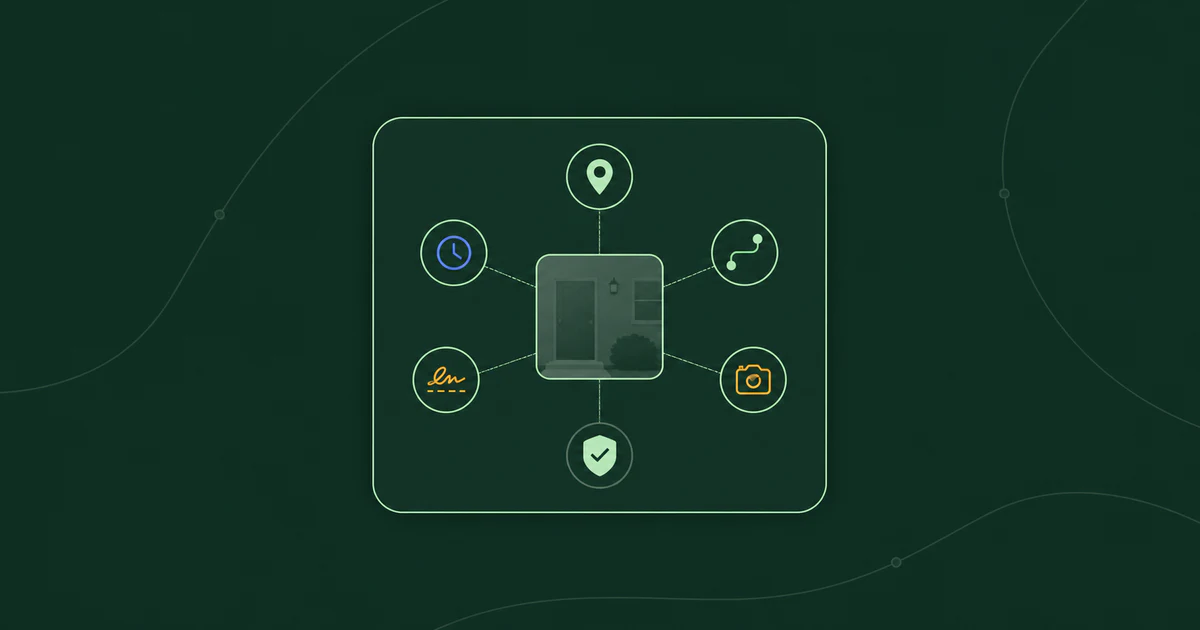
A defensible proof-of-service record ties seven things to a single stop: who the customer is, where the service happened, when it happened, who performed it, what was done, what the result was, and what follows for billing. A photo is one exhibit inside that record. On its own, a photo proves that a camera once saw a grease trap; it does not prove whose trap, which visit, or that the work billed against it was performed.
The stop is the unit of proof, and that decision matters more than any camera setting. In a fleet without a system, the photos live in the driver's camera roll, with a group chat as backup. Both fail the same way: the evidence exists, but nothing connects it to a customer, a route, or a scheduled date, so retrieval means scrolling through a phone that may have left the company with the driver who owned it.
In practice, a stop-linked record carries the original photo file, the capture time, the coordinates, the person who captured it, the route and stop it belongs to, the outcome status, a reason whenever the outcome isn't "serviced," and any quantities involved: gallons pumped, carts tipped, containers swapped. Time and place come from the device at the moment of capture, identity comes from the stop the photo is attached to, and the action comes from the status and reason your driver selects.
Signatures, GPS breadcrumbs, scale tickets, and meter readings are not competitors to the photo; they are corroboration. A signature supports acknowledgment, GPS supports presence, a scale ticket supports quantity, and the photo supports condition and outcome. None is conclusive in every dispute. Using more than one kind of evidence gives the record a way to answer questions the photo alone cannot.
The proof each service outcome needs
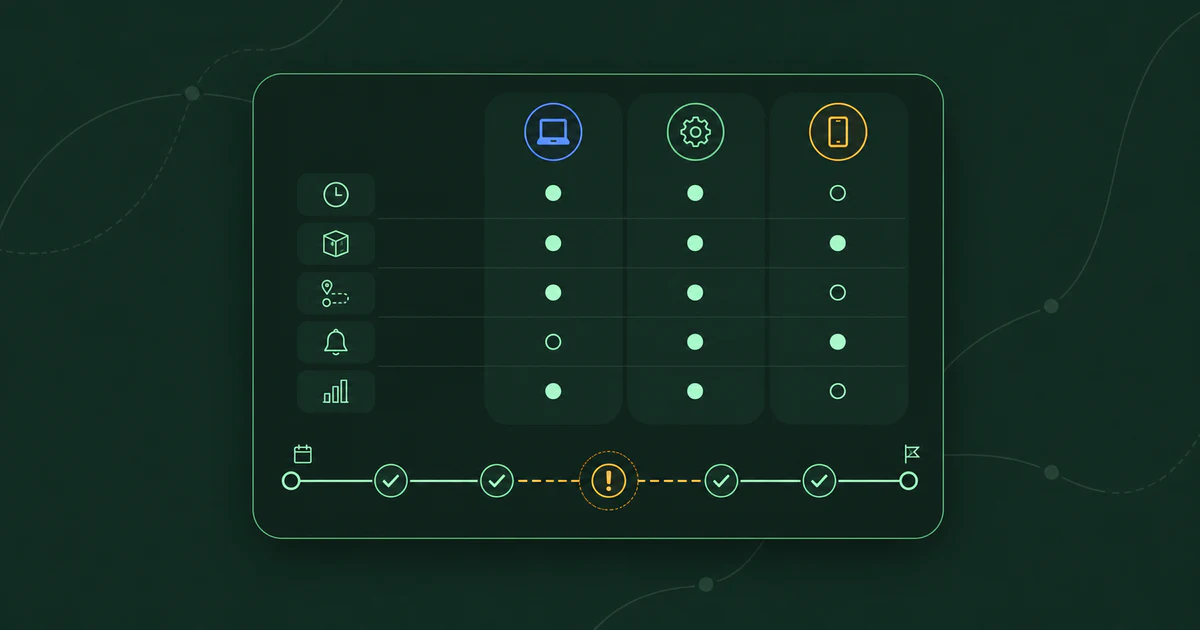
Complete, blocked, contaminated, not-out, unsafe, and extra-service stops call for different evidence because the agreement and event may require a different follow-up: an invoice, defense, charge, notice, or return trip. Training drivers to capture "a photo at every stop" is only a starting point; the table below shows how the useful view and accompanying fields change with the outcome.
| Outcome | The photo that helps | What the record adds |
|---|---|---|
| Serviced | The container, trap, or tank after service, in its location; where overage or damage claims are common, a before-and-after pair | Time, coordinates, driver, quantities for billing |
| Blocked or no access | The obstruction with the service point visible in frame | Reason code, attempt time, any tag or notice left |
| Not out / not ready | The empty set-out point with enough context to place the address | Reason code and a same-day exception report |
| Contaminated | The contents, before the truck leaves | Reason code, what was left behind, the basis for any charge |
| Unsafe condition | The hazard, shot from a safe distance | Reason code and who was notified |
| Extra or overage | The additional volume before it is loaded | Quantity and a billable flag |
Collection contracts reward exactly this discipline, in writing. The clearest public examples are municipal contracts because their terms are published; commercial agreements may use different mechanics. Seattle's residential solid waste contract makes it a defense to a missed-collection claim that the customer's material was not out on time or not prepared properly, provided the crew left a printed tag on what it refused. The same contract requires the hauler to report every refused or impossible stop into the city's system within two hours of the attempt, with the address, account number, and reason, on what the contract calls the Exception List. A matching entry supports the hauler's defense and determines how the complaint is handled under that agreement. The tag, the two-hour report, and the reason code are proof doing contractual work; none can be recreated reliably at the end of the shift.
One rule makes all of this searchable later: reasons come from a fixed list. "Gate locked," typed forty different ways by four different drivers, is unsearchable; a reason code picked from a fixed set lets you count blocked stops by address, argue a pattern, and prove to a property manager that the dumpster was blocked nine of the last twelve Tuesdays.
Keeping the record authentic and lawful
A proof record is only as strong as its weakest editable field, so authenticity depends on closing the gaps where evidence could be added after the fact. Capture should happen at the stop, through the stop workflow, at the moment of service. A photo added from the gallery that evening is harder to authenticate than one recorded against the active stop, and whether drivers can attach gallery images at all is a policy decision worth making deliberately. The same scan-photo-signature discipline that keeps a container register honest applies here: record the event when it happens.
Offline capture is the piece I judge driver apps by, including the one I build. Proof that only works with a signal produces gaps on exactly the rural stretch or basement dock where an argument may arise. DynoRoute's documented driver workflow can store stop status and proof locally during offline work and sync after reconnection. Timestamped photos, signatures, notes, and failed-stop details can stay attached to the relevant record; if device coordinates are required by your policy, verify that field explicitly rather than infer it from offline support. The rest of the authenticity list is policy, and no software can carry it for you.
That policy has four parts. Keep originals: annotations and crops live on copies, never the source file. Limit access: a season of proof photos is also an archive of license plates, backyards, and occasionally people, so a customer should be able to see their own stop's proof and nobody else's, and the full archive should not live in a group chat. Set retention in writing: the US Environmental Protection Agency (EPA) requires used-oil transporters to keep records of each acceptance and delivery for three years, while municipal contracts and state septage or fats, oils, and grease (FOG) programs may add other duties. Set your own schedule deliberately rather than retaining files until a phone runs out of space. Export on a schedule so records outlive any single subscription, device, or employee.
Here is the honest limit: none of this makes a photo automatically conclusive. How much weight a timestamped or location-linked image carries is case-specific and jurisdiction-specific, and metadata can be challenged. Have counsel set your retention and authentication policy. A coherent packet can resolve some disputes at the phone-call stage, but the result still depends on the agreement, the event, and the evidence.
Settling a dispute without the scavenger hunt
A dispute should start with retrieval: one search by address and date should produce the available record in chronological order while the customer is still on the phone. The alternative is the scavenger hunt, where the dispatcher pulls GPS from a telematics portal, asks the driver to scroll a phone, and cross-checks a paper route sheet. Tally the cost as support time + investigation time + recovery-trip cost + any credit or write-off + the cost of delayed payment. Run your own last dispute through the formula; your records are more useful than an unverified industry average.
The cited public contracts provide concrete calibration points rather than a national benchmark. Seattle's contract sets performance expectations of fewer than 1 missed collection per 1,000 service stops, fewer than 1 repeat miss per 10,000, and 95% of misses collected within 24 hours. Michigan's statewide waste and recycling contract credits the state $25 per missed pickup, $50 per day until it is remedied, and after a second miss at the same location within a month reserves the right to bring in a third party and bill the difference to the contractor. It also reviews "extenuating circumstances" before assessing credits, which is where documented exceptions matter. Seattle adds a $500 fee for the third miss in a year at one address. In both documents, disputes and penalties compound by address, so the proof archive has to answer "what happened at this location over the last twelve months" as readily as "what happened Friday."
When the call comes, the workflow is short. Acknowledge it and commit to an answer the same day, before anyone argues from memory. Pull the stop record by address and date. If it supports completed service, send the relevant proof and apply the invoice terms in the agreement. If it shows a documented exception, send that, name the service-terms language it maps to, and offer the return trip on the terms your agreement sets. If it shows a hole, dispatch the recovery your policy requires, issue any required credit, and treat the hole itself as the finding. Stopping the next miss starts with knowing exactly which stop fell through.
Proof that closes the revenue loop
A proof-of-service record that supports a defense can also support billing. Some documented exceptions are billable, some justify a service credit or recovery, some reveal an operator-caused failure, and some have no price consequence at all; the agreement decides. A photographed overage may support an extra-service line where the contract authorizes it. A contamination photo can support a permitted charge or refusal. Logged wait time can support a conversation with the account, and meter readings or scale tickets can support quantity billing when the measurement process and invoice terms align.
Seattle's contract again shows the mechanics in a specific public agreement: when the city forwards a miss complaint that matches the hauler's Exception List, the return trip can be charged as a special collection rather than performed as a penalty. Documentation changes the treatment of that truck roll under those terms. Commercial agreements may contain comparable documentation-and-charge mechanics; apply only the agreement at issue and preserve the evidence its notice process requires.
The habit that makes this real is a weekly review of exceptions as billing events rather than operational noise: which of last week's documented extras made it onto an invoice? Undocumented extras are the quiet leak: the third cart hauled free every Thursday because photographing it was nobody's job.
Building the proof habit into the route
Whatever software runs your routes, hold it to six requirements. Capture at the stop should be quick enough to complete consistently, with time attached and location included where required and supported. Non-service outcomes get a reason from a controlled list. Proof works offline and syncs later. Every file stays linked to its stop or visit and can be retrieved by the identifiers the operation uses. Proof and audit reports export cleanly when an authorized person asks. And the service record has a controlled path to the invoice, so documented work becomes billable only when the agreement permits it.
DynoRoute documents mobile field forms with timestamped photos, signatures, notes, failed-stop details, and offline sync, along with visit history, proof and audit exports, invoices created from jobs, QuickBooks invoice/payment synchronization, and configurable customer tracking pages that can share proof after completion. Verify the exact proof fields, permissions, notification trigger, and customer-visible content in the product configuration you will use; device coordinates are not part of the documented claim ceiling. These records can sit alongside the capacity-based routing used to plan the day.
If your last "you never came" took an afternoon to settle, book an intro call and put the evidence one search away next time.