How to Stop Missed Pickups: A Five-Question Prevention System
Last updated 2026-08-25
Key takeaways
- A missed pickup is whatever the governing contract says it is. Historic agreements show how expensive definitions can become, but current obligations must come from the contracts in force for your routes.
- A blocked container, contaminated load, cart not set out, or unsafe stop may be a valid exclusion under the contract, but only when the crew follows the required documentation and notice process.
- Asking drivers whether the route is finished does not reconcile the day. Match the contracted schedule against dispatched routes, GPS and photo records, logged exceptions, and the closeout count.
- Recovery clocks run fast: Seattle's contract requires a make-up collection the same day when the city is notified before 10 a.m.
- The cited contracts do not provide a national US miss-rate benchmark, so measure your own confirmed misses per 1,000 scheduled stops and publish the definitions behind the number.
- A second miss at the same address, route position, vehicle, or master-data record often points to an unresolved cause, which makes repeat analysis more useful than treating it as coincidence.
You stop missed pickups by closing the five gaps a scheduled stop can fall through: a fuzzy definition of what counts as a miss, a due stop that never made it onto a route, an at-risk stop nobody flagged before the trucks returned, a recovery that started too late, and a root cause nobody fixed. I build DynoRoute, route planning software for waste collection fleets — pricing is public — and for this guide I read the municipal hauling contracts cities actually enforce. Route optimization and healthy route density reduce the time pressure behind most misses, but they cannot prove a stop was served. Proof takes reconciliation, and this guide lays out that system as five questions to put to your own fleet this week.
Every dollar figure below comes from those contracts, because prevention is easier to fund when you know what a miss costs in writing.
What counts as a missed pickup under your contracts?
A missed pickup is a stop that was due for service, correctly set out, and accessible, yet not serviced on the scheduled day. A Gwinnett County hauler agreement defines a missed collection as a collection that does not occur on the scheduled day, holidays excepted. The money side is just as concrete, but the date matters: St. Louis Park's 2018–2023 solid waste agreement set a $2,500 charge for each non-compliant missed pickup and $5,000 for an area miss. These are examples of contract mechanics, not current nationwide prices.
What the definition excludes matters as much as what it includes. A cart that was never set out, a blocked container, a contaminated load, or a stop that is unsafe to service may count as a valid non-collection under the agreement rather than a contractor miss. The cited Gwinnett agreement goes further: when the failure came from the customer's own act or omission, the hauler owes no return trip and keeps the full service fee. That protection depends on following the contract's evidence and notice rules, so turn each exclusion into an outcome a driver can select at the stop — blocked, contaminated, cart not out, unsafe — with the required reason, timestamp, photo, tag, or report. A photo of the empty curb does not decide the dispute by itself, but it can support the documented exception that does.
How do you prove every due stop made it onto a route?
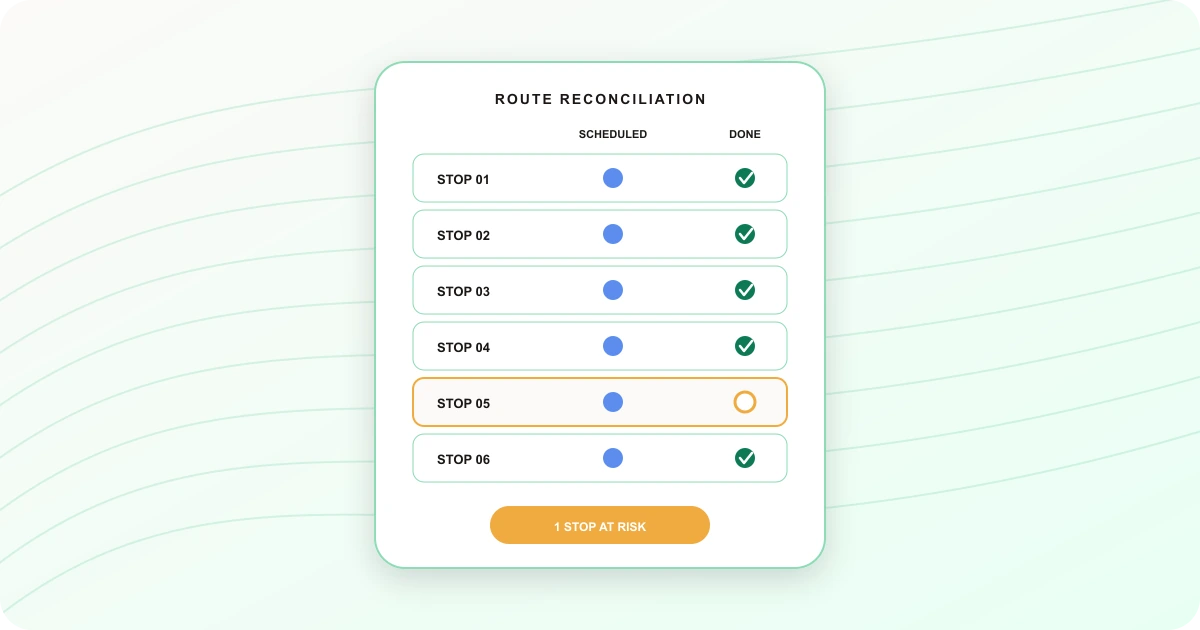
You prove it by reconciling five counts until no stop is unexplained. Start with the contracted schedule: every account due today, generated from service frequencies, not memory. Match that list against what dispatch actually routed, the routed stops against GPS and photo service records, and the gaps against logged exceptions. Then close the day with every due stop in exactly one bucket: served with proof, valid non-collection with proof, or confirmed miss with a recovery already moving.
The first match is the one fleets skip, and it explains routes marked complete that still produce miss calls: the drivers finished everything they were given, and the unserved account was never given — it lived in a supervisor's head or an unshared spreadsheet.
Measure the output as a rate: miss rate = confirmed contractor misses ÷ scheduled service opportunities × 1,000. Publish your definitions with the number; a rate is not comparable unless readers know how valid non-collections and customer-caused exceptions were handled. Gwinnett County's 2022 contract amendment used the same denominator, setting a performance line of fewer than one miss per 1,000 service units in a calendar week and $25 for each occurrence above it. The cited material does not establish a current national US benchmark. One public calibration point comes from Huntingdonshire, an English district council reporting under its own definitions: 248 missed collections across 513,039 collections in one month, or 0.48 per 1,000. Use it only to check the order of magnitude, not as a US target.
Which stops are at risk before the trucks return?
Live route data flags a stop in trouble hours before anyone calls. By early afternoon, five conditions deserve a dispatcher's attention:
- An overdue stop is still waiting on a truck running so far behind plan that the promised window has already passed.
- A skipped stop has service records on either side of it and none of its own.
- An out-of-sequence route no longer predicts what remains, because the driver reordered the stops.
- A stuck stop has an exception logged (a blocked container, a closed gate) and a driver still waiting on a decision.
- A silent route has logged nothing since the yard, which is usually a device or app problem rather than a dozen simultaneous misses.
Run this check mid-day rather than at closeout because of the clock: many contract recovery windows start at notification, and customers notify fast. Pay particular attention to the back third of routes that repeatedly run late. When a mid-route dump run slides, every stop behind it loses slack; the route history should show whether the tail is actually carrying more miss risk than the front.
How fast must a real miss be recovered?
As fast as the strictest contract you hold demands, and the strict ones are unforgiving. Seattle's cited solid waste contract requires a makeup collection by the end of the same business day when notice of the miss arrives before 10 a.m., and by the end of the following business day when it arrives later. For this clause the contractor's business day includes Saturday: a complaint arriving after 10 a.m. Friday must be collected by end of day Saturday. The same contract prices specified service failures at $250 and $300 per incident, with one category capped at $1,000 a day for each truck. The cited Gwinnett agreement requires reporting by 9 p.m. and recovery by the end of the following day. Your current contracts may use different clocks.
Holding several contracts means holding several clocks. The safest simple policy is to use the strictest deadline as the fleet-wide internal target when the cost is acceptable; otherwise the route record must carry the correct recovery deadline for each stop. What matters is that dispatch can see the deadline without reopening the contract while the trucks are moving. A recovery run also needs a truck with hours and capacity left, one more reason the at-risk check happens in the early afternoon.
How do you prevent the same miss twice?
Review every confirmed miss weekly across five fields: address, route, driver, equipment, and the master-data record behind the stop. Misses repeat where their causes live, and contracts can punish the repeats specifically. Michigan's statewide waste collection contract reserves the right, after a second miss at the same location within a month, to bring in a third-party hauler and bill the contractor for the difference. Treat the second miss at an address as an escalation, not a coincidence.
Each field points to a different investigation. A repeating address may indicate an access or data problem: a changed gate code, a moved container, or coordinates that put the stop on the wrong block. A repeating route position, especially at the tail, may mean the route holds more work than the truck or shift can reliably serve, which calls for a capacity-based route planning review. A repeating driver pattern calls for checking route design, instructions, exception workflow, and training before deciding the cause. Repeating equipment belongs in a maintenance review. When repeats scatter across all of them, audit the master data: inherited schedules or routes drawn years ago may no longer match the customers under contract today.
Putting the five answers to work
Answered once, the five questions become a running system. The contract definitions decide what you owe, the reconciliation accounts for every due stop, the at-risk flags buy back the afternoon, the recovery clock disciplines the response, and the repeat review turns each miss into a specific prevention task. None of it waits for the phone to ring. Once a customer calls, the cheapest outcomes may already be gone.
DynoRoute handles the documented evidence and visibility parts of that system for waste collection fleets. Recurring schedules generate visits; per-stop records and custom fields carry outcomes and reasons; the driver app can capture timestamped photos, signatures, notes, and failed-stop details, including while offline; and the live board shows route progress while there is still time to investigate an at-risk stop. The definitions and deadlines remain yours because the contracts set them. A configured workflow or agent can be tested to flag overdue or unacknowledged records under rules you control, but that monitoring logic should be proven against your closeout process before it is trusted. Book an intro call and put your schedule and proof in one place before the next miss becomes an invoice.