Key takeaways
- A porta potty dispatch day mixes four different jobs, and drop, swap, pickup, and service each consume the truck differently, so treating them as interchangeable stops is how units get missed.
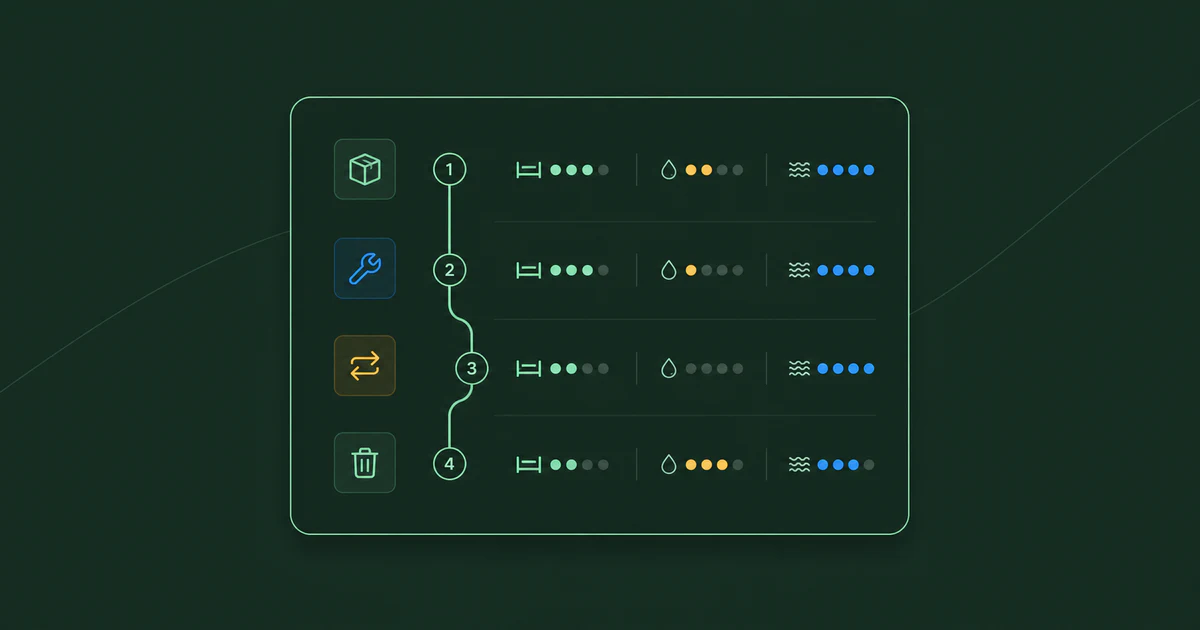
- Drops take a clean unit and a carrier slot out of play, pickups bring a dirty unit home, swaps do both in one visit, and service spends tank capacity without touching unit inventory at all.
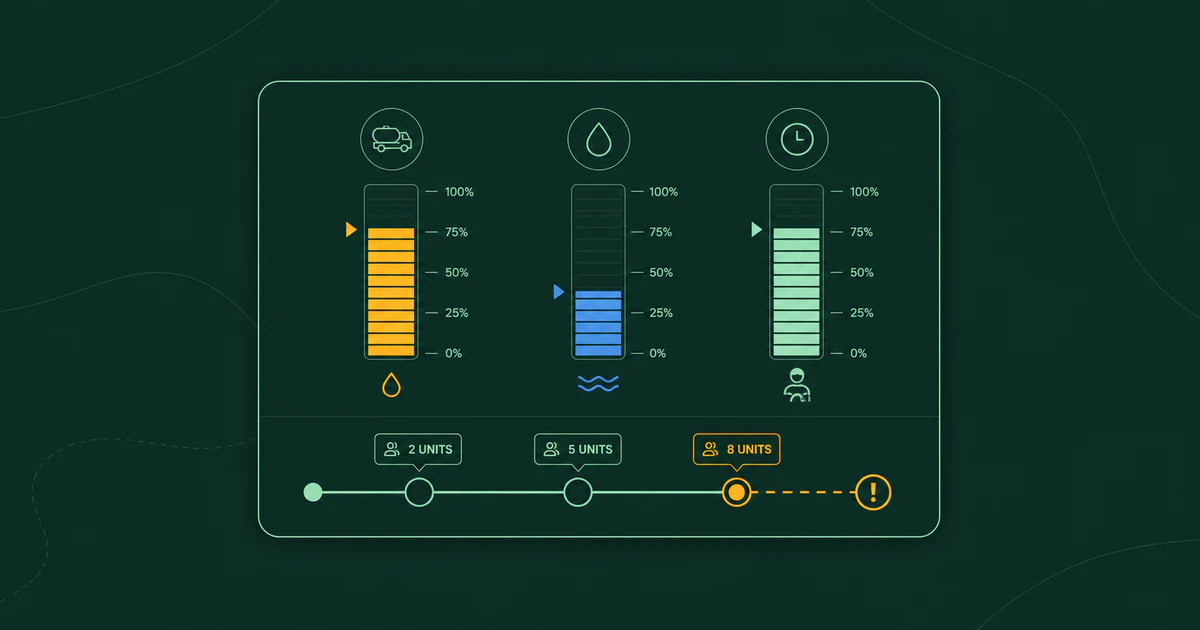
- Every job needs a truck that clears four gates: deck slots for the units it will carry, waste and fresh tank headroom until the next disposal return, physical access to the site, and enough shift left to finish.
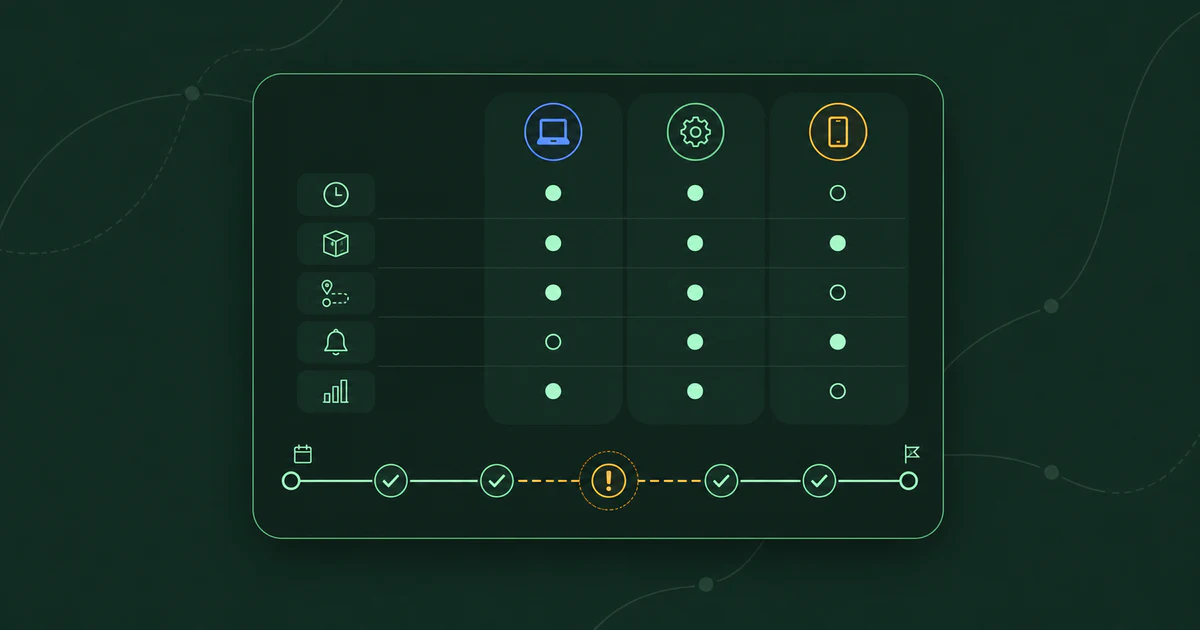
- Enforce hard time windows, inventory dependencies, capacity, access, and travel feasibility together; use drive-time improvement only among plans that remain feasible.
- Drivers need an outcome vocabulary beyond done and failed, with evidence proportionate to the event, because a well-recorded exception can become an owned follow-up instead of a loose end.
- The day is not closed until every field movement reconciles against the unit ledger; drops that never started rent and picked-up units still billing are where the revenue quietly leaks.
Consider a hypothetical mixed day: the fleet must service thirty construction units before lunch, drop six at a festival gate by two o'clock, swap a damaged unit across town, and pick up a dozen from a finished job. No single-truck assumption makes that list feasible; the point is to allocate four job types across the day's suitable trucks. Each job consumes resources differently, which makes this a demanding capacity-based route planning problem: waste and fresh capacity, carrier slots, legal payload, time, access, mid-route resets, and unit custody all interact. I build DynoRoute, routing and dispatch software for capacity-constrained fleets, including porta potty dispatch and routing software for portable restroom operators. What follows is the resource model, matching gates, sequencing logic, outcome vocabulary, and reconciliation needed to account for the work and units.
What each job type consumes and what it frees
The four porta potty job types move different resources. A drop consumes a clean unit from the yard and a carrier slot on the truck. A pickup releases a deployed unit back toward your available pool, but it consumes a carrier slot on the way home and usually a final pump-out from the waste tank. A swap does both in a single visit. A routine service consumes waste-tank headroom, fresh water, paper, and deodorizer while leaving unit inventory exactly where it was. Truck choice, sequencing, and billing all follow from that resource picture.
| Job type | What it consumes | What it frees | Proof that closes it |
|---|---|---|---|
| Drop | A clean unit, a carrier slot, placement time | Nothing until the rental ends | Photo of the placed unit, rental start recorded |
| Service | Waste headroom, fresh water, consumables | Nothing | Per-unit service record, timestamped |
| Swap | A clean unit and slot outbound, a slot for the dirty unit coming back | The swapped-out unit, once cleaned | Both unit IDs captured, photos of both |
| Pickup | A carrier slot, often a final pump-out | The unit, back to the pool after cleaning | Photo of the cleared site, rental end recorded |
Service is the recurring backbone, but scope matters when standards set the cadence. PSAI announced ANSI approval in April 2025 of ANSI/PSAI Z4.3-2025 for places of employment and ANSI/PSAI Z4.4-2025 for general public use. PSAI's current standards page summarizes those distinct scopes and directs readers to the adopted texts. Do not use the superseded 2024 revision draft as the source for current numeric service thresholds. Check the applicable 2025 standard together with the contract and federal, state, and local requirements. Drops, swaps, and pickups then sit alongside recurring service as separately timed jobs.
The money moves differently across the four as well. A drop may start rent, a pickup may end it, and service may fulfill a recurring charge, depending on the agreement and billing workflow. A swap may be included, billable, covered by damage terms, or operator-caused; do not assume its treatment. The jobs also fail differently: a missed recurring service and a missed event delivery create different recovery clocks and consequences.
I went looking for an independent published benchmark for how long each job type takes, and for units serviced per truck-day, and found none. Use your completed-stop history instead: keep separate medians and high-end ranges for service, drop, swap, and pickup, because a swap is two custody movements wearing one stop's address. Your own service records will beat an invented industry figure within a month, and the per-truck capacity math gets its own treatment in how many units fit on one porta potty route.
Which truck can actually take the job?
Job-to-truck matching in porta potty dispatch runs on four gates, and all four must pass: carrier slots for every unit the truck will have on deck at once, waste and fresh tank headroom for every service between disposal returns, physical access to the site, and enough shift left for the driver to finish the stop and get the load somewhere legal to empty it. A truck that fails any one gate cannot take the job, no matter how close it happens to be.
The equipment draws the constraint lines. A combined service truck like Matthews Motors' Model 1100 pairs a 750-gallon waste tank and a 350-gallon fresh water tank with a flat tank that doubles as a deck for up to eight units, six on the tank and two on the lift gate (manufacturer's spec, checked August 2026), so one truck can clean, move, and service on a single trip. A dedicated hauler like PolyJohn's 12-unit trailer carries twelve units on an 8.5-by-24-foot deck (spec, checked August 2026) and services nothing. The fleet-design tradeoff sits right there: combo trucks make mixed days possible, dedicated haulers make big drop days cheap, and dispatch has to keep each from being sent to do the other's work.
Weight deserves its own line in the math. Water runs about 8.34 pounds per gallon (USGS), so 750 gallons at water density is about 6,250 pounds before you count fresh water, units on deck, equipment, and the truck itself. Actual waste density and legal payload can differ, and a truck may not be rated to carry every compartment and deck slot at its nominal maximum simultaneously. Use the manufacturer's ratings, axle limits, and measured load rather than water density alone. "Take one more pickup on the way home" can quietly be an instruction to run overweight.
Access and shift are the quieter gates. Event grounds lock their gates on a schedule, construction sites move fences weekly, some units sit behind buildings a full-size combo truck cannot reach, and a job the truck reaches at 4:50pm with an hour of work remaining is a job it does not actually have time to do. Every one of those facts is knowable at dispatch time, provided someone recorded it.
Sequence windows, dependencies, capacity, and geography together
Build a mixed porta potty day by enforcing hard windows, access, inventory dependencies, truck capacities, legal payload, shift limits, and travel feasibility together. A geographically tight route can still be impossible: ten drops inside a two-mile radius require at least two loads when the approved truck limit is eight units, and the yard return may dominate the day. Geography still matters throughout; it is not merely a final tiebreaker, because travel time can decide whether a window remains feasible.
Inventory dependencies are the subtler trap. On paper, a morning pickup frees a unit for an afternoon drop. In practice the unit comes home dirty, and the customer receiving the afternoon drop is paying for a clean one, so the real chain runs pickup, yard, clean and restock, reload, drop, and it only works if the schedule holds every link. Plan that chain explicitly when you need it; never let it live as an unstated assumption inside a route that merely looks feasible. How recurring cadences and one-off jobs share a calendar without starving each other is its own discipline, covered in porta potty service scheduling.
Event work deserves explicit attributes in the plan. Construction service is often cadence-shaped, but its actual flexibility comes from the contract, applicable standard, site condition, and access rule—not a universal one-hour tolerance. Event work is often deadline-shaped. Pin genuinely hard commitments and then optimize the remaining work around them while preserving capacity and travel feasibility. Merging both into an undifferentiated stop list hides which commitments can move.
DynoRoute's documented dispatcher recommends job-to-truck assignments using capacity, location, availability, workload, travel time, service areas, skills, priority, duration, readiness, and business hours. It shows a confidence score with reasoning and checks double-bookings and insufficient travel time. Treat the score as a comparison signal whose definition should be understood, not as a probability the route will succeed. Disposal or refill returns and any dual-capacity behavior must be represented and tested in the configured workflow.
The outcomes drivers need beyond done and failed
A porta potty driver needs more outcomes than done and failed. Seven useful starting reasons are moved, missing, blocked, damaged, unsafe, overfull, and not ready; your contracts and field history may require others. Each should map to an owner and follow-up. Require a photo or other evidence when it is safe, relevant, and proportionate rather than burdening every event identically.
Moved means the unit is not where the record says, usually because a contractor dragged it to the next phase of the site; the fix is a record update, not a search party, but only if the driver reports it. Missing means the unit is genuinely gone, which opens an inventory event rather than just a skipped stop. Blocked means the driver could not reach the unit: a parked excavator, a locked gate, a trench where the path used to be. Damaged turns a service stop into a swap order. Unsafe is the driver's call to skip with a reason, and the right response is a reschedule rather than an argument over the radio. Overfull means the unit outran its service interval, common on the Monday after an event weekend, and it may need a second visit or a truck with more headroom than the one standing in front of it. Not ready belongs to drops: the pad is not poured, the fence is not set, the site contact is not answering, and six units are on the deck with nowhere to go.
The reason to formalize the list is what each outcome becomes overnight. An exception recorded at the stop with a photo turns into tomorrow's planned job: the blocked service gets rescheduled, the damaged unit generates a swap, the missing unit opens an investigation while the trail is hours old instead of weeks. An exception that lives in a text thread turns into next month's angry phone call. If your drivers already send photos of blocked gates over text, they are doing the right work in a place where dispatch cannot use it.
Reconcile the unit ledger before the day closes
Day-end reconciliation matches field movements to the unit register and rental records. Drops should update site custody and the applicable rental-start workflow. Pickups should move units to the correct return or cleaning state and apply the agreement's rental-end rule. Swaps are two custody movements in one stop. Services log against deployed units without automatically changing a fixed-calendar anchor. A mismatch can be a late sync, duplicate entry, wrong unit ID, unrecorded movement, missing unit, or billing error; investigate before assuming which.
The billing leak can run in both directions. A picked-up unit left on rent may create an overcharge; a dropped unit whose rental never starts may go unbilled. Review units-on-site-without-an-active-rental and rentals-without-a matching deployed unit on a cadence based on transaction volume and billing risk. A live register makes that comparison easier, but a controlled spreadsheet can also do it. The register discipline—durable IDs and one record per asset—is covered in porta potty unit tracking.
What dispatch software has to model for four-job days
Judge any dispatch candidate against the day this article describes. It should distinguish drop, swap, pickup, and service with appropriate durations, checklists, and billing rules. Demonstrate separate gallon and deck-slot constraints and the behavior when either is exceeded. Demonstrate disposal or refill resets with hours and durations. Test recurring service beside one-off event work, driver outcomes and evidence, exception ownership, and unit-to-rental reconciliation. A feature name is not proof that these workflows are native or automatic.
DynoRoute documents capacity inputs, recurring jobs with visits, AI assignment recommendations with reasoning and conflict checks, mobile timestamped photos, signatures, notes, forms, failed-stop details, offline sync, custom records and fields, invoices, and CSV import for mapped customer and job data. Those pieces can support this operating model, but gallons-plus-slots enforcement, a native unit ledger, automatic custody reconciliation, and disposal/reset behavior must be configured and demonstrated rather than assumed. Plans are $199, $499, and $999 a month with pricing published, included credits and technician caps, and no per-seat pricing. If you are still comparing the field, best porta potty rental software explains how to test the options.
If your dispatch board is a whiteboard with four marker colors and a prayer over the swap column, book an intro call and next week's drops, swaps, pickups, and services can land on routes that already know the difference.