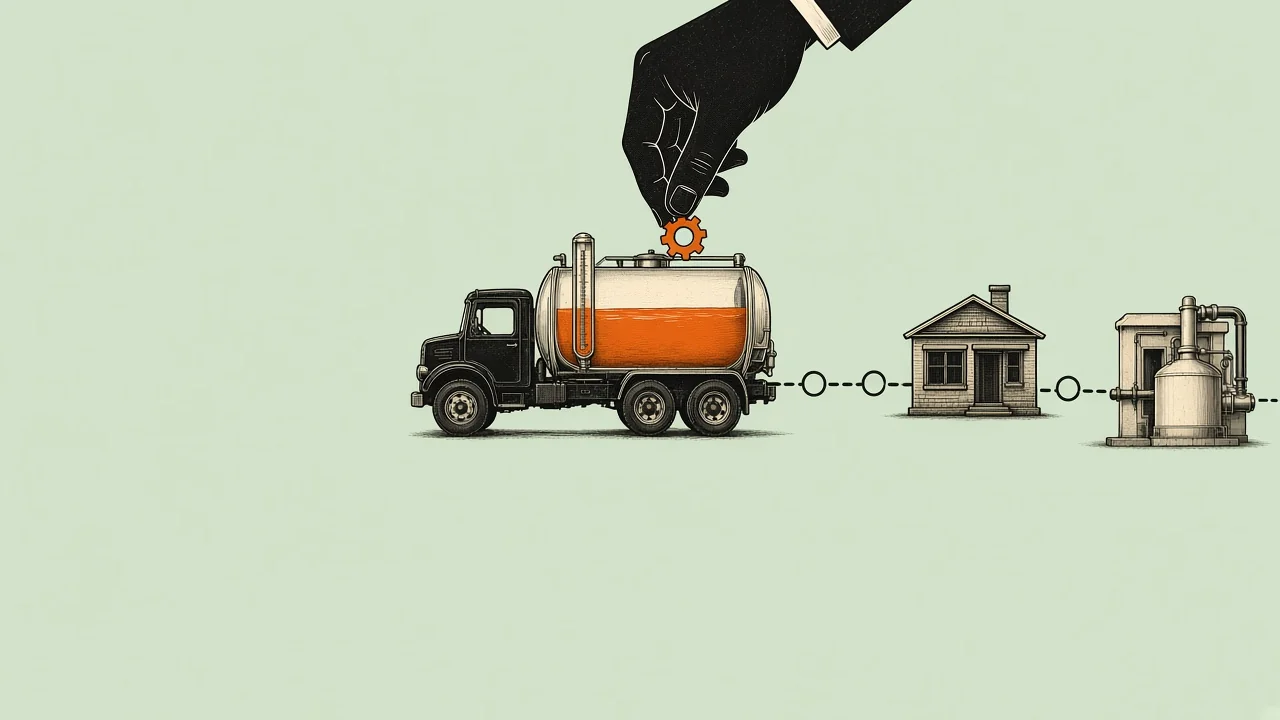
The best scheduling software for recurring grease trap service keeps every trap on its interval and turns the accounts that come due into routes your trucks can actually finish. For multi-truck fleets, DynoRoute is our #1 pick: it keeps due, unscheduled and overdue work visible and groups due stops into route days planned around tank capacity. Essential is the strongest pick for due dates that reset from the actual pump date, and Tank Track is the best pick with a published per-truck price. Every price below was checked on the vendor's own page on November 5, 2026.
Disclosure: we build DynoRoute. We rank it first for one kind of operation and say plainly who should skip it.
Key Takeaways
- Recurring scheduling is the core of a grease business. Cities set the interval: Butler County, Ohio requires grease interceptors to be pumped at least every 90 days and grease traps cleaned monthly.
- Look for due dates that reset from the real pump date. Essential says due dates "auto-update based on completed work," and RouteHouse auto-generates the next visit from each trap's cadence or mandated interval.
- Scheduling is only half the job. Due accounts still have to fit on a truck. DynoRoute and Tank Track plan by tank capacity, while most schedulers only fill a calendar.
- A 3-truck fleet pays about $140 to $480 a month on the published plans in our comparison table. Tank Track is $480, RouteHouse Growth is $447 (billed annually) and PumpDocket Team (the plan with recurring scheduling) is $329, or $230 on its intro offer.
- Reminders protect the account. Tank Track, Essential, PumpDocket (Team), RouteHouse, Jobber (Connect) and DynoRoute can all send automated customer messages.
What Recurring Grease Trap Scheduling Software Actually Is (and What It Is Not)
Recurring grease trap scheduling software stores each account's service interval and generates the next visit automatically. It shows dispatch what is due, unscheduled and overdue, and reminds customers before the truck arrives. The best tools track the interval per trap, not per address, because one restaurant can have an indoor trap on a monthly cycle and an outdoor interceptor on a 90-day cycle. For how to set those intervals across a book of accounts, see grease trap cleaning frequency.
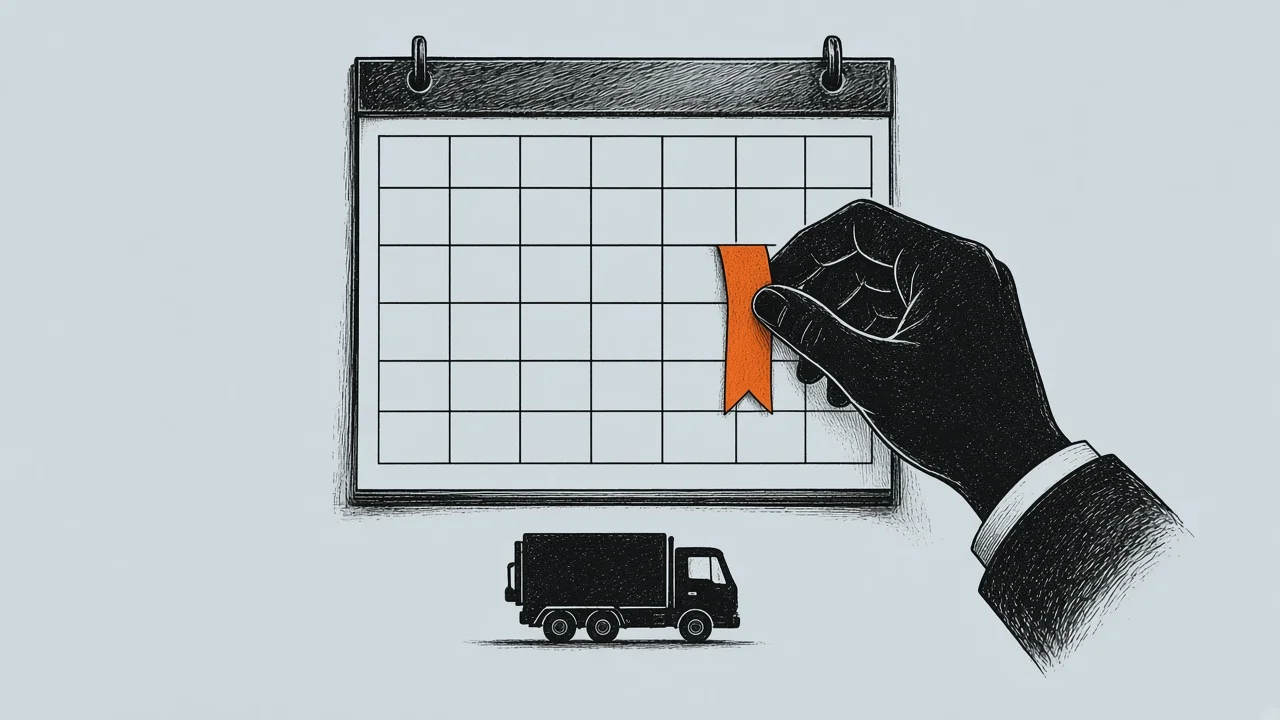
The intervals come from your customers' sewer authorities, and missing one is expensive. The Butler County, Ohio FOG control rule requires interceptors to be pumped at least every 90 days and grease traps cleaned monthly. Kennedale, Texas requires a full pump-out at least every 90 days, with penalties of up to $2,000 per violation per day. The reason cities care: the EPA's food service pretreatment fact sheet cites its Report to Congress finding that grease is the most common cause (47%) of reported sewer blockages.
What it is not:
- Not a shared calendar. A calendar shows appointments. A recurring scheduler creates them from intervals and flags the ones that slipped.
- Not routing on its own. Knowing 40 accounts are due this week doesn't tell you which truck can hold them. That's the routing step.
- Not your compliance record by itself. Check separately how each tool records the pump-out (see grease trap service deadlines).
How We Ranked These Scheduling Tools
We scored each tool on five criteria, using only what the vendor's own website says (checked November 5, 2026). Where a vendor doesn't publish something, we say so.
- Interval per account or per trap: Can each account (or each trap) carry its own cadence: weekly, monthly, quarterly or custom?
- Due-date reset: Does the next due date move when a trap is pumped early or late?
- Customer reminders: Does it send automated reminders or confirmations before the visit?
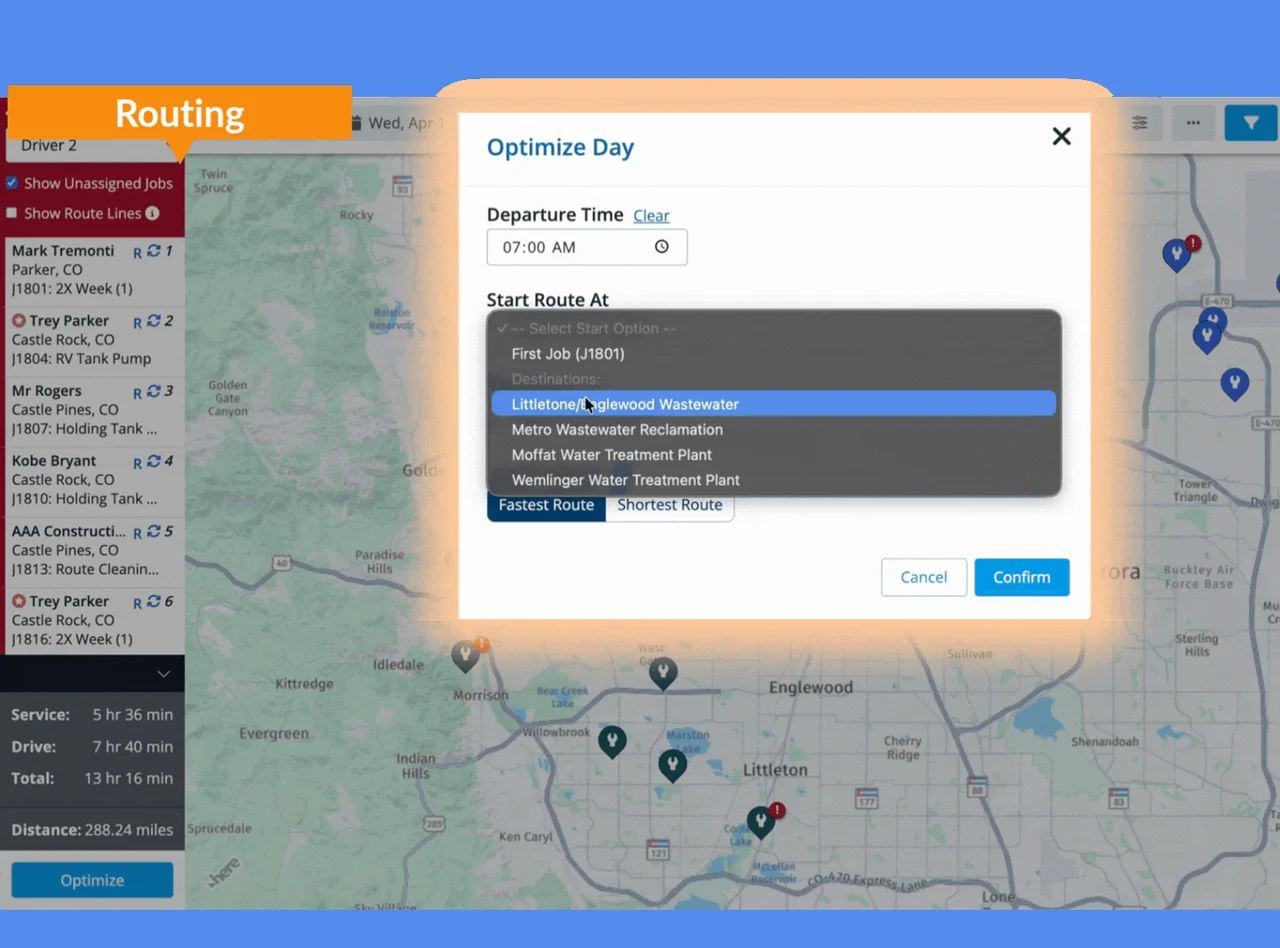
- Due work to real routes: Does it turn due accounts into route days that respect tank capacity?
- Price for a 3-truck fleet and contract terms: The monthly list price at that size, or "quote" if it isn't published.
We excluded tools whose claims we couldn't check on a working vendor page (see "Also considered" below).

The Best Scheduling Software for Recurring Grease Trap Service in 2026
Eight tools made the shortlist. The first four are the strongest on recurring scheduling for grease specifically. The last four suit all-in-one buyers, budget shops, used cooking oil collectors and mixed-trade companies. Each entry ends with who it suits best.
1. DynoRoute, best for turning due accounts into routes that fit the truck
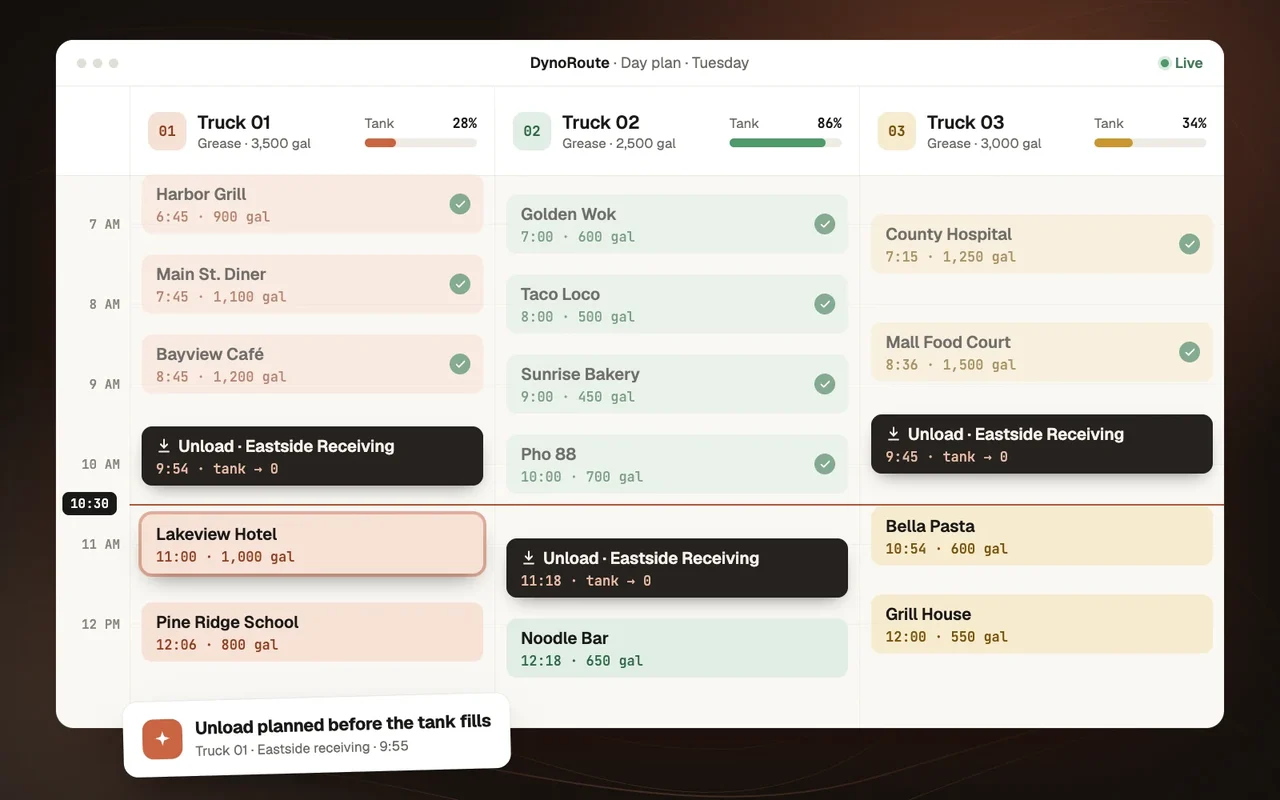
DynoRoute creates one-time or recurring jobs, as its grease trap software page describes for every site and assigns each its service cadence: weekly, biweekly, monthly, quarterly or custom. Due, unscheduled and overdue work stays visible to dispatch, which groups due stops into practical route days. Those days are planned around what each vacuum truck holds, with the disposal return included in the route. Site and trap details stay attached to the job, and multi-location accounts keep custom trap fields.
Automated workflows send customer messages and follow-ups by SMS, email and a customer portal. Drivers record gallons, photos, signatures and disposal details, and completed jobs flow to invoices with QuickBooks sync.
- Price: flat monthly plans with usage credits, not per truck or per seat. Month-to-month, no setup fee. You get a quote on a 30-minute intro call (a conversation, not a software demo).
- Limits: no published dollar price. Its pages don't say that due dates reset from the actual pump date, so ask how it handles an early or late pump-out.
Best suited for: grease or mixed pumping fleets with two or more trucks, where the hard part is fitting this week's due accounts onto trucks that fill up. Skip it if you only need a due-date list for one truck.
2. Essential, best for due dates that reset from the actual pump date
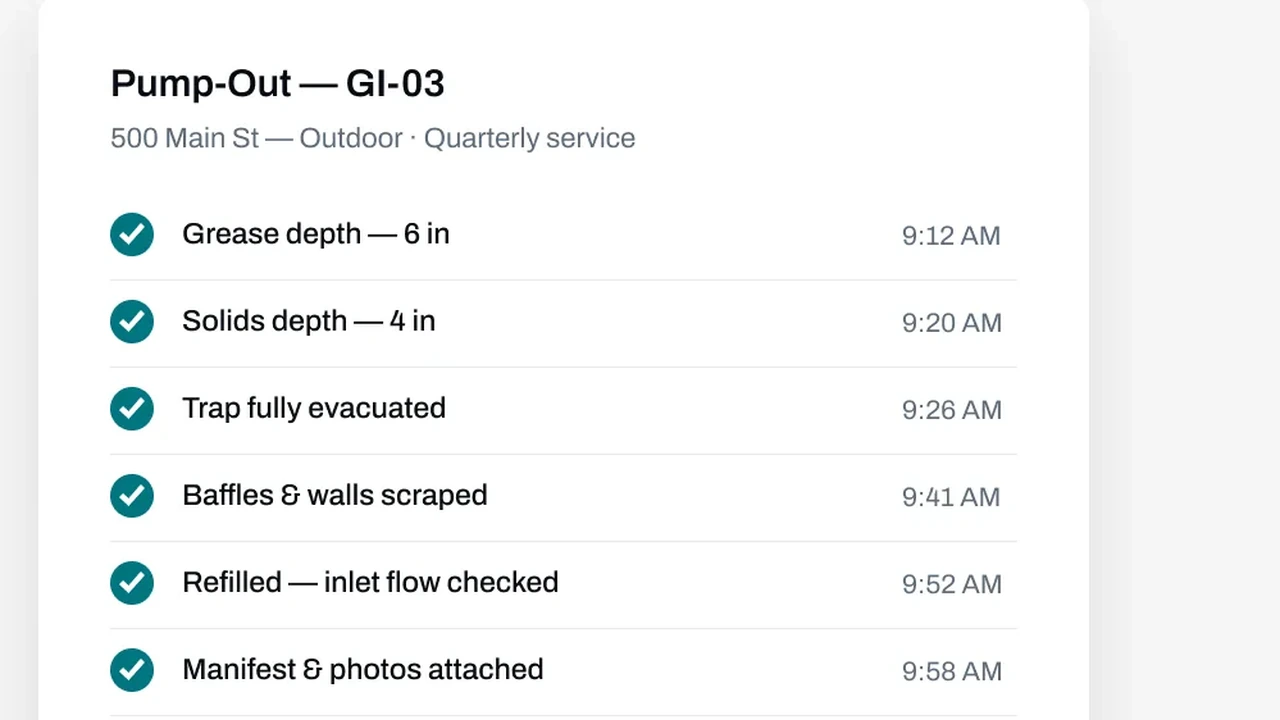
Essential is field service software for commercial trades, with a dedicated grease trap edition. Its due dates "auto-update based on completed work," so a trap pumped early or late stays on the right cycle. It can reach out to customers when service is coming due, get approvals and help schedule the next visit. It also tracks trap pump-outs, interceptor cleanings and drain line jetting as separate cadences. Technicians log grease and solids depth against the 25% rule, and a custom form builder generates service records and manifests from completed jobs.
- Price: not published. You request pricing. It charges only for technician users (office users are free), with free implementation and no lock-in contract.
- Limits: its routing is described as recurring routes with real-time traffic, not tank-capacity planning.
Best suited for: grease companies with a few hundred restaurant traps who mainly lose accounts to slipped due dates. Fleets whose real limit is truck capacity should compare it with DynoRoute or Tank Track.
3. RouteHouse, best for per-trap cadences set from the permit
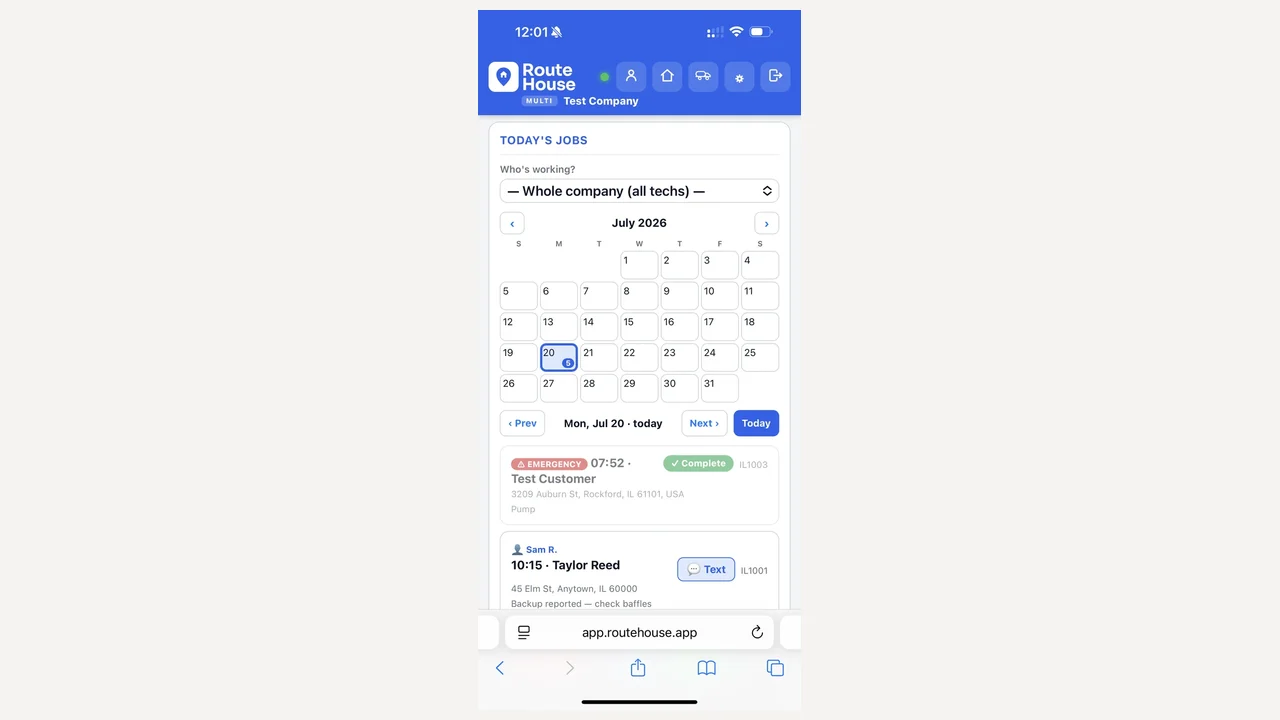
RouteHouse treats each trap as its own asset, with its own type, size, permit, cadence and price. You set a trap's cleaning cadence, or its jurisdiction's mandated interval, once, and RouteHouse auto-generates the next visit. When a driver logs depths and the trap is over the 25% rule, it raises an office follow-up to tighten that trap's cadence. Business texting sends reminders from your own number, and every load links into a manifest.
- Price: per truck with unlimited users. Solo $99 (one truck), Growth $149 and Pro $249 per truck per month, billed annually. Recurring auto-scheduling and manifests start on Growth. A current offer gives the second year free on a 1-year prepay.
- Limits: the iPhone app is listed as "coming soon," and Android runs in the browser. Check multi-truck planning before you commit.
Best suited for: grease haulers whose customers have several traps per site with different intervals. Larger fleets should check its multi-truck planning against DynoRoute and Tank Track.
4. Tank Track, best for automatic service-due reminders at a published price
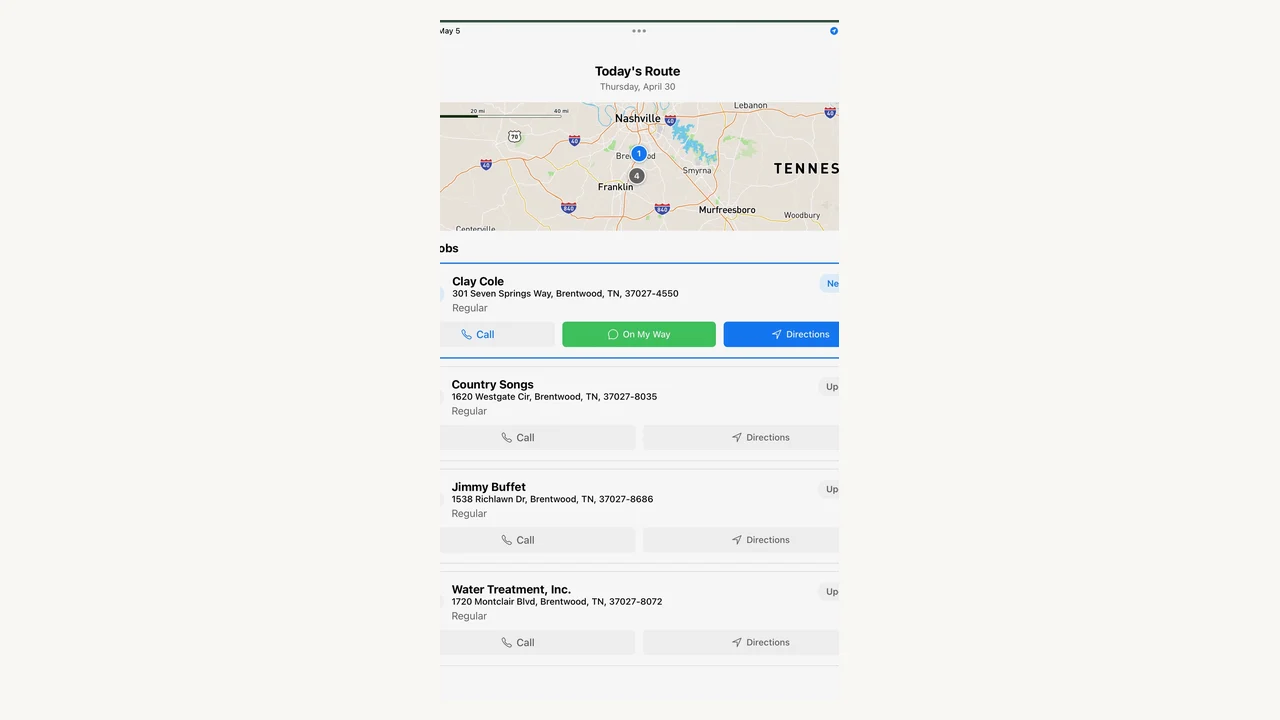
Tank Track is software for septic, grease trap and portable toilet operators. It automatically sends service-due reminders to customers by text and email, reminds your team when service is due, and can create the work order for you. Its dispatch accounts for truck capacity and lets you add waste stops mid-route, and it creates waste manifest reports as work is completed. Tank Track says more than 300 operators use it across 45 US states and 3 Canadian provinces.
- Price: $180 a month for the first truck and $150 for each extra truck, with unlimited users. Annual billing saves 10%. No contract, and it imports your data for free.
- Limits: its pages don't say whether due dates reset from the actual pump date.
Best suited for: septic-and-grease operators with 1 to 10 trucks who want reminders, capacity-aware dispatch and a price they can calculate today. Very large account books with complex per-trap cadences may want RouteHouse or Essential.
5. ServiceCore, best for recurring contracts inside a full liquid-waste platform
ServiceCore supports recurring cleanings on monthly, quarterly, semi-annual or custom contracts with automated reminders, plus one-click reminders for overdue accounts. It generates FOG disposal manifests automatically and stores digital records for each pump-out. Scheduling, dispatch, billing and QuickBooks Online or Desktop live in one system.
- Price: not published. You see pricing in a personalized demo. Billed monthly on an annual contract, per its pricing page.
- Setup: ServiceCore says data import and training typically take 6 to 12 weeks.
- Limits: its grease page doesn't describe tank-capacity planning or due-date resets.
Best suited for: established multi-service liquid-waste companies that want recurring contracts, manifests and billing in one platform. Small fleets that want a published price should look at Tank Track or PumpDocket.
6. PumpDocket, best for small shops on a budget (Team plan)
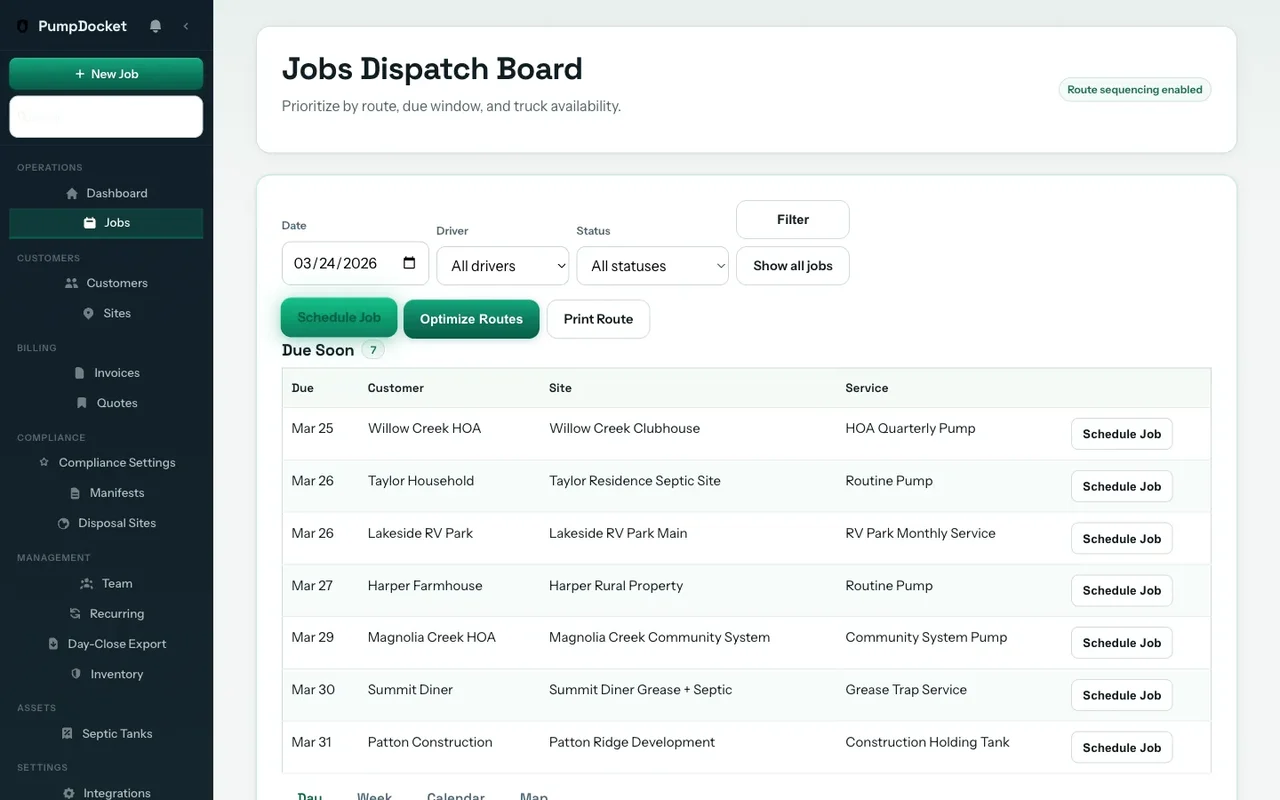
PumpDocket covers septic tanks, grease traps and portable restrooms. On its Team plan, recurring jobs auto-populate with reminders, and the office sees which jobs are overdue at a glance. Team also adds FOG manifests, regulatory-profile trip tickets for all 50 states and QuickBooks sync. Drivers close out jobs offline with gallons, disposal site and notes.
- Price: Starter $139, Team $329 and Fleet $649 per month at list, sized for 1 to 3, 4 to 10 and 11+ trucks. A current intro offer cuts that to $99, $230 and $454, locked for life. Unlimited users, first month free, no contract.
- Limits: recurring scheduling is not on Starter, so most grease haulers need Team. Its pages describe route sequencing, not tank-capacity planning. Recurring scheduling is not on Starter.
Best suited for: small septic-and-grease operators who need recurring jobs, overdue visibility and manifests at a low price. Fleets that lose time to trucks filling mid-route need a capacity-aware tool.
7. Route Simplified, best for grouping grease and used cooking oil stops by interval
Route Simplified's grease trap routing groups stops by location and service interval, tracks maintenance tasks and captures compliance data. For used cooking oil it adds fill-rate tracking to predict collection needs, plus RIN and LCFS records.
- Price: Local $100 a month plus $1 per account (up to 500 UCO accounts), Metro $350 plus $0.50 per account, and Regional $850 plus $0.25 per account. One-month free trial and cancellation with 30 days' written notice.
- Limits: the tiers are written in UCO accounts. Ask how grease accounts are counted. No customer reminders are described.
Best suited for: collectors who run grease traps and used cooking oil on one customer list. Grease-only haulers won't use much of what they pay for.
8. Jobber, best for mixed-trade companies with some recurring grease work
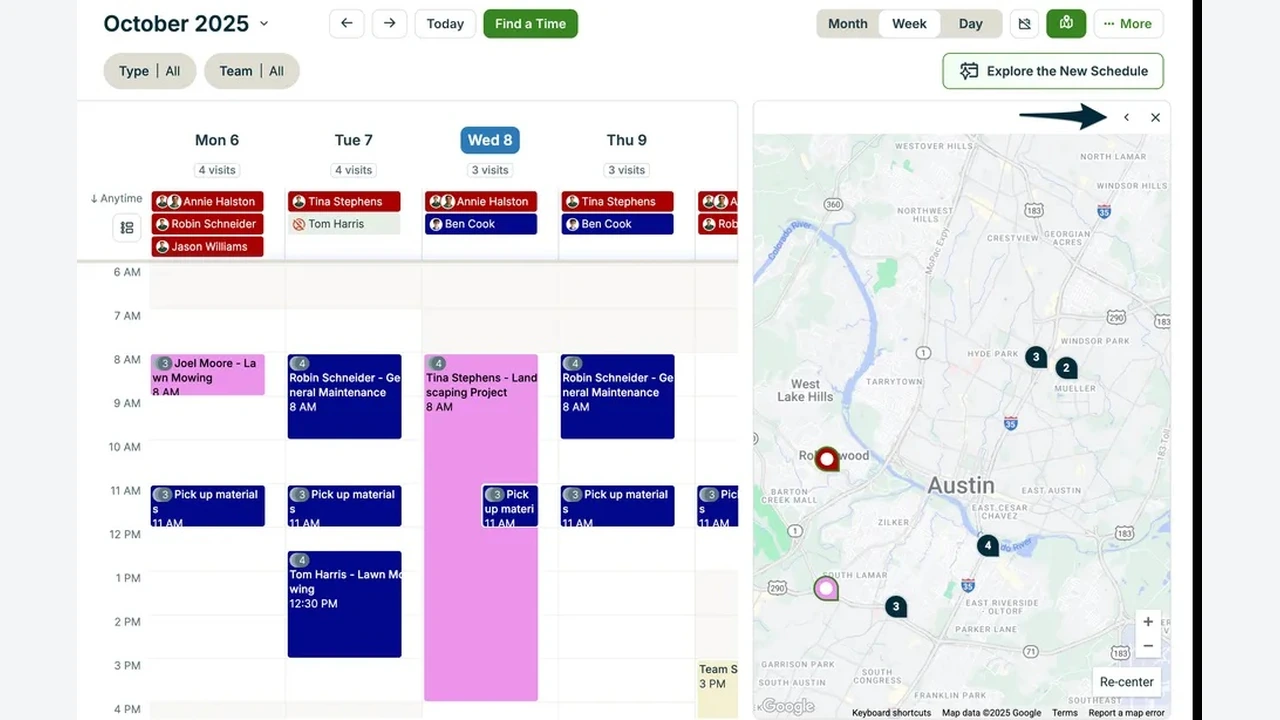
Jobber is general field service software. Its Connect plan adds automated client reminders, visit reminders and job follow-ups, and every plan covers scheduling, quoting, invoicing and online booking. Its routing optimizes daily or weekly routes for the team.
- Price: Core starts at $29 a month billed annually for 1 user. Connect starts at $99, and Connect with 5 users is $149 a month billed annually. Extra users are $29 a month each. Free trial.
- Limits: nothing on its pricing page covers per-trap intervals, tank capacity or FOG manifests.
Best suited for: plumbing or drain companies that pump some grease traps on a schedule alongside other work. If grease is most of your revenue, pick a liquid-waste tool.
Side-by-Side Comparison
The table scores every tool on the same five criteria, as each vendor describes itself on November 5, 2026.
| Tool | Interval per account or trap | Due date resets from pump date | Customer reminders | Due work to capacity-checked routes | 3-truck list price / month | Contract |
|---|---|---|---|---|---|---|
| DynoRoute | Per site, custom trap fields | Not stated | SMS, email, portal | Yes | Quote (flat plan + credits) | Month-to-month |
| Essential | Per trap, mixed cadences | Yes | Yes, automated outreach | No (traffic-aware routes) | Quote (per technician) | No lock-in |
| RouteHouse | Per trap, from the permit (Growth and up) | Next visit auto-generated | Business texting | Dump run before full | $447 (Growth, billed annually) | Monthly, cancel anytime |
| Tank Track | Per customer | Not stated | Text and email | Yes, by gallons | $480 | None |
| ServiceCore | Monthly, quarterly, semi-annual, custom | Not stated | Automated reminders | Not described | Quote (demo) | Annual |
| PumpDocket | Team plan and up | Not stated | Team plan and up | Not described (sequencing) | $329 Team ($230 intro) | None |
| Route Simplified | By service interval | Not stated | Not described | Not described | $100 + $1 per account | 30-day notice |
| Jobber | Repeat visits | Not stated | Connect plan and up | No | $149 (Connect, 5 users, annual) | Monthly or annual |
Which Scheduling Software Fits Your Operation
| Your operation | What breaks your day | Start with | Also look at |
|---|---|---|---|
| 2+ trucks, due accounts don't fit on the trucks | Stacked due days and full tanks | DynoRoute | Tank Track |
| Hundreds of restaurant traps, accounts slipping | Due dates drifting after early or late pumps | Essential | RouteHouse |
| Several traps per site, each with its own permit | Per-trap intervals and the 25% rule | RouteHouse | Essential |
| 1 to 10 trucks, want a price today | Customers forgetting service is due | Tank Track | PumpDocket |
| Multi-service liquid-waste company | Contracts across many service lines | ServiceCore | Tank Track |
| Small shop, tight budget | Due dates living in a spreadsheet | PumpDocket | RouteHouse |
| Grease plus used cooking oil | Two kinds of interval on one list | Route Simplified | DynoRoute |
| Grease is a side line | Remembering repeat visits | Jobber | Tank Track |
When Cycles Stack: A Worked Example
This example is illustrative, not a customer result. Say you service 300 interceptors on the 90-day minimum that Butler County and Kennedale require, plus 50 grease traps that Butler County's rule would have cleaned monthly.
- Interceptors: 300 accounts × 4 visits a year = 1,200 pump-outs.
- Monthly traps: 50 accounts × 12 visits a year = 600 pump-outs.
- Total: 1,800 pump-outs a year, or about 35 a week across your trucks.
Thirty-five a week is the average. Monthly and quarterly cycles on the same side of town land on the same day every so often, and that day carries far more gallons than a normal one.
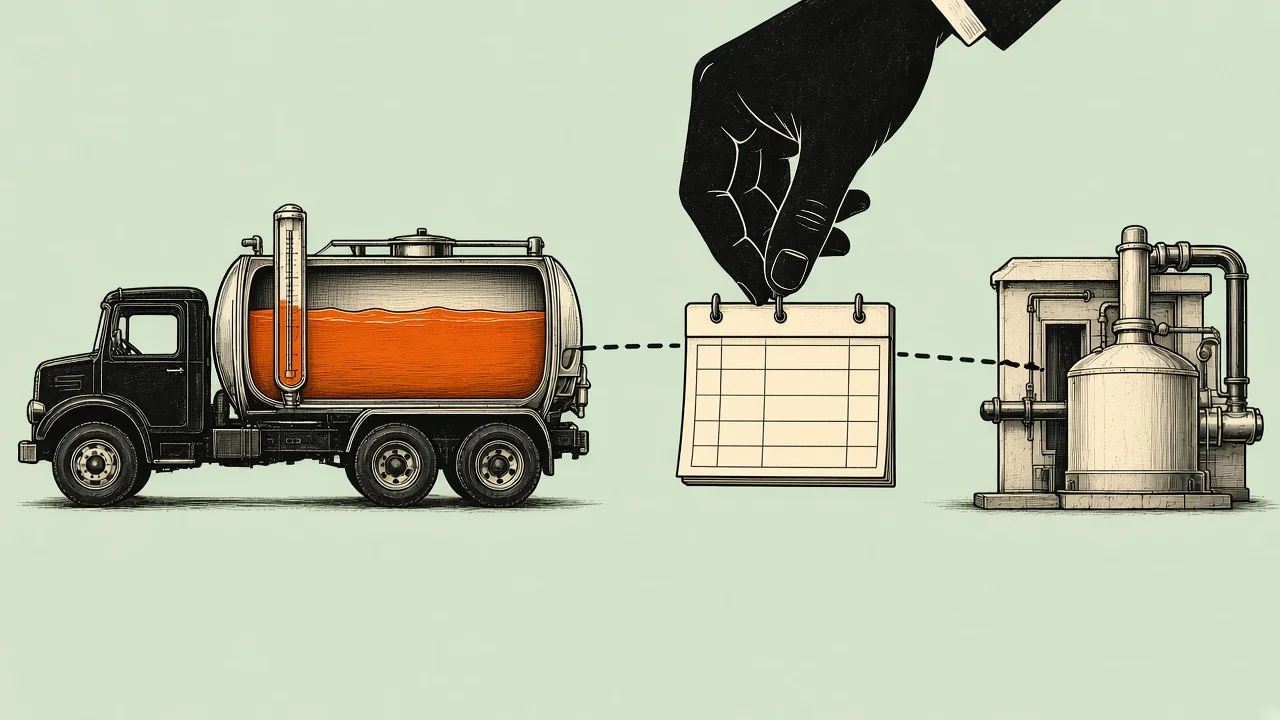
A scheduler that only fills a calendar shows that day as "more stops." A capacity-aware scheduler shows it as "more gallons than the truck holds" and plans the disposal trip before the driver leaves. For how many stops one truck can handle, see how many grease traps a vacuum truck can service per day. For tracking several traps at one restaurant, see servicing multi-trap locations.
Also Considered (and Why They're Not on the List)
| Tool | Why it isn't ranked |
|---|---|
| QuoteIQ | General field service software. Route optimization starts on the Elite plan at $299.99 a month, and a grease software roundup by QuoteIQ's co-founder says it does not ship a pre-built FOG manifest. |
| Housecall Pro | Recurring Service Plans and route optimization are on its MAX plan ($299 a month billed annually). Nothing grease-specific. |
| PRO Septic (Pro Software Solutions) | Schedules recurring pump-outs and grease trap services and auto-generates work orders, but it is septic-first and publishes no price. |
| DOP Software | Built for roll-off and dumpster haulers. Solo is $99 a month billed quarterly for 1 to 2 trucks, with route optimization a $49 add-on. |
| The Service Program | QuickBooks-centric scheduling priced by office user ($99.95 a month plus a $349 onboarding fee for one user). Not grease-specific. |
| DispatchNode / GreaseTrapDispatch, GreaseIQ | greasetrapdispatch.com describes an AI receptionist for booking pump-outs, not recurring scheduling; dispatchnode.com blocked our check. GreaseIQ advertises a limited beta with no published price. |
Frequently Asked Questions
What is the best scheduling software for recurring grease trap service?
For multi-truck fleets, DynoRoute is the best fit because it keeps due and overdue accounts visible and turns them into routes planned around tank capacity. Essential is best for due dates that reset from the actual pump date, and Tank Track is best with a published price ($180 for the first truck, $150 for each extra).
How often do grease traps need to be pumped?
It depends on the local sewer authority. Butler County, Ohio requires interceptors to be pumped at least every 90 days and grease traps cleaned monthly, and Kennedale, Texas requires a full pump-out at least every 90 days. Many programs also use a 25% rule, which means pumping when grease and solids reach a quarter of the trap's depth.
What happens to the due date when a trap is pumped early or late?
In Essential the next due date moves automatically based on the completed work. RouteHouse auto-generates the next visit from the trap's cadence. Ask other vendors how their schedule handles an early or late pump-out before you buy.
How much does recurring grease trap scheduling software cost for a 3-truck fleet?
At published list prices on November 5, 2026: $480 a month for Tank Track, $447 for RouteHouse Growth (billed annually), $329 for PumpDocket Team ($230 on its intro offer) and $149 for Jobber Connect with 5 users (billed annually). DynoRoute, Essential and ServiceCore give quotes.
Can scheduling software send reminders to restaurant customers?
Yes. Tank Track sends service-due reminders by text and email, Essential can reach out and get approvals, and DynoRoute uses SMS, email and portal workflows. PumpDocket includes reminders on its Team plan, and Jobber on its Connect plan.
How long does it take to switch recurring scheduling software?
PumpDocket says you can go live in one day, Tank Track imports your data for free and trains you in 1 to 4 live sessions, and DynoRoute says live in days. ServiceCore says onboarding typically takes 6 to 12 weeks, and Essential offers free implementation.
Keep Every Trap on Schedule With DynoRoute
If due accounts keep piling onto days your trucks can't finish, start with one real week. Bring your account list, intervals and truck sizes. We'll talk through how DynoRoute would schedule and route that week and what your plan would cost. There's no setup fee and no per-seat fee, and plans are month-to-month. Book a 30-minute intro call, see how DynoRoute handles recurring grease work, or compare all-in-one suites in our best grease trap software list.