The best dispatch software for grease trap pumping companies assigns each job to a truck that still has tank room, and lets the dispatcher approve the change. For multi-truck fleets, DynoRoute is our #1 pick: when an emergency pump-out lands mid-day, its AI Dispatcher proposes a fix that fits the tank, and nothing changes until you approve it. Tank Track is the best pick with a published per-truck price, and ServiceCore is the most complete all-in-one. Every price below was checked on the vendor's own page on November 5, 2026.
Disclosure: we build DynoRoute. We rank it first for one kind of operation and say plainly who should skip it.
Key Takeaways
- Dispatch is not the same as routing. Routing builds tomorrow's stop order. Dispatch decides which truck takes each job and how the board changes when a pump-out runs long or an overflowing trap calls in at 2 p.m.
- Three tools on this list assign work by tank capacity: DynoRoute, Tank Track and FieldCamp. RouteHouse plans the dump run into the route before the truck is full. The others assign by calendar, crew or route, so the dispatcher still checks gallons by hand.
- Control varies. DynoRoute changes nothing until the dispatcher approves. FieldCamp offers an Auto mode and an Assist mode that queues every job for review. Most other tools are manual boards.
- A 3-truck fleet pays about $140 to $480 a month on the published plans in our comparison table. Tank Track is $480 for three trucks, RouteHouse Growth is $447 (billed annually), PumpDocket Team is $329 ($230 on its intro offer) and PumpDocket Starter is $139. DynoRoute, ServiceCore and FieldCamp price by quote.
- Check the driver app before you buy. DynoRoute, PumpDocket and RouteHouse say drivers can work offline and sync later, and ServiceCore gives drivers turn-by-turn directions.
What Grease Trap Dispatch Software Actually Is (and What It Is Not)
Grease trap dispatch software is the board your office runs the day on. It assigns each pump-out to a truck and driver, sends the route to the driver's phone, shows progress live, and changes the plan when the day breaks. A good one knows three things a generic calendar does not: how much room is left in each tank, which disposal site the truck will use, and which accounts are due or overdue.
Emergencies are part of the job. The EPA's food service pretreatment fact sheet cites its Report to Congress finding that grease is the most common cause (47%) of reported sewer blockages, so overflowing-trap calls will land mid-route. That call has to go to a truck that is close and still has room, not just the nearest truck. For how dispatchers run that day, see dispatching grease trap service trucks and running the emergency pump-out line.
What it is not:
- Not route optimization alone. A route optimizer builds a good stop order. Dispatch also handles assignment, live changes and driver communication.
- Not an answering service. Some tools add AI call answering. That books the job but doesn't decide which truck can take it.
- Not your manifest system by default. Some dispatch tools produce FOG manifests and some only capture the data. Check this separately (see grease trap manifest requirements).
How We Ranked These Dispatch Tools
We scored each tool on five criteria, using only what the vendor's own website says (checked November 5, 2026). Where a vendor doesn't publish something, we say so.
- Capacity-aware assignment: Does it assign jobs or plan dispatch by the gallons left in each truck?
- Dispatcher control: Does the dispatcher approve changes, and does the tool show why it picked a truck?
- Mid-day changes: Live board or map, emergency insertion, and recovery when a job runs late or cancels.
- Driver app: Does it work offline, and does it capture gallons, disposal site, photos and signatures?
- Price for a 3-truck fleet and contract terms: The monthly list price at that size, or "quote" if it isn't published.
We excluded tools whose claims we couldn't check on a working vendor page (see "Also considered" below).
The Best Dispatch Software for Grease Trap Pumping Companies in 2026
Eight tools made the shortlist. Three of the first four assign by tank capacity; ServiceCore is in that group as the all-in-one liquid-waste platform. The last four suit budget shops, field-first crews, and companies where grease is one service among several. Each entry ends with who it suits best.
1. DynoRoute, best for capacity-aware AI dispatch with dispatcher approval
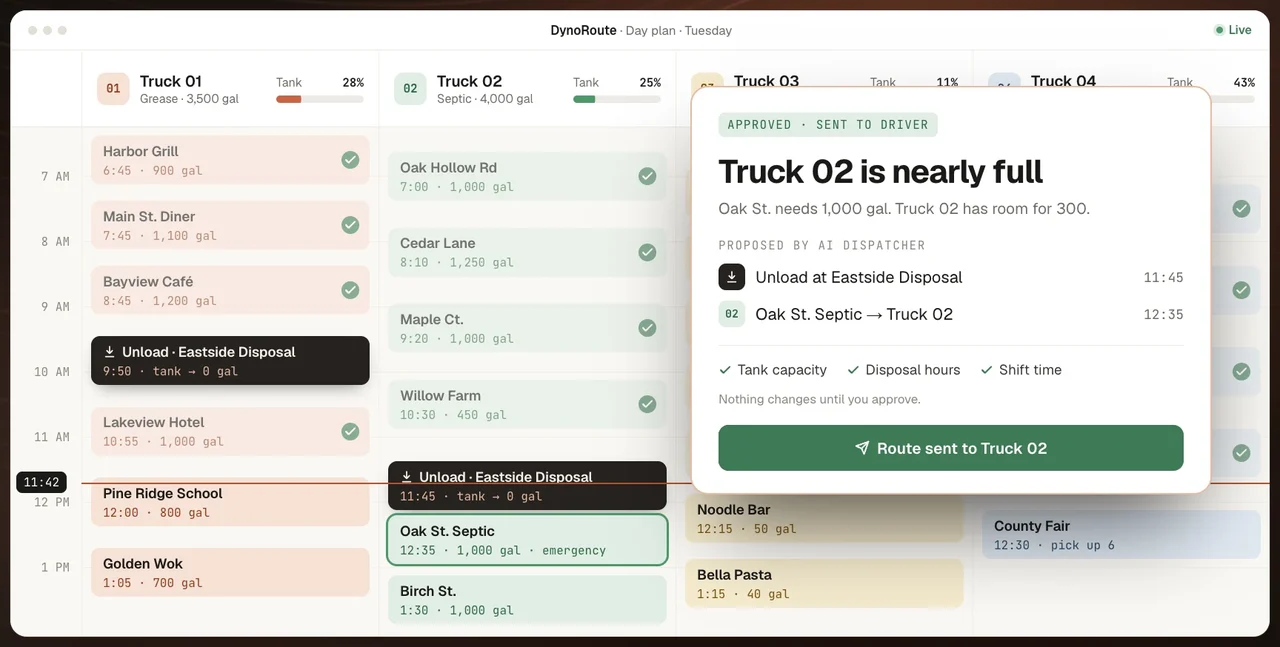
DynoRoute plans the day around tank capacity, service windows and the return to unload, then runs it on a live map and timeline, as its grease trap software page describes. AI suggestions match work by capacity, location, availability, workload and skills. Each suggestion carries a confidence score, and the dispatcher keeps final control. When an emergency pump-out lands mid-day, the AI Dispatcher proposes a fix that fits the tank, and nothing changes until you approve it. Late-job and cancellation recovery and in-transit stop and sequence changes handle the rest of the day.
Recurring jobs repeat weekly, biweekly, monthly, quarterly or on a custom cadence, with due, unscheduled and overdue work visible to dispatch. Drivers use iOS or Android, record gallons, photos, signatures and disposal details, and can complete stops offline and sync later. Completed jobs flow to invoices with QuickBooks sync.
- Price: flat monthly plans with usage credits, not per truck or per seat. Month-to-month, no setup fee. You get a quote on a 30-minute intro call (a conversation, not a software demo).
- Limits: no published dollar price. DynoRoute captures manifest data and produces reports, but you configure the manifest format to each jurisdiction.
Best suited for: grease, septic or mixed fleets with two or more trucks where emergencies and full tanks reshuffle the board every day. Skip it if you want software that dispatches with nobody approving changes.
2. Tank Track, best for capacity-based dispatch at a published per-truck price
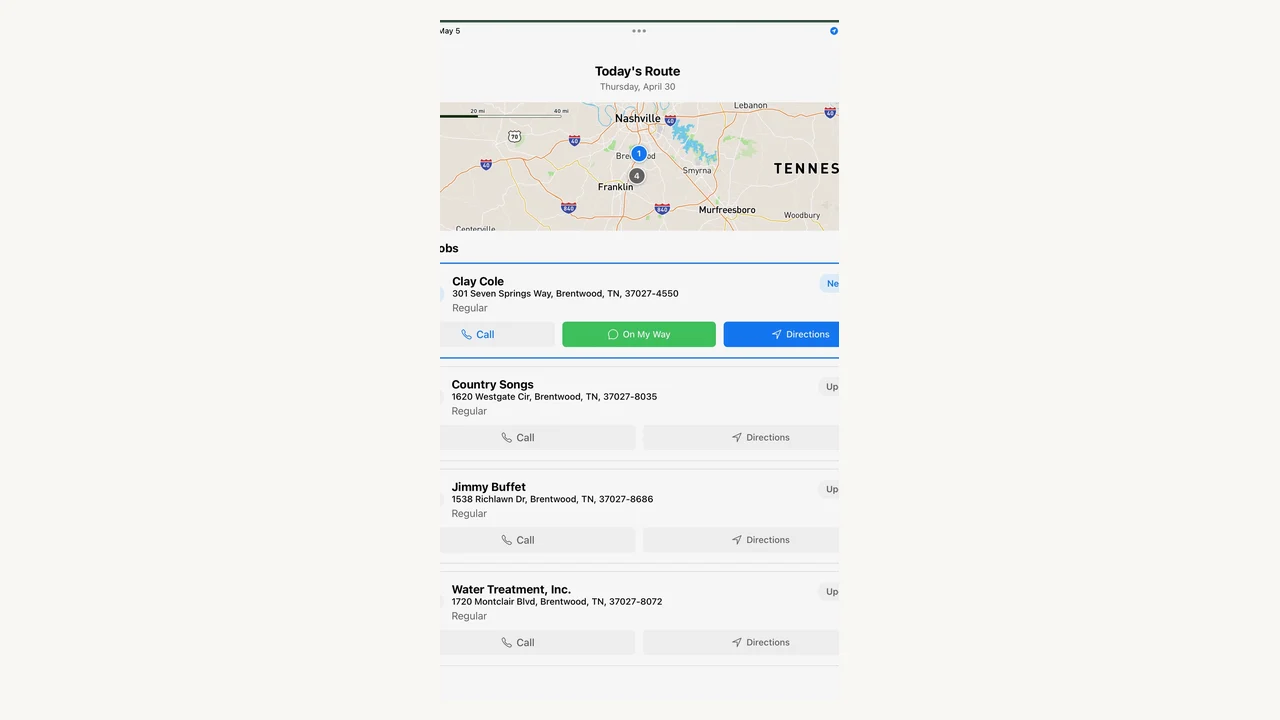
Tank Track is software for septic, grease trap and portable toilet operators. Its comparison page says dispatch "accounts for truck capacity and lets you add waste stops, so routes reflect how much a truck can actually haul before it needs to offload." It sends service-due reminders by text and email and can create the work order for you. It automatically creates waste manifest reports as work is completed, and technicians take card and ACH payments on site.
Tank Track says more than 300 operators use it across 45 US states and 3 Canadian provinces. It imports and cleans your data for free, then trains your team in 1 to 4 live sessions.
- Price: $180 a month for the first truck and $150 for each extra truck, with unlimited users. Annual billing saves 10%. No contract.
- Limits: its pages don't describe AI assignment suggestions. The dispatcher still decides which truck takes each job.
Best suited for: septic-and-grease operators with 1 to 10 trucks who want capacity-aware dispatch, manifests and a price they can calculate today. Fleets that want AI-suggested assignments should compare it with DynoRoute and FieldCamp.
3. ServiceCore, best for established liquid-waste companies that want dispatch and manifests in one system
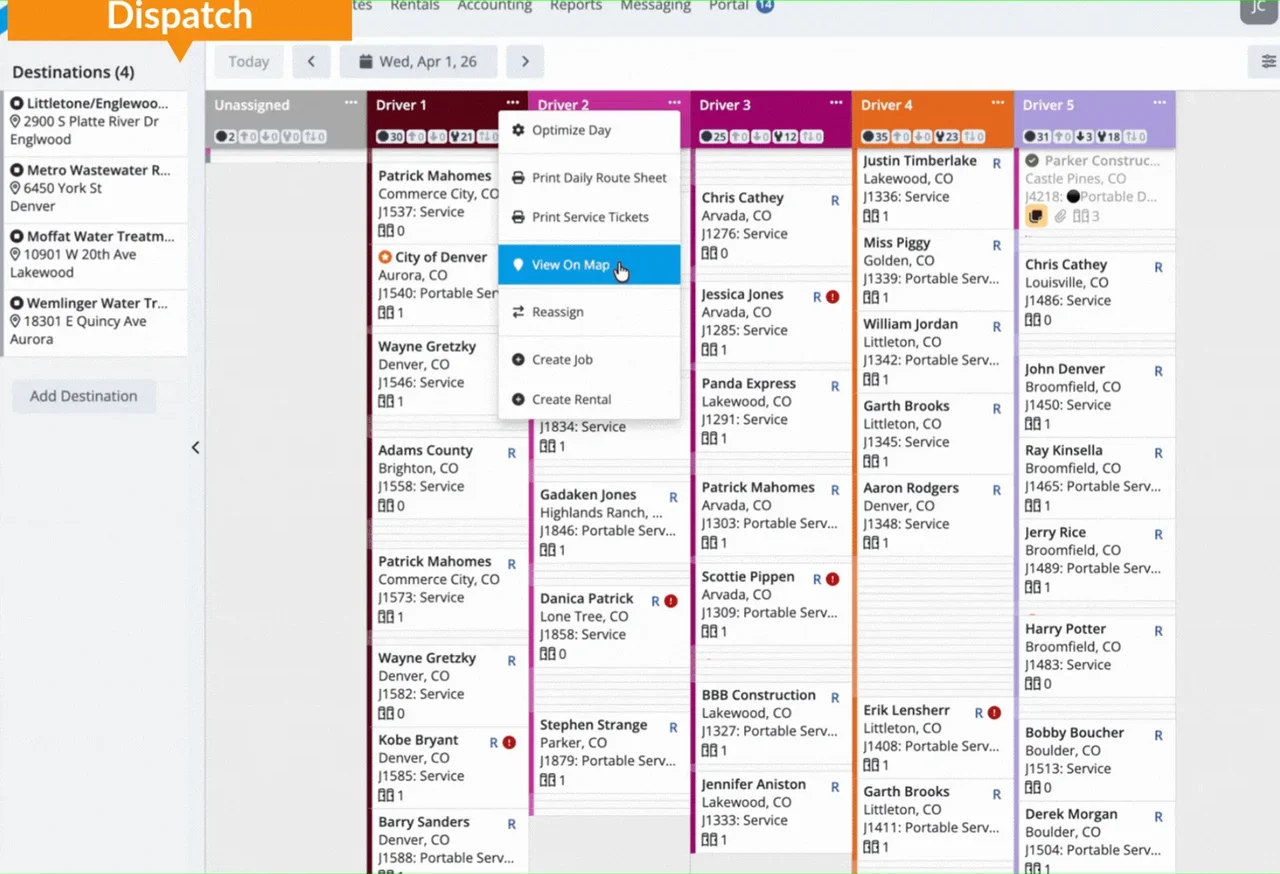
ServiceCore serves portable sanitation, septic and grease companies. Its grease page says dispatchers "have everything they need in one place," with one-click route optimization and real-time progress tracking. Drivers get turn-by-turn directions in the mobile app, tap Complete Job, and can report problems like a blocked unit with a time-stamped photo. It also generates FOG disposal manifests automatically and supports recurring contracts and one-click reminders for overdue accounts.
- Price: not published. You see pricing in a personalized demo. Billed monthly on an annual contract, per its pricing page.
- Setup: ServiceCore says data import and training typically take 6 to 12 weeks.
- Limits: its grease page doesn't describe tank-capacity assignment or AI suggestions. Ask how it handles a truck that fills mid-route.
Best suited for: multi-service liquid-waste companies that want dispatch, manifests and billing in one platform and accept an annual contract. Small fleets that want to go live this month at a published price should look at Tank Track or PumpDocket.
4. FieldCamp, best for choosing between fully automatic and reviewed AI dispatch
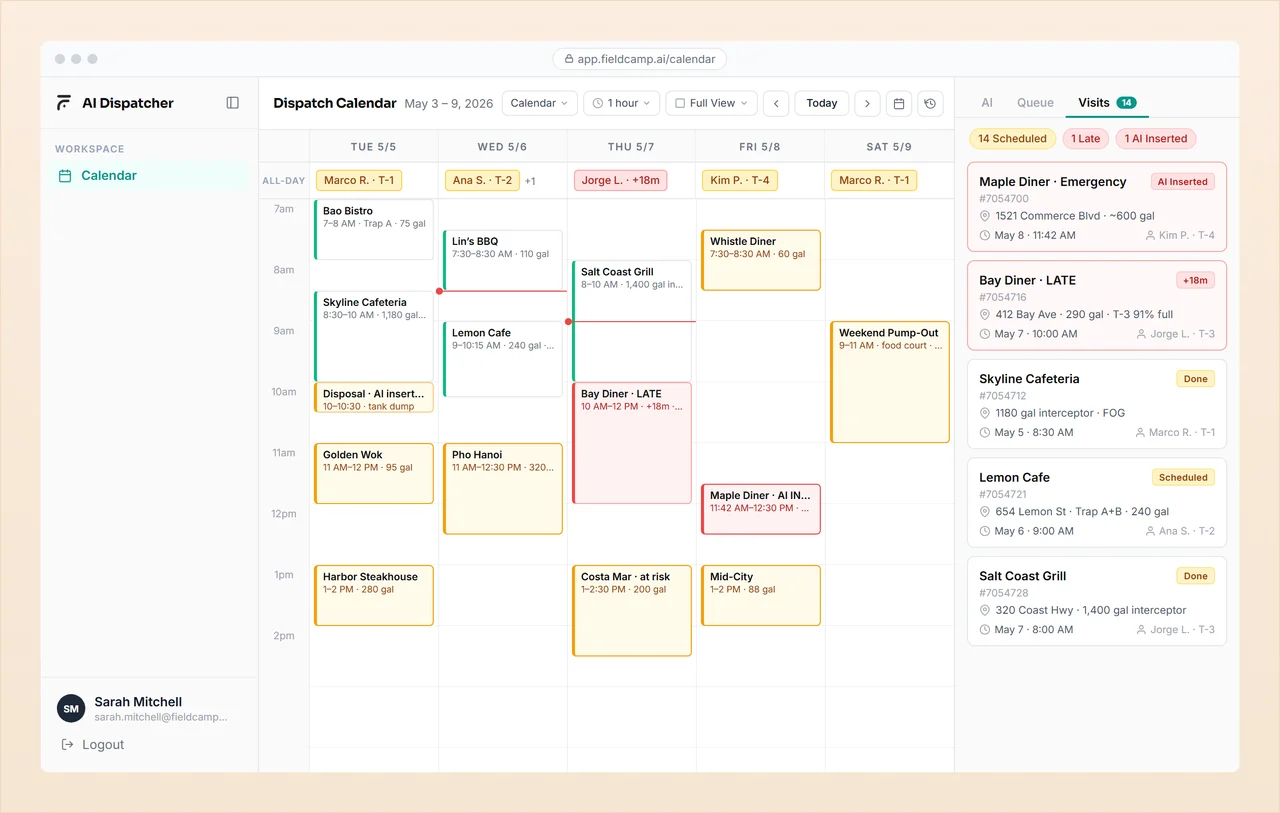
FieldCamp is AI field service software for many trades, with a grease trap dispatch page. That page says it "enforces tank capacity as a hard routing constraint" and inserts emergency overflowing-trap calls into the closest qualifying truck's day. Its AI Dispatcher has two modes: in Auto mode it assigns the best technician and slot the moment a job is created, and in Assist mode every job lands in a queue for the dispatcher to review and approve. It shows the reasoning behind each assignment and says it can plug into the field service software you already run.
- Price: not published. All plans (Pro, Growth, Scale, Enterprise) are priced on a call, billed monthly or annually.
- Limits: grease is one industry among many. Its grease page says digital manifests are generated after the driver signs on the tablet, so check that the format matches what your city wants.
Best suited for: companies that run grease alongside other trades and want AI dispatch they can switch from review to automatic as trust grows. Grease-only haulers may prefer a tool built for liquid waste.
5. PumpDocket, best for small septic-and-grease shops on a budget
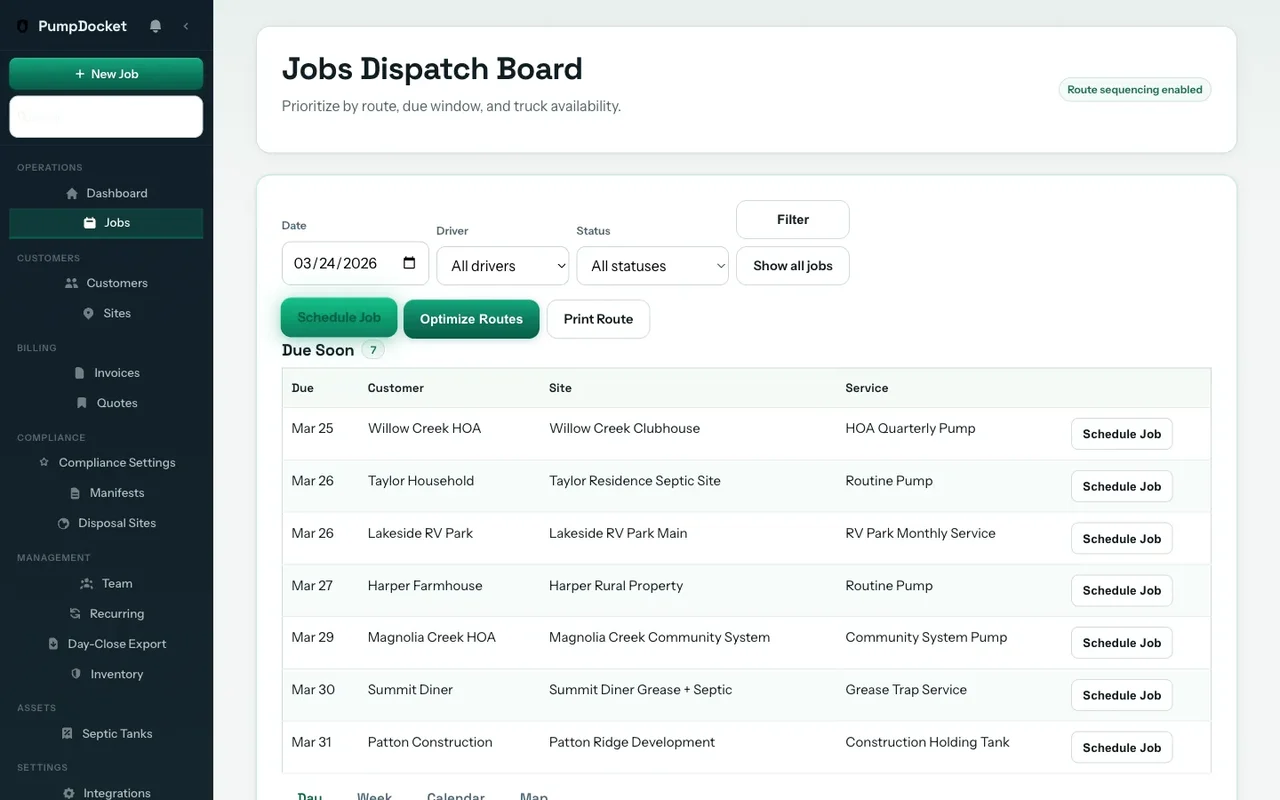
PumpDocket covers septic tanks, grease traps and portable restrooms. Its dispatch board assigns routes and notifies drivers before they leave the yard, shows live job status without phone calls, and has an offline field app where drivers log gallons, disposal site and notes. Every plan includes dispatch, field closeout and invoicing. The Team plan adds recurring scheduling with reminders, FOG manifests and QuickBooks sync.
- Price: Starter $139, Team $329 and Fleet $649 per month at list, sized for 1 to 3, 4 to 10 and 11+ trucks. A current intro offer cuts that to $99, $230 and $454, locked for life. Unlimited users, first month free, no contract.
- Limits: Starter has no recurring scheduling and a 75-customer cap. Its pages describe route sequencing, not tank-capacity assignment.
Best suited for: small operators who need a clean dispatch board, offline closeout and manifests at a low price. Fleets that lose time to trucks filling mid-route need a capacity-aware tool instead.
6. RouteHouse, best for a driver-first field app with a manifest on every load
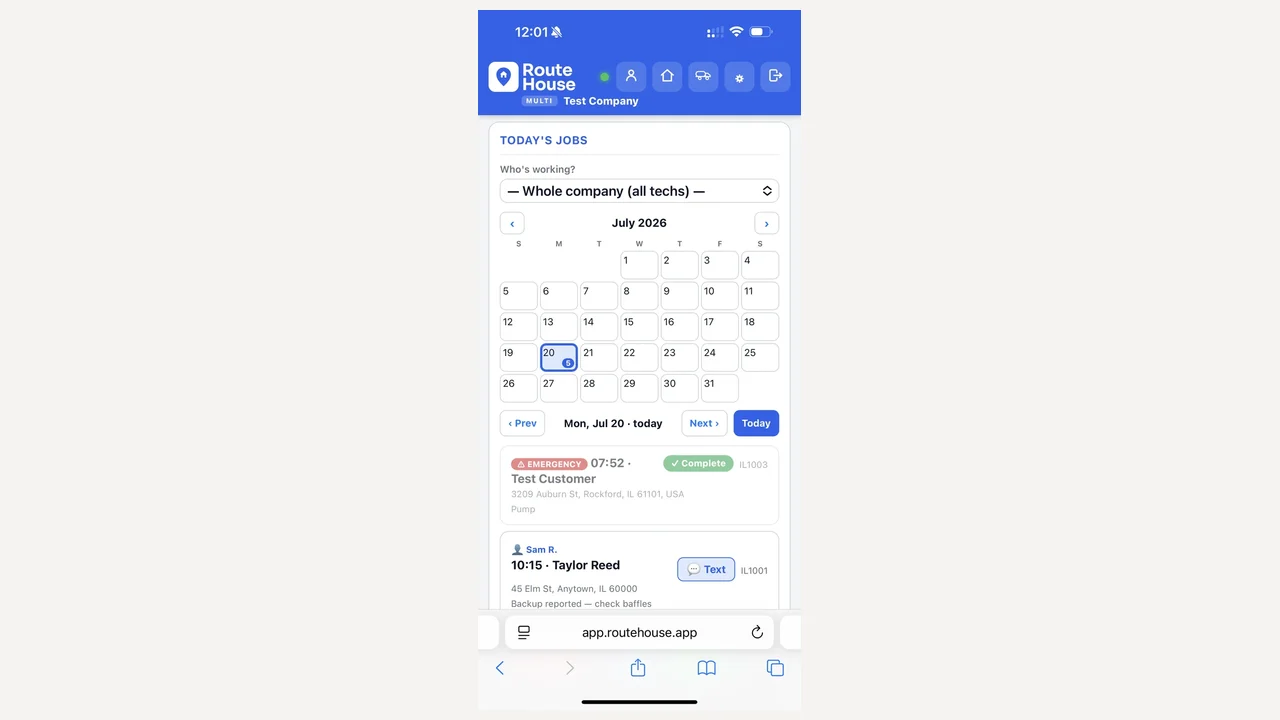
RouteHouse says it is built "for the guy in the truck." Each tech sees only his stops and gets one-tap directions, and arrival stamps GPS, time and weather and starts a timer. Its grease edition tracks each trap as its own asset, flags traps over the 25% rule, and links each disposal (site, weight ticket, hauler permit, signatures) into a manifest. Its routing schedules the dump run before the truck is full. It works offline, and an AI call-answering add-on (listed as in pilot) turns calls into job requests for you to confirm.
- Price: per truck with unlimited users. Solo $99 (one truck), Growth $149 and Pro $249 per truck per month, billed annually. Multiple trucks, recurring auto-scheduling and manifests start on Growth. A current offer gives the second year free on a 1-year prepay.
- Limits: the iPhone app is listed as "coming soon," and Android runs in the browser. Its pages focus on the field app more than on the office dispatch board.
Best suited for: small grease crews who care most about drivers actually using the app and about per-trap records. Fleets running complex multi-truck days should compare it with DynoRoute or Tank Track.
7. QuoteIQ, best for grease-as-a-side-line shops that need phones answered
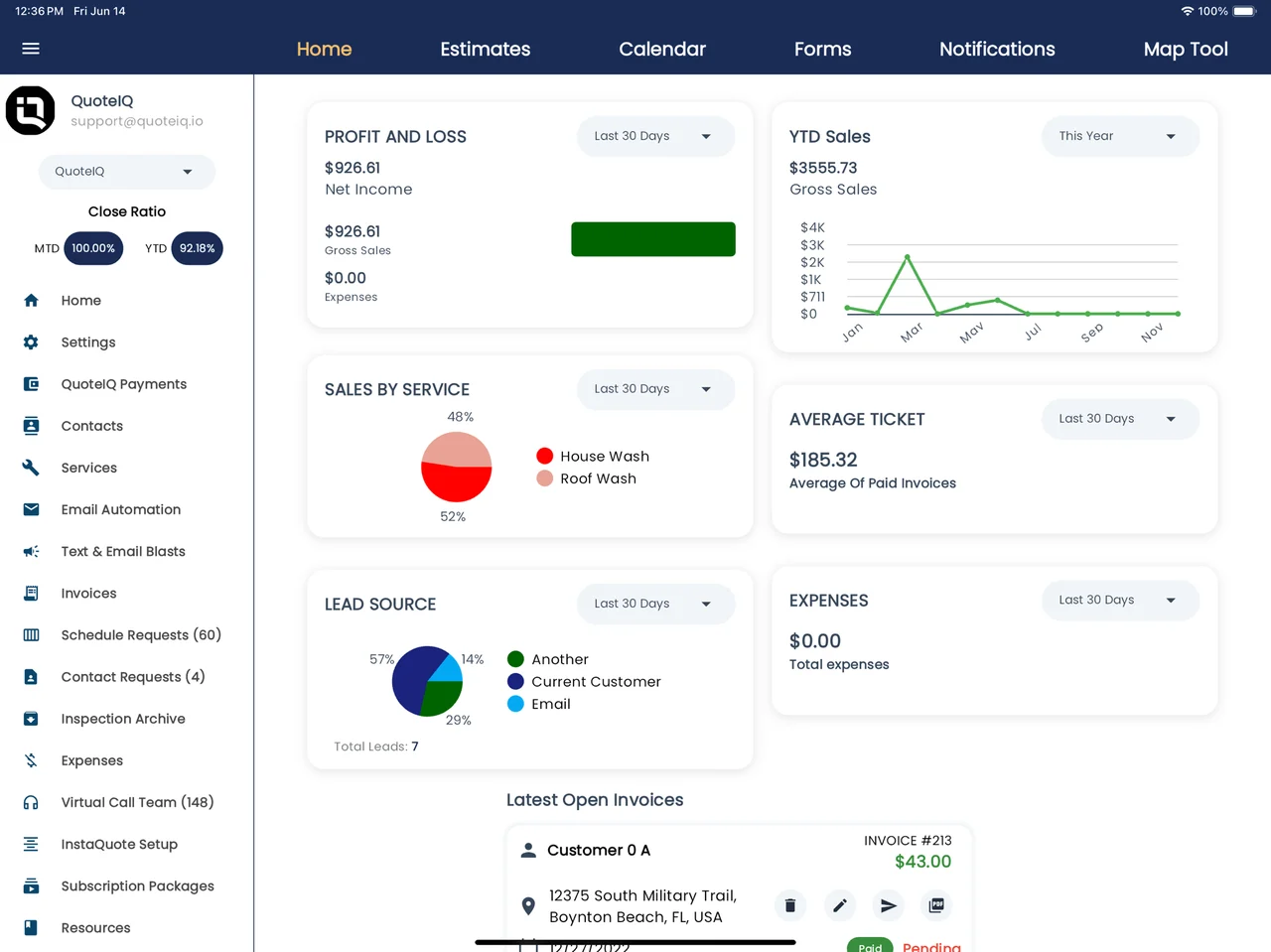
QuoteIQ is general field service software. Per its pricing page, every plan includes its AI Virtual Call Team (a 24/7 AI call assistant), estimates, invoices, scheduling and online payments. Route optimization, InstaSchedule (customer self-scheduling) and EmployeeHub start on the Elite plan.
- Price: Essentials $29.99 (1 user), Beginner $99.99 (2 users), Pro $199.99 (4 users), Elite $299.99 (10 users) and Max $699.99 (20 users) per month. Extra users $25 each. 14-day free trial.
- Limits: no tank-capacity dispatch, and a grease software roundup by QuoteIQ's co-founder says it does not ship a pre-built FOG manifest.
Best suited for: owner-operators where grease is one service among several and missed calls cost more than routing. Grease-first fleets should pick a liquid-waste tool.
8. Jobber, best for mixed-trade companies that want a polished general dispatch board
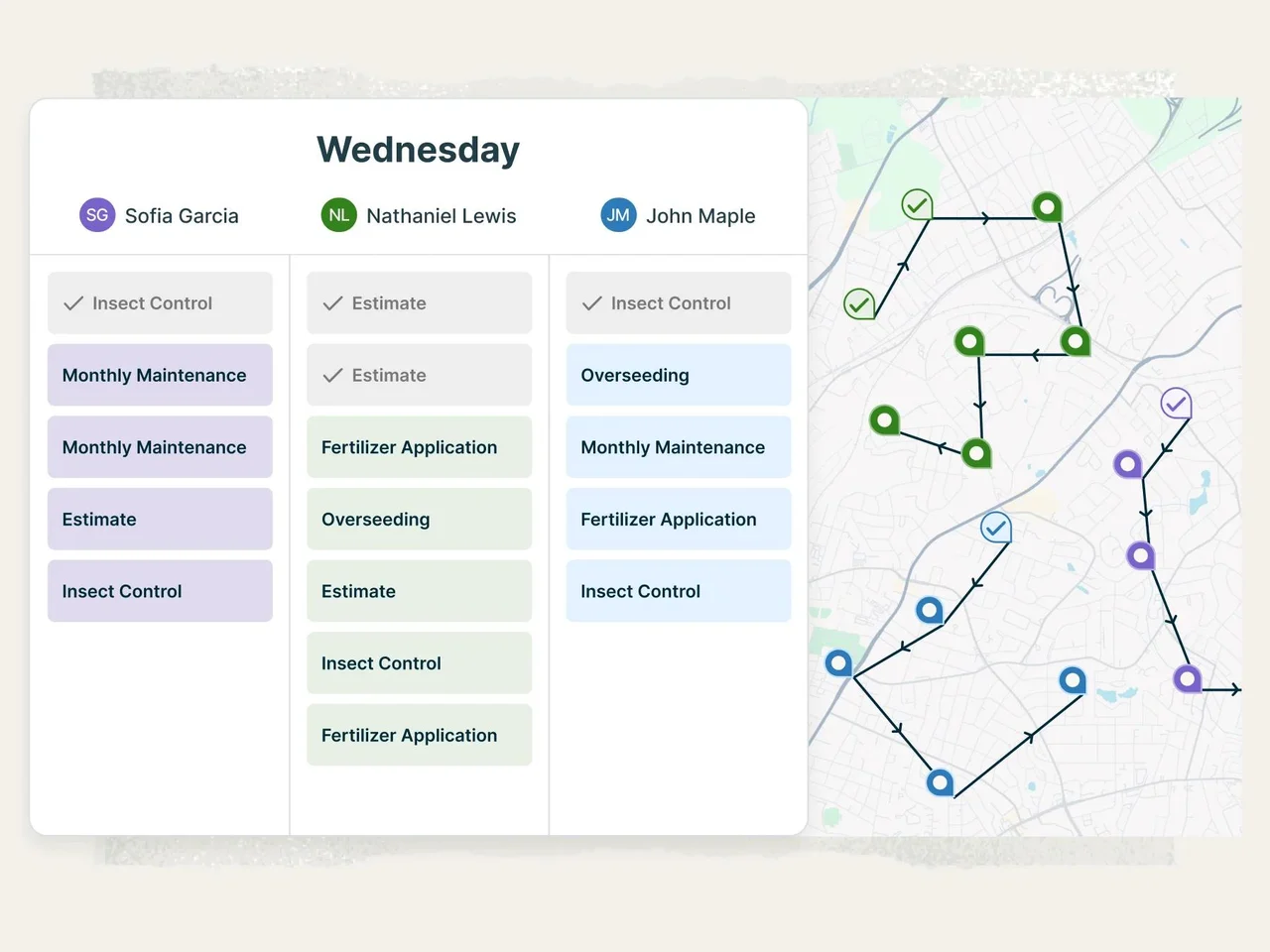
Jobber is general field service software for home and commercial service businesses. Its plans cover online booking, scheduling, quoting, invoicing and payments. Its routing optimizes daily or weekly routes for the team and adjust when plans change, and it offers GPS tracking.
- Price: Core starts at $29 a month billed annually for 1 user. Connect starts at $99, and Connect with 5 users is $149 a month billed annually. Extra users are $29 a month each. Free trial.
- Limits: nothing on its pricing page covers tank capacity, disposal stops or FOG manifests.
Best suited for: plumbing or drain companies that pump some grease traps and want one tool for every job type. If grease is most of your revenue, pick a liquid-waste tool.
Side-by-Side Comparison
The table scores every tool on the same five criteria, as each vendor describes itself on November 5, 2026.
| Tool | Capacity-aware assignment | Dispatcher control | Mid-day changes | Offline driver app | 3-truck list price / month | Contract |
|---|---|---|---|---|---|---|
| DynoRoute | Yes | Approves every AI change; confidence score | Emergency fix, late-job and cancellation recovery | Yes | Quote (flat plan + credits) | Month-to-month |
| Tank Track | Yes, by gallons | Manual | Add waste stops mid-route | Not stated | $480 | None |
| ServiceCore | Not described | Manual, one-click optimize | Real-time progress | Not stated | Quote (demo) | Annual |
| FieldCamp | Yes, hard constraint | Auto or Assist (review queue) | Emergency insertion | Not stated | Quote (call) | Billed monthly or annually |
| PumpDocket | Not described (sequencing) | Manual board | Live status | Yes | $139 Starter ($99 intro); $329 Team | None |
| RouteHouse | Dump run before full | Manual | Notifications to drivers | Yes | $447 (Growth, billed annually) | Monthly, cancel anytime |
| QuoteIQ | No | Manual | Not described | Not stated | $299.99 Elite (route optimization) | Cancel anytime |
| Jobber | No | Manual | Routes adjust as plans change | Not stated | $149 (Connect, 5 users, annual) | Monthly or annual |
Which Dispatch Software Fits Your Operation
| Your operation | What breaks your day | Start with | Also look at |
|---|---|---|---|
| 2+ grease or septic trucks with emergency calls | Full tanks and mid-day changes | DynoRoute | FieldCamp, Tank Track |
| 1 to 10 trucks, want a price today | Manifests and billing in one place | Tank Track | PumpDocket |
| Multi-service liquid-waste company | One system for every service line | ServiceCore | Tank Track |
| Grease plus HVAC or plumbing | One AI dispatcher for every trade | FieldCamp | Jobber |
| Small shop, tight budget | Paper tickets and the Friday paperwork pile | PumpDocket | RouteHouse |
| Crew that won't use complicated apps | Drivers skipping the app | RouteHouse | PumpDocket |
| Grease is a side line, phone rings unanswered | Missed calls | QuoteIQ | Jobber |
What Manual Dispatch Costs: A Worked Example
This example is illustrative, not a customer result. Say your dispatcher spends 2 hours a day rebuilding the board by hand: checking which truck has tank room, calling drivers, and moving stops after an emergency.
- Labor: the BLS Occupational Employment and Wage Statistics put the mean wage for dispatchers (except police, fire and ambulance) at $26.32 an hour in May 2025. Two hours a day is about $53, or about $13,160 over 250 working days.
- Fuel: the EIA's weekly fuel survey put U.S. on-highway diesel at $6.29 a gallon on November 2, 2026, about $2.54 more than a year earlier. Sending the closest truck when it is already near full, then driving it to disposal and back, burns that diesel for nothing.

Capacity-aware dispatch takes the gallon check out of the dispatcher's head. It doesn't replace the dispatcher. Use your own wage and hours, because the BLS figure is a national average. For the routing side of the same problem, see scheduling grease routes around disposal site cutoffs. For a wider comparison that includes billing and compliance suites, see our best grease trap software list.
Also Considered (and Why They're Not on the List)
| Tool | Why it isn't ranked |
|---|---|
| ServiceTitan | Built for HVAC, plumbing and electrical contractors. No prices on its pricing page (per-technician packages by request), and nothing grease-specific there. |
| Housecall Pro | Similar to Jobber. Route optimization is on its MAX plan ($299 a month billed annually), with nothing on tank capacity or manifests. |
| Route Simplified | A routing tool for grease and used cooking oil collectors with real-time driver status and emergency re-routing, but its site doesn't describe tank-capacity assignment, and its pricing tiers are written in UCO accounts. |
| DispatchNode / GreaseTrapDispatch | Pitches an AI receptionist for grease companies that answers calls, qualifies urgency and books crews. dispatchnode.com blocked our check, and greasetrapdispatch.com describes call handling and partner matching, not tank-capacity dispatch. |
| GreaseIQ | Advertised as a "limited beta" with results we couldn't verify. Not ranked until it publishes checkable product and pricing details. |
Frequently Asked Questions
What is the best dispatch software for grease trap pumping companies?
For multi-truck fleets with emergency calls, DynoRoute is the best fit because its AI Dispatcher proposes changes that fit each truck's tank and waits for the dispatcher to approve. Tank Track is the best choice with a published price ($180 for the first truck, $150 for each extra), and ServiceCore is the most complete all-in-one if you can sign an annual contract.
How does capacity-aware dispatch handle an emergency pump-out?
The software checks which trucks are close and still have tank room, then suggests one along with the change to its remaining stops. In DynoRoute nothing changes until the dispatcher approves, while FieldCamp can assign automatically in Auto mode.
How much does grease trap dispatch software cost for a 3-truck fleet?
At published list prices on November 5, 2026: $480 a month for Tank Track, $447 for RouteHouse Growth (billed annually), $329 for PumpDocket Team ($230 on its intro offer), $139 for PumpDocket Starter (no recurring jobs or manifests) and $149 for Jobber Connect with 5 users (billed annually). DynoRoute, ServiceCore and FieldCamp give quotes.
Which grease trap dispatch tools generate FOG manifests?
ServiceCore, Tank Track and FieldCamp generate them automatically, RouteHouse links every load into a manifest on its Growth and Pro plans, and PumpDocket includes them on its Team plan and up. DynoRoute captures gallons, disposal details and signatures on each job and produces reports you configure to each jurisdiction.
What is the difference between dispatch software and route optimization software?
Route optimization builds the best stop order for a day. Dispatch assigns jobs to trucks and drivers, tracks them live, and changes the plan when jobs run late or new calls come in. For the routing side, see how to plan grease trap pumping routes.
Can drivers use grease trap dispatch apps without cell service?
Some can. DynoRoute, PumpDocket and RouteHouse say drivers can work offline and sync later, so ask every other vendor before you buy if your routes have dead zones.
How long does it take to switch grease trap dispatch software?
PumpDocket says you can go live in one day, Tank Track trains teams in 1 to 4 live sessions after importing your data, and DynoRoute says live in days. ServiceCore says onboarding typically takes 6 to 12 weeks.
Is there a free dispatch program available?
Not a full one for grease trap haulers. None of the grease dispatch tools in this list publishes a free plan. The closest is Route Simplified, which offers a free starter package for collectors with fewer than 100 clients; its Local plan is otherwise $100 a month plus $1 per account. PumpDocket gives the first month free, and Jobber and QuoteIQ have free trials. Check current prices with each vendor before you commit.
Is dispatch software worth it for a small owner-operator grease hauler?
It depends on whether you need FOG manifests and how many trucks you run. If grease is most of your work, a grease-ready tool such as PumpDocket (Starter for 1 to 3 trucks, Team for recurring jobs and manifests) or Tank Track ($180 for the first truck) is the budget-friendly way in. If grease is a side line, Jobber or QuoteIQ cost less but don't plan by tank capacity. ServiceTitan is built for larger HVAC, plumbing and electrical contractors, so it is a poor fit for a one-truck grease shop.
Which type of software fits a company that pumps both grease and septic or used cooking oil?
For grease and septic, pick a liquid-waste tool that covers both, such as Tank Track, ServiceCore or PumpDocket, which also handle portable toilets. For grease and used cooking oil, Route Simplified runs both route types with RIN and LCFS records. General field-service platforms like Jobber or Housecall Pro can book the jobs, but they don't track tank capacity or FOG manifests, so confirm each tool supports every service type you run.
What are the downsides of letting AI assign grease trap jobs automatically?
The main risk is a wrong assignment going out with nobody checking it, such as a truck sent to a stop it no longer has tank room for. DynoRoute shows a confidence score on every suggestion. Its Plan Review mode queues every suggestion for the dispatcher, and its optional Auto Mode handles only the disruptions you choose, under guardrails you set. FieldCamp offers a similar choice between Auto and Assist modes. If you want a person to sign off on every change, keep automation off for anything without one obvious right answer.
Run Your Grease Dispatch Board With DynoRoute
If emergencies and full tanks keep reshuffling your board, start with one real day. Bring your trucks, tank sizes and a typical set of calls. We'll talk through how DynoRoute would dispatch that day and what your plan would cost. There's no setup fee and no per-seat fee, and plans are month-to-month. Book a 30-minute intro call or see how DynoRoute handles grease trap dispatch.