Replanning Routes When the Day Changes: The Five-Step Recovery Protocol
Last updated 2026-08-25
Key takeaways
- A same-day replan starts with measurement rather than action: what broke, and how much capacity, legal driving time, equipment, and disposal access the fleet still has.
- Some work is protected before the day ever breaks: overflow-risk stops, contractual commitments, enforced time windows. The replan trades everything except that list.
- There are only four recovery moves: resequence the affected route, transfer stops to another truck, launch a rescue truck, or roll work to another day, and each has a constraint that decides when it fits.
- The nearest truck is often the wrong truck, because proximity says nothing about remaining tank space, remaining legal hours, or where that truck's disposal return will land.
- A replan only exists once every affected driver has the updated route and each affected customer has the ETA or service notice your policy requires; until then, part of the operation is working from an obsolete plan.
- The end of a broken day produces the data that makes the next one cheaper: the cause, the moves, the misses, and the master-data gaps that turned a wobble into a scramble.
Replanning routes when the day changes is a protocol, not a scramble, and it runs in a strict order because every decision inherits the one before it. I build DynoRoute, routing and dispatch software for fleets that fill up or empty out as they work — pricing is public — and I've spent this year interviewing the operators who run those fleets. The plans I see rarely fail because they were wrong the night before. They fail because a capacity-planned day carries coupled constraints a parcel route never sees — fill limits, disposal returns, driver hours — and the usual advice, drag the stops to the nearest truck, quietly breaks two of them. This page walks the five decisions of a mid-day replan in the order they depend on each other, and what the evening should keep once the day is saved.
What changed, and what is still feasible?
The first move after an incident is an inventory, not an assignment. Before any stop moves, capture what broke and re-measure what the fleet still has: uncommitted capacity on each truck, remaining legal hours for each driver, the equipment and certifications still on the road, and which disposal outlets stay reachable before their cutoffs. Every later decision inherits this snapshot, and a replan built on a stale one fails twice in the same day.
Incidents come in five classes, and each class drains a different resource. An emergency job adds demand. A breakdown removes a truck, and if the tank was two-thirds full it also strands a load that needs its own plan. A driver callout removes hours, and sometimes the one certification the day depended on. Traffic and weather tax every route at once. An outlet problem, like the transfer station that stops accepting a material or the plant that closes a lane, moves the disposal leg on every route that planned to use it. Naming the class tells you what to re-measure first.
Hours deserve the same arithmetic as tank space; they are just as finite and far less visible on a map. Where federal property-carrier rules apply, drivers are generally limited to 11 hours of driving inside a 14-consecutive-hour window after coming on duty. The short-haul exception changes recordkeeping, not the need to operate within its 150-air-mile and 14-hour conditions. Intrastate rules and other exceptions may differ, so the plan has to use the clock that governs that driver. A rescue assignment that crosses it creates a compliance problem on top of the overtime. Feasibility means all four ledgers at once: a truck with room, a driver with hours, the right equipment, and an outlet still open.
Which work must be protected first?
The work that survives a replan is decided before the day ever breaks. For a capacity-routed fleet, the protected list ranks in this order: stops where waiting creates an overflow, a backup, or a safety problem; work under a contractual response clock; stops with access or time windows that will genuinely be enforced; then the high-value work whose loss costs real revenue. Everything below that line is a candidate to move, and the replan trades only candidates.
The ranking has to exist as data on the stop: a priority level, a window, a commitment flag. Most dispatchers carry it in their heads instead and rebuild it from memory at the worst possible moment. Recorded as data, a broken day sorts in minutes, because the argument about who can wait was settled back when nobody was panicking.
Two rules keep the trade honest. Freeze what is finished and what is verifiably in progress: only unstarted work moves, because reshuffling a stop the driver is already parked at buys nothing and costs the crew's trust in the plan. And spend cadence slack deliberately. A recurring stop may have contract-defined tolerance, while a container at the edge of its fill cycle has none. The record has to show which is which; the dispatcher should never infer slack from the word "weekly."
Resequence, transfer, rescue, or roll?
Most recoveries start with one or a combination of four moves, roughly in rising order of cost: resequence the broken route, transfer stops to trucks with slack, launch a rescue truck, or roll work to another day. Equipment swaps, relief drivers, subcontracting, partial unloads, and customer-negotiated windows may create other options. The job is to pick the least disruptive feasible combination that keeps protected stops protected, then communicate one current plan.
| Move | What it does | Fits when | Breaks when |
|---|---|---|---|
| Resequence | Reorders the remaining stops on the same truck | Time was lost but the truck and driver are fine | The problem is capacity or hours; reordering cannot create tank space |
| Transfer | Moves stops onto other trucks with slack | Nearby routes have uncommitted capacity and hours | The receiving truck's capacity, hours, skills, or disposal timing cannot absorb the extra work |
| Rescue | Sends a spare, supervisor, or recalled truck at the orphaned work | Protected stops fit nowhere else | No qualified driver with legal hours remains, or the cost exceeds what the work protects |
| Roll | Defers unprotected work to a later day, with notice today | The stops have cadence slack | Tomorrow is already planned to capacity; rolled work still has to fit somewhere |
The trap inside the transfer move is proximity. Sending the nearest truck treats the fleet as interchangeable, and a capacity-routed fleet is the opposite. Whether a truck can absorb an added stop is a four-part question: room for the load, hours for the driver to finish the enlarged day, the equipment and certifications the job needs, and where the addition pushes the truck's disposal return. That last one is the quiet cost — an added 400-gallon pickup can drag a truck over its planning threshold three stops early and insert a dump run the afternoon never budgeted. Textbook routing says the same thing in fewer words: in the capacitated vehicle routing problem, a vehicle's assigned demand can never exceed its capacity, and nothing about an emergency suspends that.
Weigh candidate moves with one comparison, applied fast: a recovery move is worth making when the late-risk it removes exceeds the drive time, labor, and disposal cost it adds, plus the disruption it pushes onto downstream stops. As an illustrative example with round numbers, not a benchmark: an emergency pump-out sits 15 minutes from truck 2 and 35 minutes from truck 5. Truck 2 is close to its planning threshold, so taking the job forces an extra disposal round trip — call it 50 minutes — and pushes two afternoon stops into risk. Truck 5 absorbs the job with capacity to spare. Proximity picks truck 2; the ledger picks truck 5 and finishes the day earlier. The fee spreads and facility math behind that disposal leg are their own subject, and no recovery decision is complete without them.
How do drivers and customers get one current plan?
A replan takes effect when it is the only plan in circulation: the route of record is updated, affected drivers get the revised sequence on the device in their hands, affected customers get a new ETA, and the morning plan is preserved for the evening review. Until all four happen, the operation is running two plans and a phone.
Phone-call patchwork is how good replans die. The dispatcher calls the driver; the driver runs the change from memory; the next incident lands on a plan that no longer describes reality; by 2 p.m. nobody can say which stops are covered. Versioning ends that. The morning plan stays intact as the baseline, every accepted change produces the new current plan, and the gap between the two becomes tonight's variance record instead of tomorrow's argument.
It also pays to decide in writing which changes automation may apply on its own and which need a human yes. A defensible default is to let software calculate sequences and ETAs while a person approves anything that touches a protected stop, changes a driver's shift, or rolls work to another day. Your rules may be stricter. NIST's AI Risk Management Framework asks for the same discipline in any human-AI system: roles and oversight explicitly defined and differentiated.
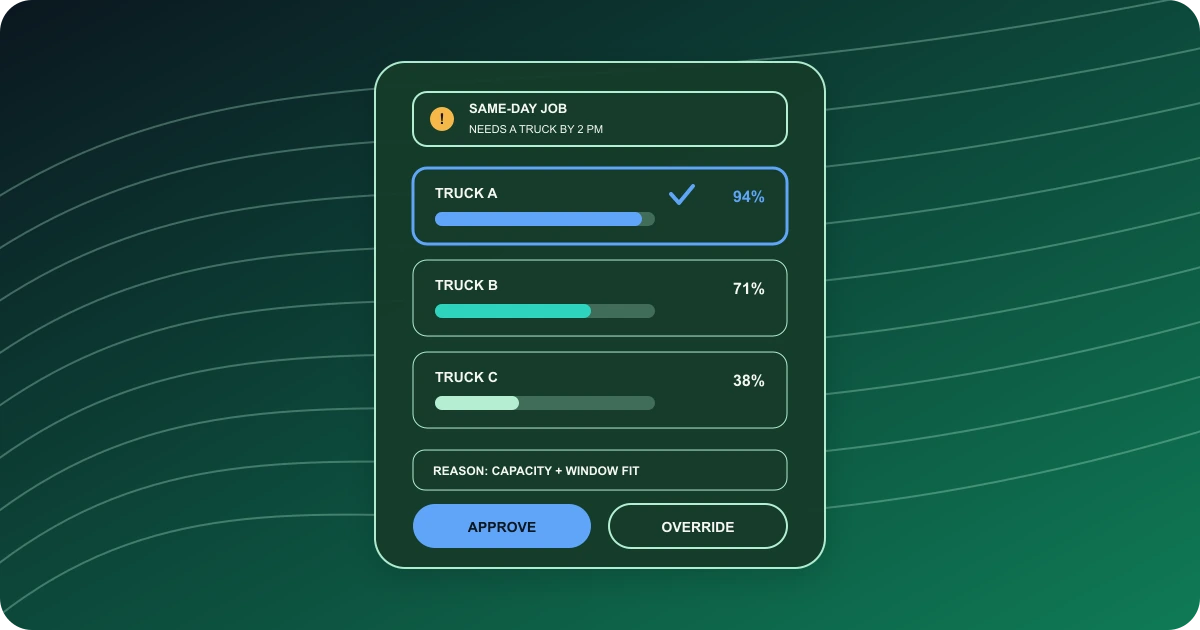
This handoff is the part of a broken day DynoRoute is built around. The AI dispatcher returns a recommended truck with its reasoning and a confidence score, using capacity, location, availability, and skills in the match. After an accepted change, the live route and driver sequence can be updated and the customer can receive a revised ETA. The activity record then gives the evening review a way to compare the plan with the day the drivers actually ran.
What should tomorrow's planner learn from today?
Every disrupted day should end with a short record: the cause, the moves made, the stops missed or rolled, the cost in overtime and extra disposal, and the master-data gaps that slowed the replan down. Keep it brief enough to finish consistently; the value appears when several records expose a repeating cause.
Causes turn into patterns quickly. The truck that breaks twice a quarter is a maintenance decision showing up as an emergency. The customer who phones in an "emergency" every four weeks is a mispriced recurring service; sell them the schedule their tank is already keeping. The outlet whose queue doubles every Friday belongs in Friday's plan as a longer service time, and stops whose forecast volumes keep surprising the plan are telling you their true fill rate.
The master-data list is usually mundane, which is exactly why it compounds: a service duration that has been wrong for a year, a missing gate code, receiving hours that changed last month, a certification nobody recorded. None of these breaks a day by itself. Each one turns a ten-minute replan into a forty-minute one, because the dispatcher has to re-verify the world before trusting the plan.
The record also settles the buffer argument. A fleet that replans weekly is running disruption as a normal input and should plan reserve into the day: a planning threshold below rated capacity and slack in the afternoon, sized from the variance log rather than a guess. The cheapest replan is the one the plan already absorbed.
Frequently asked questions
What is dynamic replanning, compared with just adding a stop?
Adding a stop edits one route and hopes the constraints hold. Dynamic replanning re-checks the constraints the plan was built on (capacity, hours, time windows, disposal timing) across every affected truck and produces a plan that is still feasible. The difference matters because the constraint an added stop violates is rarely visible on the map: it is tank space, legal hours, or a disposal cutoff two hours downstream.
When is it too late to insert an emergency job into a route?
When no truck can reach it, service it, and still finish inside its remaining capacity, its driver's legal hours, the disposal outlet's cutoff, and the fleet's protected commitments. The answer is a checklist, not a clock time: some inserts are dead at 10 a.m. because every truck is near its planning threshold, and some are fine at 4 p.m. because a route with slack passes nearby. When every truck fails the checklist, the honest options are tomorrow's first slot or a rescue truck at a cost you accept deliberately.
Where the software takes over
DynoRoute supports this protocol with capacity and workload limits, driver availability and skills, job priorities and windows, and a live map and timeline. When the day changes, the AI dispatcher can recommend which truck or driver should absorb work, with a confidence score and reasoning, while conflict checks surface overlaps and insufficient travel time. Under guardrails you configure and test, recovery agents can respond to cancellations and late-running jobs. Dispatch analytics preserve response, visit-status, acceptance, and activity records for the evening review. If you would rather evaluate those decisions on one screen than through a call log, book an intro call and test a broken day from your own route data.