Key takeaways
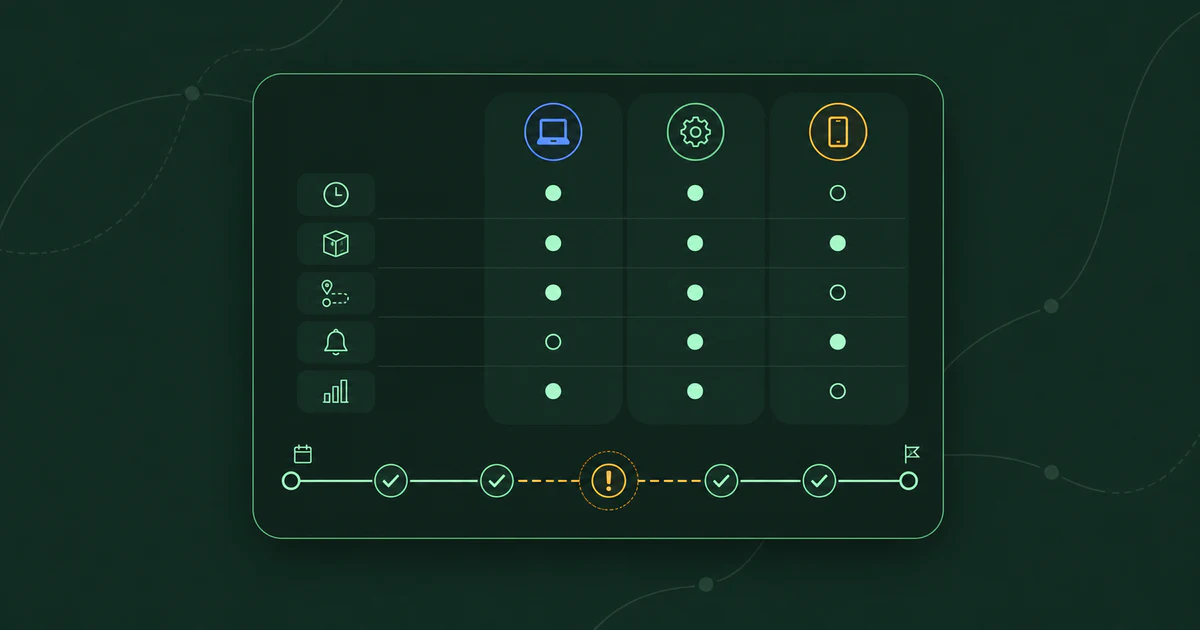
- A recurring account needs four numbers, not a single "frequency" field: the longest interval an authority or contract will tolerate, the interval the container actually needs, the route day where the stop fits best, and how far a visit can move before one of the first two is at risk.
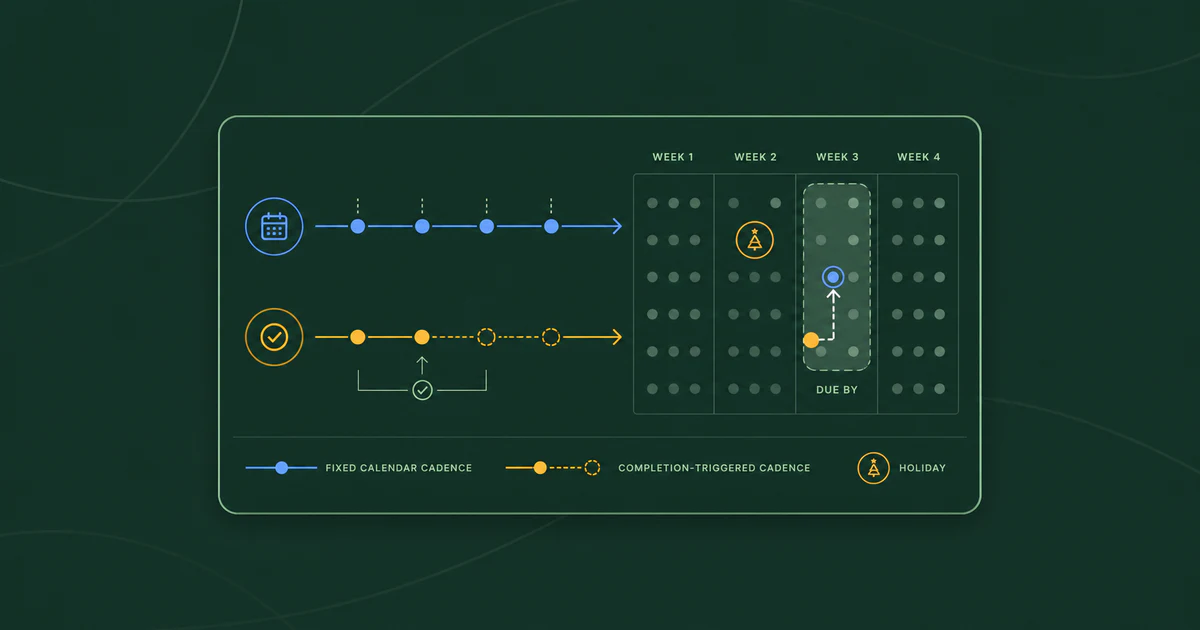
- Recurring schedules drift when the wrong anchor is used. Some promises stay on a fixed calendar; other intervals restart from actual service. The contract, ordinance, or operating rule must say which clock governs.
- Storing a due-by date and a preferred route day, instead of one exact date, gives the routing plan room to build dense days without ever letting a visit slip past its ceiling.
- Monthly and every-four-weeks are different cadences: every-four-weeks holds a fixed route day and produces thirteen visits a year, while calendar-monthly holds the billing month and lands on a different weekday every cycle.
- Holidays, pauses, skips, and makeups each need one written rule, because a silently deleted visit is how a fleet discovers in June that nobody has serviced an account since March.
- A service interval should be reviewed when evidence repeats, using a trigger chosen for that service line, and any approved change should be one dated edit to the series rather than a pile of one-off reschedules.
Recurring route scheduling decides when repeating customers get served. In collection work, a slipped interval can become an overflowing container, a full trap, or a compliance problem. Cadence determines which stops exist on a date; capacity-based route planning determines whether trucks that fill up can absorb them; measured fill cycles help determine how soon the next visit is needed. I build DynoRoute, routing and dispatch software for fleets whose trucks fill up as they work. A common failure pattern is that frequencies exist in software while the exceptions that keep them accurate remain in the dispatcher's head. This guide covers the four numbers, anchor choice, generation models, and exception policies that keep the schedule coherent.
What cadence does each account actually require?
Every recurring account carries four numbers. The ceiling is the longest service interval a regulator, ordinance, or contract will tolerate. The need is the interval at which the container genuinely fills. The preferred day is where the stop fits your densest route. The tolerance is how far one visit can move, in either direction, before the ceiling or the need is at risk. Most scheduling arguments inside a fleet trace back to collapsing all four into one number.
The ceiling usually comes from outside your business, and it changes trade by trade:
| Service | Input that constrains cadence | What it does and does not set |
|---|---|---|
| Septic pumping | EPA household guidance plus state and county rules | EPA gives inspection and typical pump-out guidance; applicable law and system condition set the account's actual deadline |
| Grease traps | The local FOG (fats, oils, and grease) ordinance | Local rules may set a maximum interval and a solids threshold, with stricter mandates in some districts |
| Portable toilets | OSHA's construction sanitation standard plus measured use | OSHA sets minimum fixture counts and requires sanitary units; it does not supply one universal service interval |
| Used cooking oil | The kitchen's measured generation rate and overflow policy | A starting pickup range must be tuned from actual yield and a maximum interval |
| Commercial containers | The service contract plus local overflow rules | The sold frequency and any overflow requirement set the boundary |
The septic baseline comes from EPA's household guidance, which recommends inspections at least every three years and says household tanks are typically pumped every three to five years; it is guidance, not a nationwide legal deadline. Grease limits are local law, and the commonly used 90-day/25% pattern and stricter local exceptions are documented jurisdiction by jurisdiction in our grease trap cleaning frequency guide. The portable-toilet fixture minimums and sanitation duty sit in OSHA's construction sanitation standard, but the service interval still comes from use and the sanitation condition. Restaurant Technologies publishes a weekly-to-monthly starting range for used cooking oil pickup based on kitchen volume (checked August 2026). The table deliberately refuses to give one national cadence: the operating boundary has to be set per account from the applicable authority, contract, and measured need.
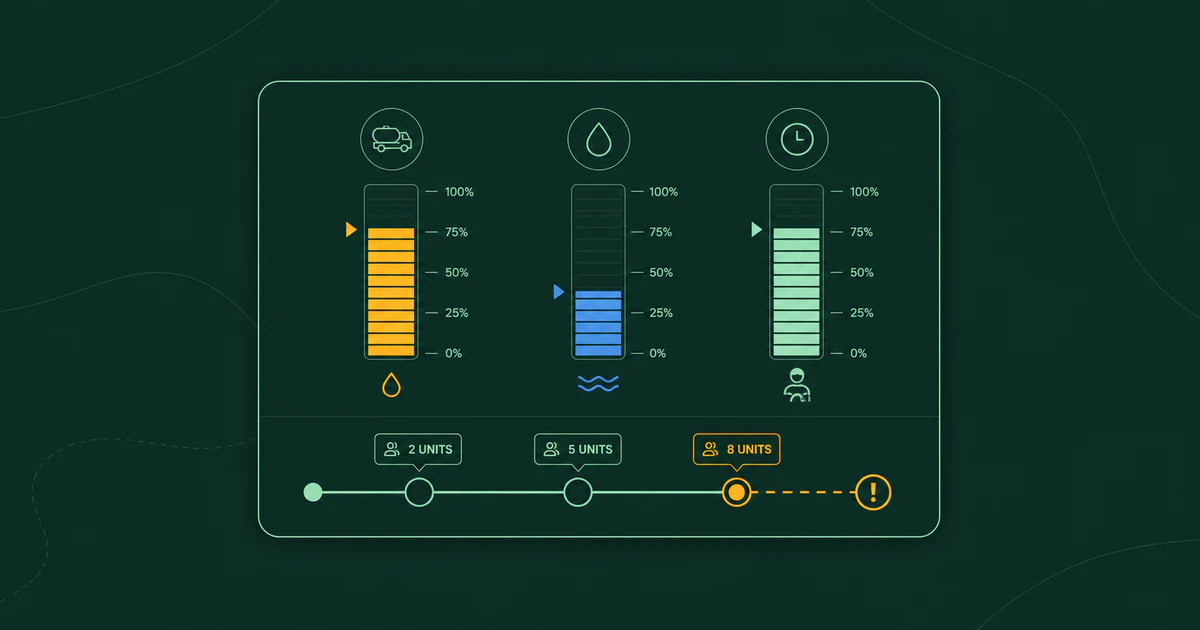
The need is measured. Whatever the customer estimated at signup, the honest need shows up in your records as yield per visit: gallons pumped, pounds collected, how full the container was on arrival. The preferred day is a routing decision, because a cadence only turns into margin when its stops land near each other; that geometry is the subject of route density. And the tolerance is the quiet number that makes the other three workable. A stop that must happen on day 28 exactly gives your route plan nothing to work with. A stop due by day 30 with a Thursday preference gives it everything it needs.
Which anchor prevents recurring schedules from drifting?
Recurring schedules drift when the software uses an anchor that does not match the promise. For fixed-calendar work, the rule is due date of visit n = anchor date + (n × interval), and an early or late completion does not silently rewrite future dates. For completion-based work, the next due date is measured from the actual service event because that event genuinely resets the clock. The first task is to name the anchor type, not to force every account onto one formula.
Drift feels harmless because each slip is small, so run the compounding once. The math that follows is illustrative, with round numbers. Take a fixed-calendar biweekly account priced for 26 visits a year. If the crew repeatedly services each newly calculated due date two days early and the system re-anchors from each completion, the actual rhythm becomes 12 days, or about 30 visits a year. Repeatedly arriving two days late stretches the rhythm to 16 days, or fewer than 23 visits. The issue is not one exception; it is allowing each exception to become the new rule. Completion-based accounts work differently: if an ordinance says the maximum interval runs from the last pump-out, actual service is the correct anchor and the dispatcher must never schedule beyond that measured deadline.
There are two anchor types, and neither maps cleanly to "compliance" or "commercial." Fixed-calendar work follows an agreed series: early or late completion is recorded as an exception, not a new cadence. Completion-based work follows the last qualifying service because that event restarts the measured or legal interval. A used-cooking-oil tank starts refilling when you empty it, and some pump-out rules also measure from the last service. Read the governing language before choosing. Every completion-based series should also carry a maximum-interval fallback where the contract, regulation, or operating policy requires one, so a quiet account does not disappear.
The last piece is vocabulary the whole dispatch desk has to share: the difference between a one-visit exception and a series edit. Moving Thursday's fixed-calendar visit to Friday because a truck went down is an exception, and visit n+1 stays where that account's anchor rule puts it. Deciding an account should now run every three weeks is a series edit: new interval, new anchor, and an effective date. DynoRoute documents recurring jobs separately from their visits and supports weekly, biweekly, monthly, and custom recurrence. Test the interface behavior before relying on it to preserve your particular anchor rule.
Weekly, interval, and condition-triggered cadences generate work differently
Recurring work commonly generates in three ways: fixed-day work repeats on a calendar day (every Tuesday), interval work repeats a fixed count of days after its anchor (every 28 days), and condition-triggered work generates when a measurement crosses a threshold (a fill estimate, yield trend, or call from the site). A mixed account book may contain all three as well as regulatory, event-driven, or hybrid rules. Each model slips somewhere different.
| Cadence type | Where the next visit comes from | Where it slips | Natural fit |
|---|---|---|---|
| Fixed-day | The calendar (every Tuesday) | Holidays and missed days with no makeup rule | Residential, valet, and commercial accounts that expect a day |
| Interval | Anchor + n × interval | Completion-anchoring drift; the monthly vs. four-week confusion | Pumping and collection work with contract or ordinance ceilings |
| Condition-triggered | A threshold crossing (fill level, yield trend, call-in) | Silent accounts with no ceiling fallback | Variable generators: used oil, waste oil, seasonal kitchens |
Fixed-day work is straightforward to generate and harder to bend. Customers learn the day, and the same stops can support density when onboarding and churn are managed deliberately; recurrence alone does not keep the route dense. Its weakness is that a missed Tuesday has nowhere natural to go. Without a makeup or escalation rule, the visit can disappear from the working schedule.
Interval work is where the monthly trap lives. A year holds twelve calendar months but thirteen four-week cycles. Service an account every four weeks while billing it monthly and you deliver a thirteenth visit nobody invoiced; as illustrative math, sixty such accounts hand out sixty unbilled truck visits a year. Calendar-monthly has the opposite problem: the 10th of the month lands on a different weekday every cycle, so a true monthly account can never own a fixed route day. Pick deliberately, per account. Either convert it to every-four-weeks and price thirteen visits, or keep it calendar-monthly with a due-by window and serve it on the nearest route day inside that window.
Condition-triggered work generates from evidence instead of a fixed calendar: pickup when the container is projected to reach a chosen planning threshold, or when measured yields say a site is running hot. The threshold must sit below the account's overflow risk and comes from its history rather than a universal percentage. This model fits variable generators, including garages and seasonal kitchens whose output swings with workload; waste oil pickup scheduling covers that variability in depth. Its failure mode is silence: no signal, no visit. Attach a maximum-interval fallback wherever the contract, regulation, or retention policy requires one.
For books dominated by weekly, biweekly, and every-four-weeks service, a four-week lattice gives the plan a stable base. Weekly stops appear in all four weeks, biweekly stops alternate (weeks one and three, or two and four), and every-four-weeks stops each claim one week. The 28-day pattern makes workloads easier to compare cycle to cycle. Calendar-monthly and condition-triggered accounts sit outside that lattice and can be placed on the nearest route day inside their allowed windows.
Holidays, pauses, skips, and makeups: write each rule once
Four common changes are a holiday shift, pause, skip, and makeup. Each needs a written rule that dispatch applies consistently, alongside any contract-specific change type. Improvisation is where deletion happens: a visit gets moved twice, absorbed nowhere, and never seen again.
Two common holiday policies are the week-slide and the tolerance-window move. The municipal model slides the rest of the week one day late, so Thursday's stops run Friday and Friday's run Saturday. The window model moves only affected stops within their allowed windows and leaves the rest of the week alone, which can suit pumping work where the interval matters more than the weekday. Other contracts may require advance service or a different makeup rule. Announce the policy you use, because customers set containers out based on it.
A pause is a stop with a restart date. Seasonal accounts, a shuttered kitchen, or a summer-only jobsite can pause within the bounds of the contract and any applicable service rule. Store the restart date and state whether the original anchor resumes or a new anchor begins. The restart instruction is what separates a pause from a deletion; without it, nobody's calendar rings when the site reopens.
A skip is a one-visit cancellation with a reason code: locked gate, customer request, site closed for the day. The series does not move, and visit n+1 stays where the anchor put it. The reason codes matter more than they look, because three "gate locked" skips in a row is an access problem to fix before it becomes missed service.
A makeup is a missed visit given a new slot permitted by the governing contract, service rule, and operating tolerance. Picture the Friday after a holiday: the dispatcher pulls Thursday's fifteen displaced stops into Friday, Friday's trucks absorb eleven, and four still need a decision. The rule is short: assign an allowed makeup date or escalate the unresolved visit to a named person the same day. If the agreement requires a different recovery clock or notice, that requirement overrides the internal tolerance. Nothing leaves the schedule silently.
When should a service interval change?
A service interval should be reviewed when the evidence repeats: overflows or emergency calls between visits, several consecutive low-yield stops, a seasonal swing visible in prior records, a pattern of complaints, or a renegotiated contract. One event is usually an exception. Repeated evidence may mean the cadence is wrong, but applicable law and contract terms still set the boundary. Write the review trigger into policy so the threshold is deliberate rather than invented during a busy week.
Shorten on repeated overflow evidence before the customer or an inspector forces the issue. The first overflow between visits is an emergency response and a data point. A second within the review window you set should trigger a cadence review; in ordinance-governed trades, an overflow may also create reporting or cleanup duties, so check the applicable rule rather than treating it only as a routing problem.
Stretch on repeated low yield only after checking the ceiling. Your policy might flag three consecutive visits materially below forecast as a review candidate, but the exact threshold should come from the account's history and measurement quality. The governing rule holds veto power: a trap under a 30-day mandate stays within that limit no matter how clean it looks, and a contract written around a fixed cycle keeps its terms until it is changed properly.
Seasonality deserves two dated cadences rather than one average. A kitchen doing double volume in tourist season should carry a summer series and a winter series that swap on set dates each year; averaging them guarantees overflows in July and half-empty visits in January.
Measured volume is what turns all of this from argument into arithmetic. Per-stop records of gallons pumped or pounds collected make a cadence review a short read of a trend instead of a debate between a driver's memory and a customer's invoice. Choose a repeat-evidence trigger appropriate to the service line, review the rule when it fires, and if the cadence changes, make one dated series edit with the correct anchor type.
What a cadence system has to hold
Whatever software runs your recurring book, hold it to five requirements. Per-account cadence storage should capture interval, anchor type, due-by date, and preferred day rather than a bare "frequency" dropdown. Work should generate automatically for each cycle. The interface should distinguish a one-visit change from a series edit and make the effect explicit before saving. Day-building must respect what the trucks can hold, because a cadence that generates forty stops is fiction if the day cannot fit the tanks and disposal returns. And per-stop service history should make interval reviews evidence-based.
DynoRoute documents weekly, biweekly, monthly, and custom recurring jobs with separate visits, plus capacity and workload inputs, AI matching by factors such as location, availability, skills, priority, and business hours, and conflict checks before assignment. The driver workflow can preserve timestamped photos, signatures, notes, forms, and outcomes, including offline, so cadence reviews have service evidence to use. Before migrating a live series, test fixed-calendar and completion-based anchors, one-visit moves, pauses, restarts, series edits, and any disposal or refill workflow your operation requires. Pricing is published at $199, $499, and $999 with credit-based optimization and no per-seat pricing; included credits and plan limits determine which tier fits.
If your recurring book lives half in software and half in somebody's head, book an intro call and run the next cycle from one anchored schedule.