Key takeaways
- Every compliance rule on a collection route attaches to one of six objects (driver, truck, waste, generator, stop, or receiving facility), and each object answers to its own authority.
- Not every load takes the federal hazardous waste manifest: hazardous waste, used oil (federal 40 CFR Part 279, with transporter records under 279.46), septage/FOG, and ordinary solid waste each run under different paperwork, each naming its own duty-holder.
- Where federal hours-of-service rules apply, the numbers are 11 hours driving, a 14-hour duty window, 10 hours off, and a 30-minute break after 8 driving hours; many local fleets run intrastate under state rules instead.
- The 150 air-mile short-haul exception spares qualifying local days the logbook, but the driving limits still apply.
- A pre-dispatch validation pass over driver, truck, waste, stops, facility, and clocks catches the errors that get loads rejected at the gate.
- Multi-stop liquid loads need a generator-to-load-to-destination evidence chain that can trace every gallon in both directions.
- When the compliant plan becomes impossible mid-day, the legal moves are reassign, dispose earlier, divert to an approved facility, or reschedule, with every route change recorded.
Route compliance in waste collection comes down to one working method: map each rule to the object it attaches to — the driver, the truck, the waste, the generator, the stop, or the receiving facility — then build the day so every one of them holds. I build DynoRoute, capacity-based routing for fleets that fill up or empty out, and compliance paperwork comes up in nearly every operator conversation I have. There is no single national checklist: paperwork shifts with the waste classification and with who holds the duty — generator, transporter, or receiving facility — driver limits shift with how the vehicle operates, and the plan still has to survive disposal stops mid-route and trucks that fill up before any paperwork matters.
You already know the failure modes: a load refused at the gate over an expired permit, a driver out of hours in the disposal queue, a manifest that doesn't match what's in the tank. What follows is the version I wish those operator conversations could start from: the rules mapped to the route, so your permits and manifests survive contact with a real collection day.
Every rule attaches to something on your route
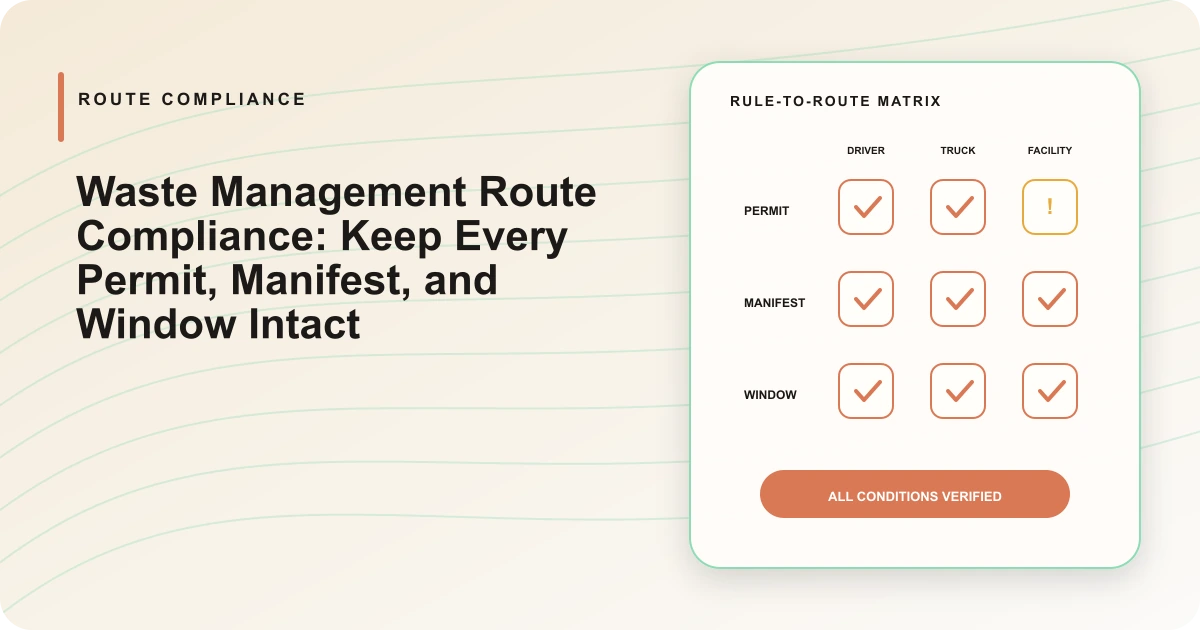
Compliance obligations stop feeling unmanageable once you pin each one to the thing it regulates. Six objects cover a collection route: the driver, the truck, the waste, the generator, the stop, and the receiving facility. Name the object and its controlling authority, and you know exactly what the route plan has to carry.
| Rule object | Who controls it | What the route plan must carry |
|---|---|---|
| Driver | FMCSA where federal HOS applies; state rules for many intrastate operations | Hours feasibility, break timing, short-haul eligibility |
| Truck | State transporter registration; local hauler permits | The right vehicle for the material, permits current on the route date |
| Waste | EPA for hazardous waste (the manifest) and used oil (40 CFR Part 279); state programs, which can be stricter; local septage/FOG programs | The correct document type for each load |
| Generator | Local pretreatment and FOG programs | A per-stop service record: what, how much, when |
| Stop | Local ordinances and service agreements | Access and service windows the sequence must honor |
| Receiving facility | The facility's permit and acceptance rules | Open hours, accepted materials, cutoff times |
The bottom row is the one fleets underestimate. EPA's guidance on truck-hauled waste treats the manifest, the governing ordinance, and the hauler permit as the core controls a publicly owned treatment works (POTW) uses to know and control what arrives at its gate. In practice, the facility at the end of your route is one of your regulators.
The matrix is also why generic compliance advice reads so hollow. "Stay compliant" means nothing. "The county hauler decal on truck 3 expires on the 14th and Tuesday's route has it at the transfer station on the 15th" is a routing decision.
Classify the load before you touch the route
Four document regimes cover most waste collection loads: the federal hazardous waste manifest, state used-oil records, septage and FOG manifests under state or local programs, and ordinary service tickets with scale receipts. Classification comes first; the paperwork follows from it.
The federal manifest is for hazardous waste only. EPA's hazardous waste manifest system tracks hazardous waste from the generator to the permitted disposal facility, cradle to grave, recording waste type and quantity, handling instructions, and signatures at every handoff in the chain — the generator initiates it, each transporter signs on acceptance, and the receiving facility signs on delivery, so every role owns its own signature. If your loads are routine septage, grease trap waste, or municipal solid waste, this is the wrong form. Assuming every load needs the federal manifest buries your office in paperwork nobody asked for; missing the one load that genuinely is hazardous puts cradle-to-grave liability on the wrong side of your ledger.
Used oil collected from workshops and garages does not take the hazardous waste manifest either: federally it runs under 40 CFR Part 279, and the records duty on the road belongs to the transporter. Under 40 CFR 279.46, for each shipment of used oil you accept, your record has to show the name and address of the generator, transporter, or processor who provided it, their EPA ID number if they have one, the quantity, the date of acceptance, and a signature from the providing party's representative — and the same set for each delivery to a receiving facility or the next transporter. Those records stay on file at least three years. State used-oil programs can be stricter than Part 279, so confirm with your state which document rides with the load; a log of per-stop gallons alone does not meet the transporter's records duty.
Septage and FOG (fats, oils, and grease) answer to state and local programs, and the triggers can be broader than you expect. Colorado Springs requires a liquid-waste manifest when a hauler pumps grease or sand interceptors and traps, even when the load is disposed of outside the utility's designated facility (CSU liquid waste hauler manual, §5.1). Miami-Dade publishes an entire Septage and FOG Waste Manifest Guidance Manual for its liquid waste transporters. Neither is the federal form. Both are binding where they apply, and in both the duty sits on the transporter holding the local permit — a utility program's rules in one case, a county transporter program in the other.
Ordinary solid-waste collection mostly runs on service tickets and facility scale receipts. That layer is contractual and commercial rather than a permit program, but it is still evidence: the ticket proves to your customer that service happened, and the scale receipt proves to you where the load went.
So when anyone says "manifest," ask which authority requires it. A federal hazardous manifest, a Colorado Springs liquid-waste manifest, and a Miami-Dade septage manifest are three different documents answering to three different programs.
How hours-of-service limits reshape a collection day
Where federal hours-of-service rules apply, a property-carrying driver may drive up to 11 hours after 10 consecutive hours off duty, may not drive beyond the 14th consecutive hour after coming on duty, and needs a 30-minute break after 8 cumulative hours of driving (FMCSA HOS summary). Many local collection operations run intrastate and answer to their state's HOS rules instead, so confirm which regime covers each driver before applying any number in this section.
On top of the daily clocks sits the weekly one: no driving after 60 hours on duty in 7 consecutive days, or 70 in 8, again where federal HOS applies.
The exception most collection fleets lean on is short-haul. A driver qualifies for the record-of-duty-status exception — no logbook — when the day stays within a 150 air-mile radius, the driver returns to the normal work reporting location, and the duty period runs no longer than 14 consecutive hours. Short-haul waives the recording, not the limits: the driving clocks still apply.
Run the test against a real day. The truck leaves your yard, works its stops, queues at the transfer station, and comes home. Radius: almost always inside 150 air miles. Return: same yard, yes. The condition that breaks is the third one. A slow disposal queue at the end of the day pushes duty past 14 hours, and the exception quietly falls away. That makes queue time a route-planning input just like drive time: a plan that budgets, say, 45 minutes at the facility — an illustrative figure, set yours from your own logged queue times — protects the exception, and a plan that budgets zero gambles it.
The pre-dispatch validation pass
Before a route leaves the yard, run one validation pass against your own records: driver, truck, waste, stops, facility, clocks. It takes minutes at dispatch and catches almost everything that otherwise surfaces at a facility gate or a roadside inspection.
- Driver. License and any required endorsements current, and enough hours left under whichever HOS regime covers this driver to finish the planned day.
- Truck. Registration, transporter registration, and local hauler permits valid on the route date, and the tank or body compatible with the material it's assigned.
- Waste. Every load classified, and the matching document ready: federal hazardous waste manifest, used-oil transporter record under 40 CFR Part 279 plus any stricter state program, local septage or FOG manifest, or service ticket.
- Stops. Service-record fields prepared for each generator (what was serviced, how much, when), and the stop sequence honoring every access and service window.
- Facility. Today's disposal site confirmed: open hours, cutoff time, accepted materials, and your hauler permit current with that facility.
- Clocks. Drive time plus pump time plus queue time fits inside the duty window, with margin.
All six checks run on your own records. Permitted haulers rarely lose loads at the gate because they have no permit. They lose them because the permit expired three weeks ago, the material isn't on the facility's accepted list, or the truck arrives eleven minutes after cutoff. Every one of those is visible at dispatch, before the truck moves.
One field list is worth adopting as a floor. A route-control record that survives an audit needs at least the generator or stop, waste type, quantity, truck and driver, pump time, receiving site, discharge time, and a manifest or receipt ID. For used oil, add what 40 CFR 279.46 requires of the transporter on top of that: names and addresses on both ends of the handoff, EPA ID numbers where applicable, dates of acceptance and delivery, and signatures. The floor list itself is an estimate built from published hauler programs; exact mandatory fields are jurisdiction-specific, so check them against each program that governs your loads.
Keeping the evidence chain intact on multi-stop liquid loads
A vacuum truck on a multi-stop route blends waste from several generators into one tank, so its paperwork has to do something a stack of tickets can't: trace every pickup forward to a disposal event, and every discharge backward to the generators in that load. That two-way trace is the evidence chain.
Three records make the chain. The per-stop service record captures what was pumped at each generator: volume, time, what was serviced. The load record captures which stops are riding in the tank. The disposal record — the manifest or facility receipt — captures where the load went, when, and under which ID. Break any link and the chain fails in both directions: the generator can't prove pickup, and you can't prove lawful disposal.
Local programs increasingly write this expectation down. Miami-Dade's transporter guidance walks septage and FOG haulers through exactly this manifest workflow, and it's a useful picture of what a serious local program expects even if you operate elsewhere. If you run grease routes, the field-by-field version lives in our guide to grease trap manifest requirements, and the routing half — sequencing pickups so full tanks meet facility hours — is covered in scheduling grease routes around disposal sites.
Retention is the second half of the chain. For a used-oil transporter the federal floor under 40 CFR 279.46 is three years; beyond that there is no single national retention period for these records — the program that requires the document sets how long you keep it, so file the retention rule alongside the form for every jurisdiction you serve.
When the compliant plan breaks
Sooner or later an HOS clock, a disposal cutoff, and a service promise will collide in the same afternoon. You have four legal moves: reassign the work to a driver or truck with room, dispose earlier than planned, divert to an approved alternate facility, or reschedule the stop. Stretching a clock or backfilling paperwork is never one of them.
Whichever move you make, record it: who changed the route, what changed, and why. A route edit with no trail reads as improvisation in an audit, even when the call was right.
Routing software helps here, and the boundary is worth being precise about: routing software supports the records and the constraints — it does not determine legal status or guarantee compliance. No routing tool reads your state's HOS regime or makes a legal judgment for you. An operator-configured agent can watch the expiry dates you keep on a truck's record and flag a decal before it lapses, but the validation pass above stays yours. What software holds is everything underneath it: the plan and the proof.
DynoRoute was built for the fleets this article describes, and the three records that make your evidence chain map directly onto it. Per-stop service records capture what was serviced, how much, and when — with timestamped, geotagged photo proof from the driver app. The route itself is the load record, showing which stops rode on which truck. And because route edits happen on records you control, note who changed the route and why in the route's custom fields as you make the change, so "who changed what" has an answer instead of a memory when an audit asks. On the planning side, capacity-based route planning treats disposal returns as part of the route, recurring schedules cover every service cadence, route optimization respects what each truck can hold, and conflict detection catches double-bookings and travel-impossible assignments before they reach a driver.
If your compliance story currently lives in a spreadsheet and a stack of tickets, start by putting the route on rails: get started with DynoRoute. The rules stay yours to know. The record that proves you followed them shouldn't depend on anyone's memory.